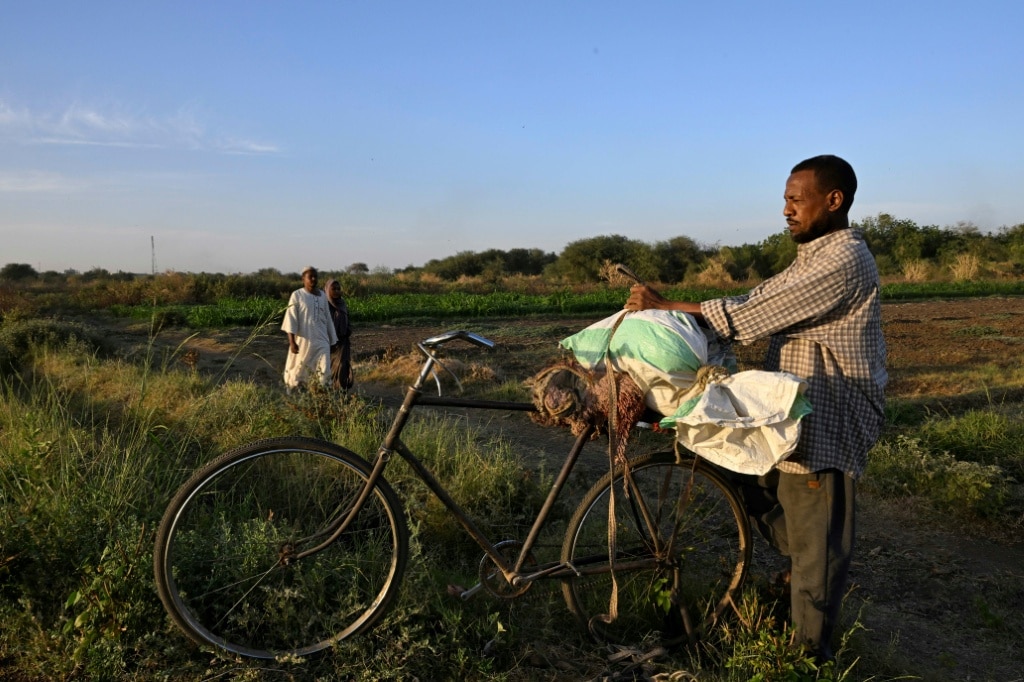
Nestled at the confluence of Uganda’s White Nile and Ethiopia’s Blue Nile, right in the center of Sudan’s war-ravaged capital Khartoum, the crescent-shaped Tuti Island has begun the slow, fragile process of coming back to life. A year after the Sudanese army broke a nearly 24-month paramilitary siege that emptied most of the island’s streets and homes, the deep, unbreakable bond between residents and their ancient land is on full display.
At 80-some years old, Al-Shubbak is one of the few who never left. When the Rapid Support Forces (RSF) clamped down on the only bridge connecting Tuti to the mainland in June 2023, turning the island into an open-air prison, she refused to flee. “I didn’t even move for the English when they colonised us,” she told AFP, her toothless smile undimmed by hardship. She still recites the generations-old battle cry of Tuti’s defenders: “Our fathers resisted the occupiers with stones. Though they met them with gunfire, they still could not take Tuti the green.”
The war between Sudan’s national army and the RSF first erupted in Khartoum in April 2023, and Tuti, positioned directly across the river from the first flashpoints of conflict, bore an outsize share of the violence. For nearly two years, no supplies could enter or exit without RSF approval. Islanders were forced to pay exorbitant bribes just to access food, medicine, or fuel for water pumps — and to buy the right to leave. For 34-year-old day laborer Salaheldin Abdelqader, who escaped seven months into the siege and returned after the army recapture, that toll hit 350,000 Sudanese pounds, roughly $90 today, more than double a Sudanese doctor’s average monthly salary.
Local elder Sheikh Mohamed Eid, who spent months using community donations to smuggle food to trapped residents to prevent mass starvation, was detained by the RSF for his activism. Thrown into a series of the paramilitary group’s notorious prisons, he watched fellow Tuti inmates die one by one before he was released nine months later. Retelling his story from his home, where a gaping hole in the roof left by an artillery shell still opens to the sky, Eid explained that for Tuti’s residents, leaving the island is not an option. “We’re like fish in the water, we can’t survive outside Tuti,” he said, noting that even former president Omar al-Bashir’s government, which tried for years to relocate the community to make way for luxury real estate developments, never succeeded in severing that tie.
By the final months of the siege, out of Tuti’s estimated 30,000 pre-war residents, only Al-Shubbak’s family remained, staying behind to care for the bedridden matriarch and guard their ancestral land. “We stayed to guard our soil,” said her daughter Najat al-Nour, a 50-something Quran professor who calls those who fled a mistake. For many others, however, leaving was the only way to survive. Nosayba Saad and her family endured a year and a half of RSF occupation, during which fighters repeatedly broke into homes, stole valuables, threatened residents, and left many dead from stray gunfire. By the time her family paid to leave in October 2024, the RSF had begun seizing even the last of residents’ food stores.
Today, after the army retook Khartoum and lifted the siege in March 2025, hundreds of former residents have returned. Boarded-up shops have reopened, farmers have walked back to their fertile orchards and vegetable fields that once supplied most of Khartoum’s fresh produce, and Friday prayers draw crowds to the 15th-century red-brick mosque that has stood on the island for hundreds of years.
Still, the joy of homecoming is deeply bittersweet. Saad’s two uncles remain missing, presumed dead, and every family on Tuti carries the weight of loss. The iconic riverfront spot where the two Niles merge to form the single Nile flowing north to Egypt is now littered with unexploded mines, a permanent reminder of the siege’s violence. To the south, the gutted, bombed-out skyscrapers of central Khartoum loom on the horizon, a constant reminder of the terror the island endured.
Yet as the sun sets over the Nile, turning the water a glowing orange, small signs of normalcy are returning. A squash farmer trundles home with a heavy sack of his first post-war harvest. A fisherman packs up his rods beside a family picnicking on the cleared waterfront. A young couple on a date asks for a photo, a memento of their first trip home to Tuti. For the first time in two years, the scent of jasmine and incense drifts across the island, a quiet testament to the resilience of a community that refused to let their home be taken.