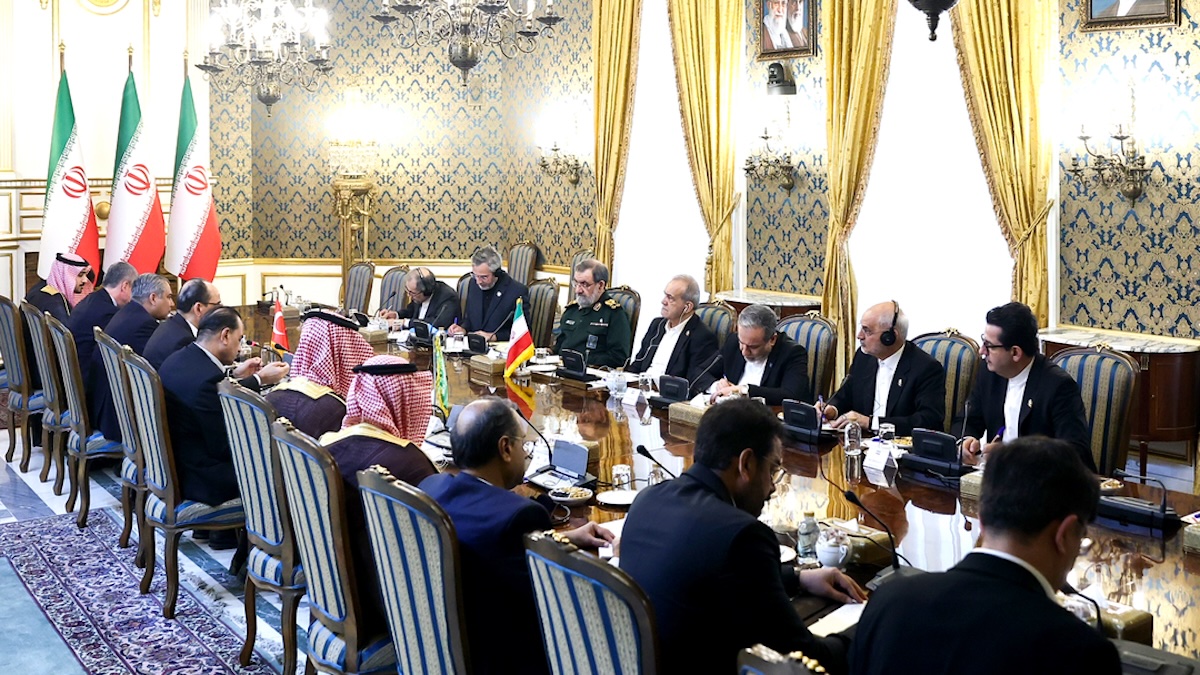
In a departure from the standard mandate of collective defense pacts, high-ranking representatives of the Mecca Joint Defense Agreement traveled to Tehran on Monday for landmark negotiations aimed at de-escalating volatile regional security dynamics. The delegation included Saudi Arabia’s Defense Minister Prince Khalid bin Salman, Pakistan’s Chief of Army Staff Field Marshal Asim Munir, and Turkey’s intelligence chief Ibrahim Kalın, who held closed-door talks with Iranian President Masoud Pezeshkian and Secretary of Iran’s Supreme National Security Council Mohsen Rezaei. The four parties formally committed to ongoing structured dialogue to advance shared goals of regional peace and stability, with Iranian state broadcasters framing the gathering as the first joint multi-party meeting of the bloc’s representatives with Iranian leadership since Yemen’s Houthi movement escalated targeted attacks on Saudi territory. Notably, the diplomatic overture did not pause active hostilities: on the very same day as the Tehran talks, Houthi forces publicly claimed responsibility for drone assaults on critical Saudi pipeline pumping infrastructure and Riyadh’s King Khalid International Airport, laying bare the sharp, ongoing friction of a scenario where three nations bound by a mutual defense pledge (stipulating that an attack on one member constitutes an attack on all) are actively engaged in diplomatic outreach to Tehran even as Iranian-aligned militias launch strikes against one of their core partners.
The timing of the high-stakes meeting carries deliberate geopolitical weight, falling exactly one day before Israeli national elections and eight days ahead of the U.S. midterm elections. Preliminary exit polls from Israel’s vote confirmed a deadlocked electoral outcome, with neither former Prime Minister Benjamin Netanyahu nor rival candidate Gadi Eisenkot positioned to secure a governing parliamentary majority. Parallel developments in Washington further amplify the high-stakes context: on October 23, former U.S. President Donald Trump publicly referenced the possibility of launching “another little Epic Fury”, the official Pentagon designation for the military campaign first launched in February of that year. Having previously ruled out any pre-midterm military strike, a Wall Street Journal investigation later revealed that the U.S. administration has formally advised Gulf partner states to prepare for a short, intense post-November 3 military operation targeting Iran. While Trump has not issued a final executive order, multiple insiders report he is leaning toward authorizing a large-scale military campaign, with a negotiated diplomatic settlement positioned as the sole alternative. Gulf Cooperation Council states stand to bear the brunt of any direct conflict, as Iranian officials have repeatedly warned they will retaliate against regional civilian and economic targets, mirroring patterns of strikes seen earlier in the year’s hostilities.
Critics have pointed to an apparent contradiction in a mutual defense bloc pursuing diplomatic outreach to Iran, but analysts note no inherent inconsistency: defense alliances routinely leverage their demonstrated military readiness to signal a preference for de-escalation over armed conflict. The sequence of recent moves aligns with this logic: on October 5, the Mecca pact’s governing committee convened in Riyadh in the wake of repeated Houthi attacks on Saudi Arabia, and formally advanced plans to fully implement the bloc’s collective defense provisions. Just three weeks later, the delegation traveled to Tehran, following closely on the heels of a separate visit to the Iranian capital by Qatari mediators. Riyadh has explicitly framed the diplomatic trip as complementary to the ongoing mediation efforts led by Qatar and Pakistan. The pact also includes built-in guardrails to avoid unintended escalation: the chair of Turkey’s parliamentary foreign affairs committee has confirmed that the collective defense clause does not trigger automatic military intervention, and any deployment of Turkish forces under the agreement will require separate, explicit approval from the Turkish national assembly. Turkish Foreign Minister Hakan Fidan has also repeatedly emphasized that the Mecca pact is not structured to target Iran, a key reassurance that cleared the path for Tehran to agree to the high-level talks.
The diplomatic initiative faces multiple tangible failure risks, however. First, the sustained Houthi campaign of attacks on Saudi Arabia will test Riyadh’s strategic patience and the credibility of the entire bloc’s collective defense commitments, threatening to reduce the outreach to little more than a diplomatic facade if strikes continue. Second, competing interpretations of shared statements could derail progress: following the Tehran meeting, Iranian official Mohsen Rezaei stated that regional security must be entirely homegrown, with all forms of foreign intervention barred from the region. Tehran is pushing to frame this as a unified shared position, but Washington and NATO-member Turkey, bound by longstanding transatlantic alliance obligations, are likely to interpret the clause very differently. Third, incomplete domestic ratification undermines the bloc’s negotiating leverage: while Saudi Arabia and Pakistan have completed all internal legislative processes to formalize their membership in the Mecca pact, Turkey’s national assembly has not yet held a full ratification vote, with opposition parties in Ankara warning the agreement could drag Turkey into unwanted foreign conflicts. A fourth critical vulnerability stems from the strategic Strait of Hormuz: according to Reuters, the number of ship attacks in the chokepoint hit an all-time monthly record in October, and any new round of regional hostilities will worsen disruption to global energy supply chains, inflicting steep economic costs on energy-importing nations across Asia, including Pakistan.
Analysts have laid out four clear actionable steps the Mecca pact can take to turn the recent Tehran meeting into tangible progress. First, the bloc should make a time-bound, verifiable halt to Houthi attacks on Saudi civilian and energy infrastructure the core opening demand of all future negotiations, paired with a reciprocal confidence-building measure that Riyadh has already signaled it is willing to implement. Second, the three member states should coordinate fully with Qatari and Pakistani mediation efforts to present a unified, single diplomatic channel to Tehran, rather than operating as a separate competing track. Third, the bloc should publish a clear, public, detailed framework defining the practical scope of its collective defense commitments, including explicit thresholds that will trigger mutual support. Turkey’s existing assurance that military intervention is not automatic should be formalized as a public, binding commitment, rather than a closed-door committee remark, to eliminate miscalculation risks for stakeholders in Tehran, Tel Aviv and Washington. Fourth, the bloc should propose a formal incident-prevention arrangement for the Strait of Hormuz that both the U.S. and Iran can join, supported by independent, third-party verification mechanisms. The Monday meeting in Tehran was not a transformative breakthrough: deep, unresolved gaps remain between Washington and Tehran over sanctions rollbacks, Iran’s nuclear program, and security arrangements for the Strait of Hormuz. But the diplomatic outreach has already signaled to both U.S. and Iranian leadership that the Mecca pact intends to act as a constructive stabilizing force before it is forced to test its mutual defense provisions. The ultimate success of the alliance will not be measured by the number of ballistic missiles its member states can intercept, but by the ability of Riyadh, Ankara and Islamabad to demonstrate to all parties that a negotiated, peaceful settlement delivers far greater long-term value than another devastating round of regional war.
The Mecca pact goes to Tehran. Can it keep the region out of another war?