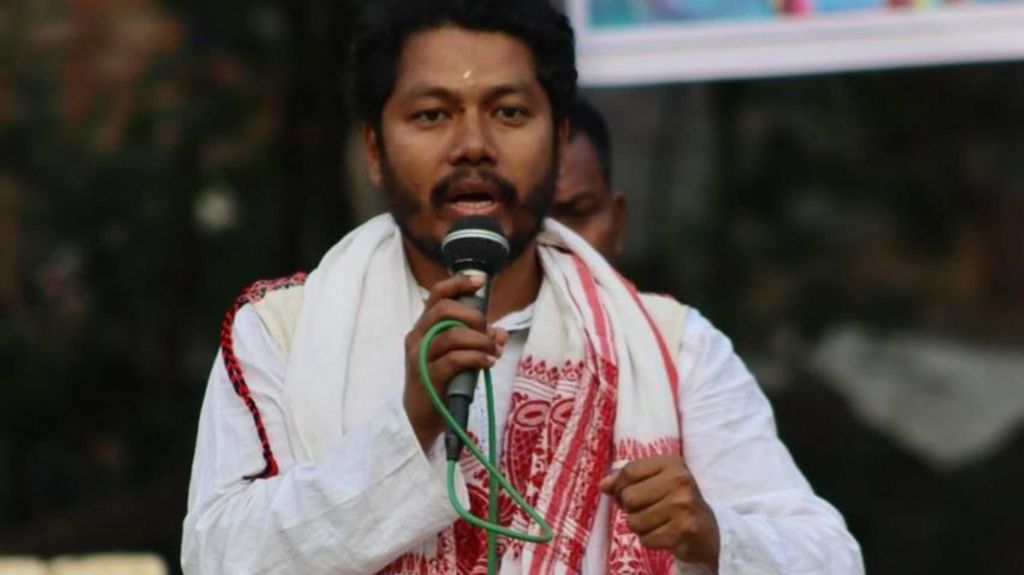
In the northeastern Indian state of Assam, a long-serving community rights activist centered on the Kaziranga National Park region remains behind bars, after state authorities blocked his court-ordered release and invoked a controversial sweeping security law to detain him indefinitely without trial. The case has thrown a spotlight on a simmering conflict between conservation, development, and indigenous land rights around one of the world’s most celebrated wildlife protected areas.
Forty-year-old Pranab Doley, a well-known local activist who has spent decades advocating for communities living on the edge of the UNESCO World Heritage Site, was arrested in late June, just weeks after he joined a public demonstration against a proposed five-star luxury hotel project on park-adjacent land. On July 29, a local court granted bail to Doley and four other co-accused protesters. When Doley’s father and legal counsel arrived at the prison on July 30 to escort him home, they were turned away: the Assam state government had triggered the National Security Act (NSA), a decades-old legislation that permits authorities to hold individuals for extended periods without formal trial, to block his release.
Official detention orders reviewed by the BBC justify Doley’s ongoing detention by referencing 13 criminal cases filed against the activist dating back to 2017, citing a pattern of alleged unlawful assembly, intimidation, public obstruction, and even violence. The order also raises questions about the source of funding for Doley’s international travel and alleges suspicious cross-border financial transactions. But Doley’s legal team and supporters reject these claims, arguing that most of the decades-old cases have already been resolved, with only two remaining open at the time of his latest arrest – both of which Doley openly disclosed in his official affidavit when he ran as an independent candidate in Assam’s 2024 state legislative assembly elections, an election he ultimately lost.
“He is an activist who fights for people’s rights,” Doley’s lawyer Mrityunjoy Pegu told the BBC. “That is why the police had registered some cases against him.” Critics of the detention argue the state has deployed a draconian law to silence opposition to a high-profile development project, sparking widespread anger across regional human rights circles.
The proposed hotel project, first announced in 2023 as a public-private partnership between the Assam government and the Saraf Group, is being developed by Juniper Hotels with backing from Hyatt, the U.S.-based global hospitality brand. State officials frame the 10-acre development as an economic boon for the region, arguing it will attract high-spending international tourists, generate local employment, and bring much-needed infrastructure investment to the Kaziranga area, which is globally renowned as a conservation success story for the endangered one-horned rhinoceros.
But dozens of local farming families say the project will displace them from land their families have cultivated for generations. While the Assam district administration claims the full project site is government-owned land, protesting residents push back against this narrative, noting that state officials have collected land revenue from their families for decades. Geeta Gwala, one of the residents who has challenged the land acquisition in court, says her family has held formal tax receipts for their 2.81-acre plot dating all the way back to 1956. A court-ordered land boundary demarcation to resolve the ownership dispute had been scheduled for June 24, but has yet to be completed, according to Gwala.
Deputy Commissioner Biswajit Phukan, the top local district official, clarified that the government has not seized land already formally registered to protesting families, and that while some residents may have informally cultivated portions of the project site, the land was never legally allocated to them. He added that the administration has offered financial compensation, alternative land to eligible residents, and job skills training to support local people affected by the project. Phukan declined to comment directly on Doley’s detention, noting that the administration does not wish to prejudice ongoing legal proceedings, and said the government remains “extremely sensitive” to local community concerns.
For Doley, the debate over the hotel project is not an abstract policy dispute – it is rooted in decades of personal experience with the complex tensions between conservation, flooding, and land rights along the Brahmaputra River floodplains where Kaziranga is located. Growing up in a small farming family near the park, Doley saw his own village displaced multiple times by recurring river erosion and annual flooding, a common issue in the region where shifting riverbanks render official land records outdated far faster than bureaucratic systems can update them. Even today, Doley’s own parents do not hold formal legal title to the land they live on.
He also witnessed first-hand the conflict between wildlife conservation and local communities: when annual monsoons flood Kaziranga, rhinos, tigers, and elephants flee to higher ground on adjacent farmland, destroying crops and sometimes triggering deadly encounters between people and animals. These experiences shaped Doley’s core belief: that conservation of Kaziranga’s unique ecosystem cannot be separated from protecting the land rights of the communities that have lived alongside the park for generations.
Doley first rose to prominence as an activist challenging alleged extrajudicial killings of suspected poachers within Kaziranga, before expanding his work to address forced evictions, unfair land acquisition, and inadequate compensation for displaced local families. Last year, he brought these demands to the global stage, speaking at the UN Forum on Business and Human Rights in Geneva to urge governments and corporations to prioritize indigenous community rights when pursuing development projects.
The tensions over the hotel project boiled over on June 28, when Doley joined a peaceful protest at the construction site. Police allege that protesters entered the project area, damaged construction equipment, and attacked law enforcement officers, naming Doley as the crowd’s primary instigator. Doley’s organization, the Greater Kaziranga Land and Human Rights Protection Committee, denies these claims, arguing that police initiated violence against peaceful demonstrators and that Doley was never involved in any confrontation.
The judge who granted bail to Doley and four other co-defendants largely backed the activists’ account, finding that available video footage contradicted many of the prosecution’s key claims. While the footage showed minor pushing and shoving between protesters and police, it showed no evidence of a direct attack on officers or any attempt to set construction machinery on fire, as police had alleged. The judge’s ruling noted that Doley was captured on camera speaking with officials to seek a negotiated resolution to the dispute, and acknowledged that while some officers were injured, the protest stemmed from legitimate concerns about environmental harm and community impacts. The ruling concluded: “True public order is achieved not by silencing the affected, but by listening to them.”
Despite the court’s bail order, Doley remains in detention under the National Security Act, as his legal team works to challenge the government’s action. For supporters, his detention has become a flashpoint for the broader fight over who gets to benefit from development and conservation around one of India’s most iconic protected areas – and Doley now waits for the justice he spent years fighting for on behalf of others.