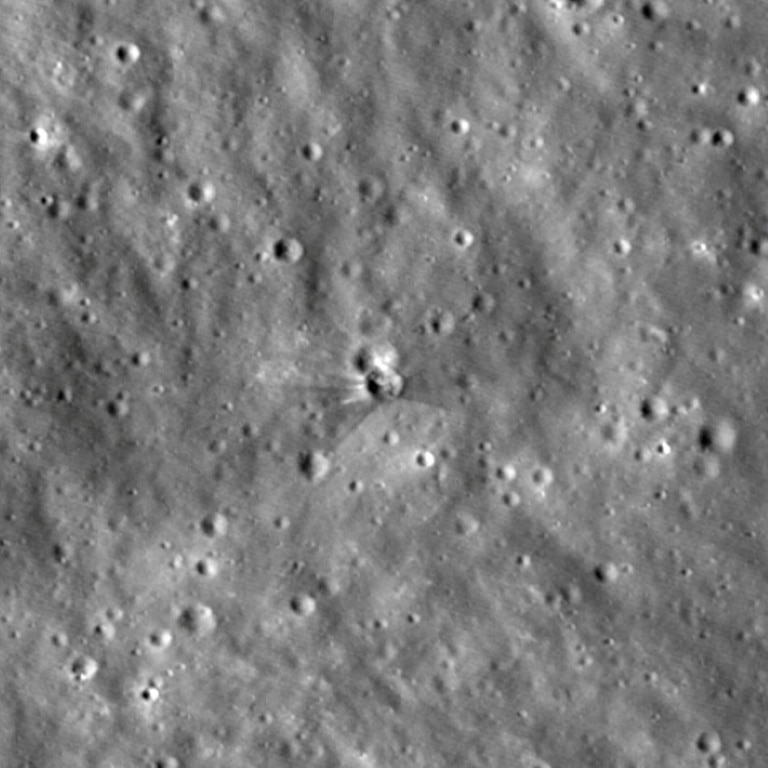
Nearly two weeks after a discarded SpaceX rocket stage collided with the lunar surface, NASA has publicly released high-resolution new images capturing the fresh impact crater the collision left behind, marking the culmination of a global collaborative effort to locate and document the crash site. The new imagery was captured between August 11 and 12 by NASA’s long-serving Lunar Reconnaissance Orbiter (LRO), a robotic spacecraft that has been mapping the moon’s surface and studying its geology since it launched into lunar orbit in 2009. The impact itself occurred on August 5, when the upper stage of a SpaceX Falcon 9 rocket, which had completed its primary mission earlier that year, crashed into the moon’s surface after months of uncontrolled drift through cislunar space.
By analyzing the length of the shadow cast by the crater’s edges in the new images, NASA planetary scientists have confirmed the impact scar measures approximately 60 feet (18 meters) wide and less than 10 feet deep. This impact was not an unplanned accident: the Falcon 9 rocket launched in January 2025 carrying Firefly Aerospace’s Blue Ghost 1, a private commercial lunar lander mission that successfully completed its own soft landing on the moon as planned. After deploying the lander, the empty upper stage was left in a trajectory that would eventually intersect the moon’s gravity, resulting in the controlled, uncrewed impact.
This is not the first set of imagery released from the crash site. Just one day after the impact, South Korea’s lunar orbiter, the Korea Pathfinder Lunar Orbiter (known domestically as Danuri), captured the first photos of the impact location, which were published by the Korean space agency on August 6. Locating the small impact crater on the vast lunar surface required close international coordination between the two space programs, with additional input from amateur astronomy enthusiasts and planetary researchers around the world. NASA’s Center for Near Earth Object Studies repeatedly refined the discarded rocket’s trajectory over months to narrow down the impact location, before sharing that coordinate data with the Danuri team. The Korean team then shared their own refined positioning data with NASA’s LRO team to help plan the precise flyover and imaging sequence.
Capturing the high-resolution images was far from a straightforward task, NASA officials explained in an official statement. The LRO operates in a polar orbit that circles the moon from pole to pole once every two hours, while the moon slowly rotates beneath the spacecraft. This means the orbiter can only capture images of a specific location when that location rotates into the orbiter’s field of view — a wait that took six full days for this particular crater. Additionally, the orbiter has to be tilted at a precise angle to point its camera at the impact site while flying 60 miles overhead. Even a timing error of just 10 seconds, NASA noted, would have pushed the crater 10 miles off-center in the frame, resulting in a ruined shot.
The new images, captured from multiple different viewing angles, reveal distinct geological features surrounding the new crater that scientists say will provide valuable insights into lunar surface composition. The collision ejected subsurface material outward from the impact site, creating fanning streaks of lighter and darker material stretching away from the crater. NASA scientists explain the darker streaks consist of material excavated from around 1.5 feet below the surface; this material had been altered over billions of years by constant exposure to solar wind, galactic cosmic rays, and small micrometeorite impacts, changing its surface properties to appear darker when excavated. The brighter streaks, by contrast, hug the crater’s rim and consist of completely unaltered, fresh material dug out from deeper below the lunar surface, giving scientists a rare close-up look at untouched lunar regolith.
The collaborative effort to locate and image the crater highlights how international partnerships and open data sharing between space agencies are advancing lunar science in an era of growing commercial and public exploration of the moon. As more private and public missions target the moon in preparation for future crewed landings under NASA’s Artemis program, studies of new impact craters like this one will help researchers better understand lunar surface processes and the composition of the moon’s outer layers.