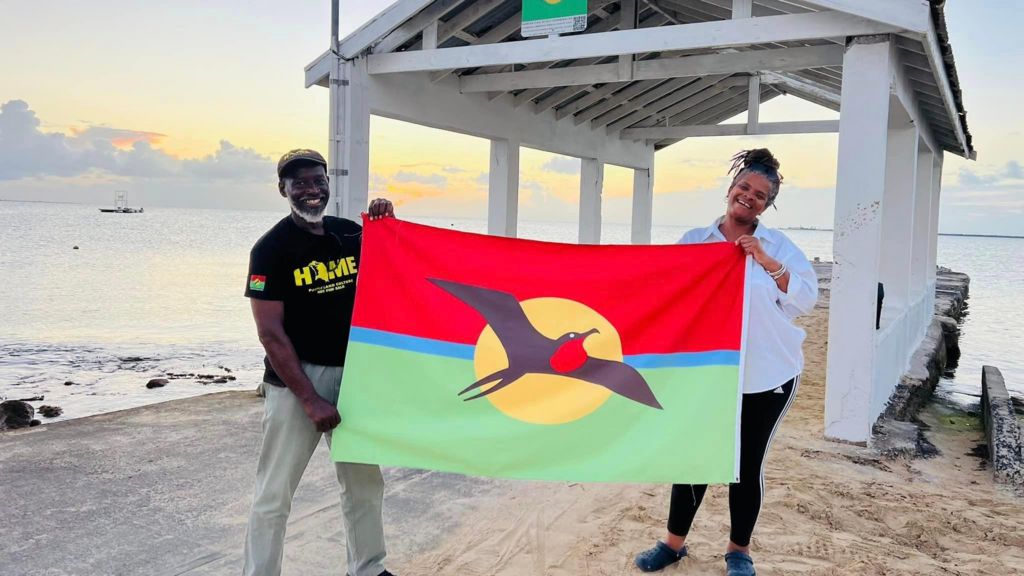
Against the backdrop of post-hurricane recovery and a booming global luxury tourism market, grassroots activists across multiple Caribbean islands are waging a growing battle to protect local communities’ long-held access to public coastlines, as wealthy foreign developers push to transform prime beachfront into exclusive, high-end resorts.
One of the most high-profile cases centers on the tiny Caribbean island of Barbuda, where for more than two decades, Pink Sands Beach Bar served as the beating heart of local social life. Owned by Miranda Beazer, the open-air spot — named for its iconic rose-hued shoreline — drew generations of locals for Sunday post-church relaxation, domino tournaments, and casual community gatherings. That all changed in 2017, when Category 5 Hurricane Irma swept across the island, destroying every structure in its path, including Beazer’s bar and family home. All 2,000 Barbudans were evacuated to neighboring Antigua, and Beazer later lost her husband before she could begin rebuilding. When she returned to reclaim her plot, foreign developers quickly offered massive sums to buy out her claim, offers she rejected outright. “It’s not the money that I’m after,” Beazer explains. “I actually want to retain my land.”
Barbuda’s unique land tenure system, rooted in post-emancipation justice, adds layers of complexity to Beazer’s fight. When slavery was abolished on the island in 1834, collective land ownership was established to guarantee all Barbudans access to territory. This system was formally enshrined in national law with the 2007 Barbuda Land Act, which states that all land on the island is communally owned; individual citizens can secure long-term leases to occupy plots, but the community retains collective oversight and final say over major development projects. Beazer holds a valid lease for 30 acres of southern Barbuda coastline, but today she can only access 8 of those acres. The Global Legal Action Network (GLAN), the international legal advocacy group supporting her case, alleges that the remaining 22 acres are being illegally occupied by two foreign developers: Murbee Resorts and Peace Love and Happiness (PLH). Both developers have denied any wrongdoing, with Murbee stating it only operates on land for which it holds valid legal leases, and PLH asserting it has never occupied Beazer’s plot and has strictly followed all local regulations since securing its own Barbuda lease in 2017. Beazer alleges that developers even bulldozed what was left of her damaged bar after the hurricane, leaving her locked in a protracted court battle to reclaim access to her leased land.
Just a few miles up the coast from Beazer’s plot, one of the Caribbean’s most high-profile luxury resort projects is nearing completion. The Beach Club Barbuda, a 400-acre development from Paradise Found, a venture backed by Oscar-winning actor Robert De Niro and Australian billionaire James Packer, will include a 17-villa Nobu Beach Inn and 25 private luxury beachfront homes, with plot prices starting at $7 million. Locals report that a new bypass road built to ringfence the resort has already blocked public access to the beach the project sits on. The development’s approval highlighted how national governments have changed local land laws to clear the way for foreign investment: in 2015, the Antigua and Barbuda government passed the Paradise Found Act, which explicitly exempts the resort complex from the protections of the 2007 Barbuda Land Act. Local campaigners challenged the law all the way to the Judicial Committee of the Privy Council (JCPC) in London, Antigua and Barbuda’s highest court post-independence. In 2022, the JCPC ruled in favor of the government, stating that collective rights held by Barbudans do not constitute a formal property interest that can block development. Paradise Found has said it complied with all national laws, and that public access to Princess Diana Beach, now part of the resort, “remains unchanged.” John Mussington, chair of the Barbuda Council, the island’s local governing body, argues that the development only moved forward by violating the 2007 Land Act that protects community land rights. Beazer’s stretch of coastline is now the last remaining section of southern Barbuda’s shoreline still open to local access, making her fight all the more critical. “If you were to ever come here and experience it yourself, you would really understand why we’re so committed to this little piece of rock that we have,” she says.
Barbuda’s battle is not an isolated case. It reflects a growing crisis across the Caribbean, where outdated colonial-era land laws and surging demand for luxury Caribbean getaways have combined to erode local access to public beaches. Some 1,600 kilometers west of Barbuda, Jamaica has been grappling with its own long-running dispute over beach access. Devon Taylor, president of the Jamaica Beach Birthright Environmental Movement (Jabbem), says current Jamaican land law explicitly denies locals any formal rights to the country’s foreshore, effectively handing control of most coastlines to private developers. The Jamaican government recently proposed a new bill meant to expand local beach access, but Taylor argues the legislation actually tightens restrictions by framing access as a paid benefit, requiring locals to purchase beach passes from large hotels. “You’re selling back the access to the people,” Taylor says, arguing that this echoes the exclusionary “colonial logic” of the past. According to Jabbem, less than 1% of Jamaica’s entire coastline remains freely open to local residents, and the group is currently involved in five separate legal challenges against the government and private developers to defend public access. The Jamaican government has not yet responded to requests for comment on the proposed legislation.
Even smaller, less developed Caribbean islands such as Grenada are already facing similar tensions as international tourists seek out lesser-known, off-the-beaten-path destinations. Kriss Davies, chair of local advocacy group Grenada Land Actors, warns that unchecked large-scale resort development risks stripping the island of the cultural and natural charm that draws visitors in the first place, while displacing local communities from their traditional coastlines.
According to the United Nations Development Programme, the Caribbean is the most tourism-dependent region in the world, with nearly half of all visitors arriving from the United States. For cash-strapped regional governments, foreign investment in luxury tourism offers an undeniably appealing path to economic growth and job creation. But local activists argue that this growth comes at a steep, irreversible cost to the communities that have shaped the Caribbean’s cultural identity. “Travel is never neutral — it carries both an economic and moral weight,” Taylor says. “These developments often displace residents from ancestral coastlines, restrict public access to beaches, and channel wealth away from the very people whose culture sustains the tourism experience.” As global demand for exclusive Caribbean paradise continues to rise, local land defenders warn that unregulated tourism could permanently alter the home they have stewarded for generations, erasing public access to the natural treasures that make the region unique.