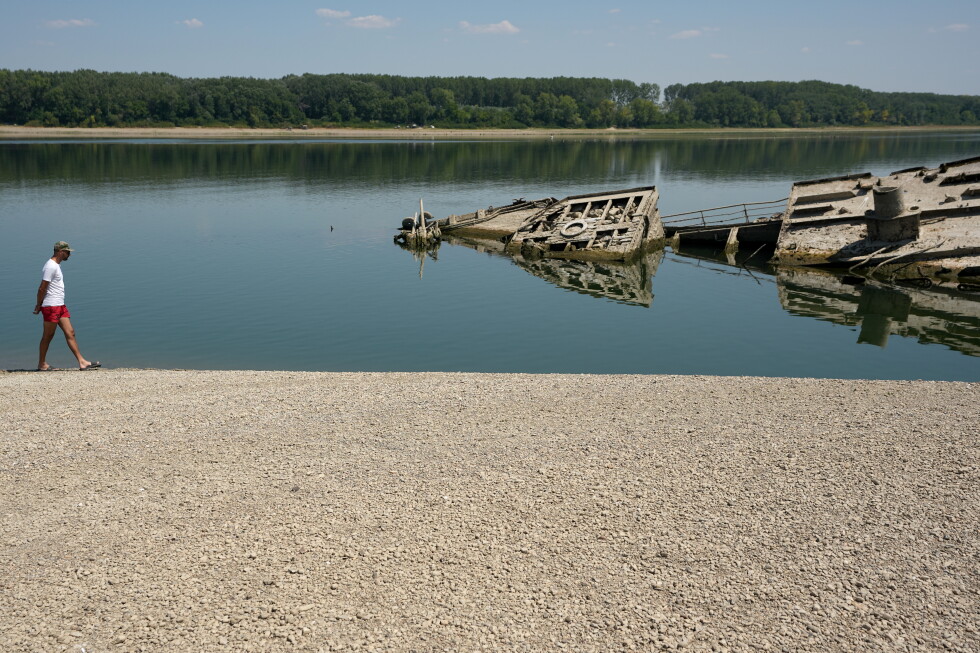
A crippling European drought has shrunk water levels on the Danube — Europe’s second-longest river — to near-record lows, revealing a haunting relic of World War II: the rusted hulls of dozens of deliberately sunken Nazi German warships near the Serbian port town of Prahovo.
Lying along the central stretch of the river that forms the natural border between Serbia and Romania, the emerging wrecks include a corroded vessel with a snapped mast that once flew the Nazi battle flag. Historians confirm these ships were part of Nazi Germany’s Black Sea fleet, scuttled by retreating German forces in September 1944 as Soviet troops pushed into the Balkans. The deliberate sinking was intended to block the river and slow the Soviet advance, though the Third Reich collapsed just eight months later in May 1945. Experts estimate as many as 200 German warships were scuttled in the Danube gorge near Prahovo, many still holding undeployed weapons and unexploded ordnance that has kept them in place for nearly 80 years.
While the visible wrecks have drawn curious onlookers escaping the record summer heat, the extreme low water triggering their exposure has sparked a far more urgent crisis across Central and Eastern Europe. Multiple regional power plants that draw cooling water from the Danube have been pushed to the edge of full shutdown, forcing national governments to implement strict electricity conservation measures. The shallow waters also create major hazards for commercial navigation, grinding cross-border river traffic to a near halt in the worst-hit stretches.
Prahovo local resident Krsta Brandic confirmed the severity of the navigation disruption, noting large cargo and passenger vessels are no longer able to traverse the shallow section of the river near the town.
Efforts to remove the dangerous wrecks have been underway for decades: the Serbian government has pursued removal projects with financial backing from the European Union, and Communist-era Yugoslav authorities already cleared a small number of the ships. However, the presence of unstable explosives onboard most wrecks has complicated and delayed large-scale clearance operations for generations.
Climate scientists have linked this summer’s record-breaking heat and sustained drought across the Danube basin to human-caused global warming, a pattern that has intensified drought conditions across Southern and Central Europe in recent years. Spanning 10 European countries, the Danube functions as a critical commercial and ecological artery for the continent, making low water events a growing concern for regional energy, trade and infrastructure stability.