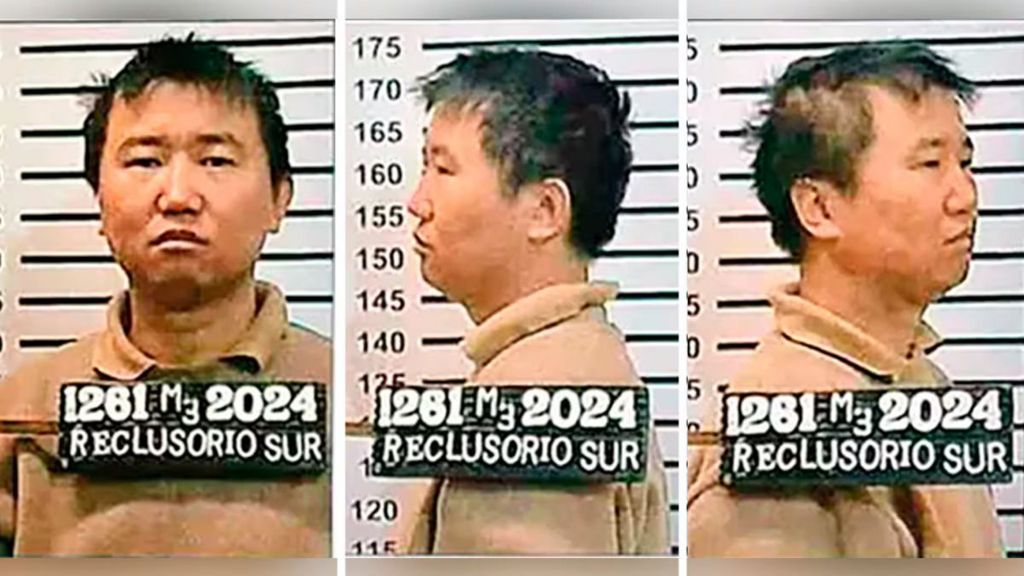
The US justice system is preparing to try a 39-year-old Chinese national identified by US authorities as Zhang Zhidong, who is accused of building the critical supply chain that funneled deadly fentanyl precursor chemicals from Chinese factories to Mexican cartel labs, fueling a public health crisis that has killed tens of thousands of Americans annually.
Nicknamed “Brother Wang” in criminal circles, Zhang has entered a plea of not guilty to charges of large-scale drug trafficking and money laundering. For the first time, current members of Mexico’s Sinaloa cartel, one of the world’s most powerful transnational criminal organizations, and former colleagues of Zhang have spoken anonymously to the BBC, offering an unprecedented look at how a top Chinese university graduate pivoted from legitimate business to become one of the world’s most sought-after drug brokers.
Zhang’s path to international infamy began in 2010, when he graduated from Peking University, China’s most elite higher education institution, with a degree in Spanish. Just one year later, he relocated to Mexico to take a senior role at a Chinese-owned iron ore mining firm. Former university classmate and mining colleague Alex, who requested anonymity for security reasons, described Zhang as a sharp, adaptable young professional with a knack for negotiation. Fluent in Spanish with a keen grasp of local street slang, Zhang quickly built connections with both government officials and criminal groups that control large swathes of Mexican territory, Alex said. Drawn to risk, Zhang showed little fear of consequences, Alex recalled, sharing anecdotes of reckless behavior including crashing his boss’s car and shooting at road signs on empty late-night highways.
When the mining company collapsed in 2013, Alex returned to China, but Zhang chose to stay. Within a few years, he began offering below-market currency exchanges to alumni on a Peking University WeChat group, activity Alex believes was a front for early money laundering operations. US court documents allege Zhang launched his full-scale global narcotics trafficking enterprise in June 2016. According to Sinaloa cartel coordinator Enrique, also speaking under a pseudonym, Zhang solidified his position in the cartel’s inner circle through a romantic relationship with a female relative of a top cartel leader.
Luis, a former cartel fentanyl cook who also requested anonymity, recalled a 2019 meeting where Zhang first offered to supply the cartel with the chemical precursors required to manufacture fentanyl — a synthetic opioid 50 times more potent than heroin, with a lethal dose equal to just a few grains of salt. Luis described Zhang as the catalyst that launched the cartel’s large-scale fentanyl production, and he later became a cook himself, witnessing at least five colleagues die from accidental chemical exposure that seeped through their inadequate protective gear.
Per Enrique’s account of the supply chain Zhang built, the cartel would place precursor orders with Zhang, who used his extensive industry connections in China to source the chemicals. The ingredients were then shipped thousands of miles by air or sea to Mexico, where the cartel distributed them to clandestine labs across Sinaloa for processing into finished fentanyl, most of which was eventually trafficked across the border into the United States.
When asked about the thousands of deaths tied to the illicit fentanyl trade, Enrique acknowledged the trade weighs on his conscience — a relative of his died from a fentanyl overdose — but said he has no other way to earn a living. For Luis, leaving the lab was not an option: he was given a choice between continuing to cook fentanyl or joining armed cartel patrols, a near-certain death sentence.
By the time of his capture, Mexican security agencies allege Zhang ran illegal operations spanning the Americas, Europe, China and Japan. US authorities accuse him of moving more than 1,000 kilograms of cocaine, 1,800 kilograms of fentanyl and 600 kilograms of methamphetamine into the US, while laundering more than $150 million in criminal proceeds annually. To move illicit funds, the US Department of Justice says Zhang recruited individuals to open bank accounts for more than 100 shell companies, who collected cash across the US, deposited it into the accounts, then wired the funds overseas to complete the laundering process.
Victoria Dittmar, a senior researcher at think tank InSight Crime who has spent years investigating precursor chemical flows to Mexico, said Zhang occupied a uniquely critical role in the global drug trade. As a broker connecting Chinese chemical producers, Mexican cartels, and US distribution networks, Dittmar noted that few individuals can operate across all three regions, making Zhang’s position key to the entire fentanyl supply chain. “He was a broker that connected Mexican trafficking organisations with Chinese suppliers of precursor chemicals, a world that is incredibly hard for outsiders to navigate,” Dittmar explained.
The case also shines a light on longstanding debates around chemical regulation in China, the world’s largest producer and exporter of the industrial chemicals used to make fentanyl. A 2025 US State Department report argues that while Chinese authorities have implemented some controls, the country’s massive 160,000-firm chemical industry lacks sufficient staffing and resources for effective oversight. However, the Chinese Embassy in Washington told the BBC that China is “one of the world’s toughest countries on counternarcotics”, noting that all fentanyl-related substances were placed under strict government control in 2019. The substances are not fully banned, the embassy explained, because many have widespread legitimate industrial uses, and added that China’s “extensive and in-depth” counternarcotics cooperation with the US has been “highly productive”.
Zhang’s run as a top drug broker came to an end in October 2024, when he was first arrested in Mexico. A controversial court decision ordered him placed under house arrest, but Zhang staged a dramatic escape, cutting a hole through a wall and fleeing via private jet to Cuba, then on to Russia. Russian border officials detected his forged travel documents and sent him back to Cuba, which returned him to Mexican authorities, who extradited him to the US in 2025. The arrest shocked Zhang’s Peking University alumni network, former colleague Alex said: “It was such a shocking story and he’s probably one of the most famous people Peking University produced.”
In Sinaloa, cartel members felt Zhang’s absence immediately. Enrique said that with Zhang gone, the cartel lost its primary Chinese connection, making it far harder to source precursors and forcing the group to rebuild its supply network from scratch. This disruption aligned with US Drug Enforcement Administration observations that fentanyl purity dropped significantly after Zhang’s arrest, consistent with widespread shortages of key precursor chemicals among Mexican producers.
However, experts and cartel members agree that the disruption is likely temporary. Dittmar describes the global drug trade as a “constant game of cat and mouse”: when key brokers are arrested or chemicals are regulated, producers quickly adapt by switching to alternative chemical inputs and developing new manufacturing processes. Even well-connected brokers like Zhang can be replaced, cartel members say. Enrique confirmed that a new broker has already stepped into Zhang’s role, and another senior cartel coordinator noted that Zhang left behind an extensive network of connections that will keep the trade running. “If he’s gone, someone else will step in… the business will not stop,” the coordinator said.