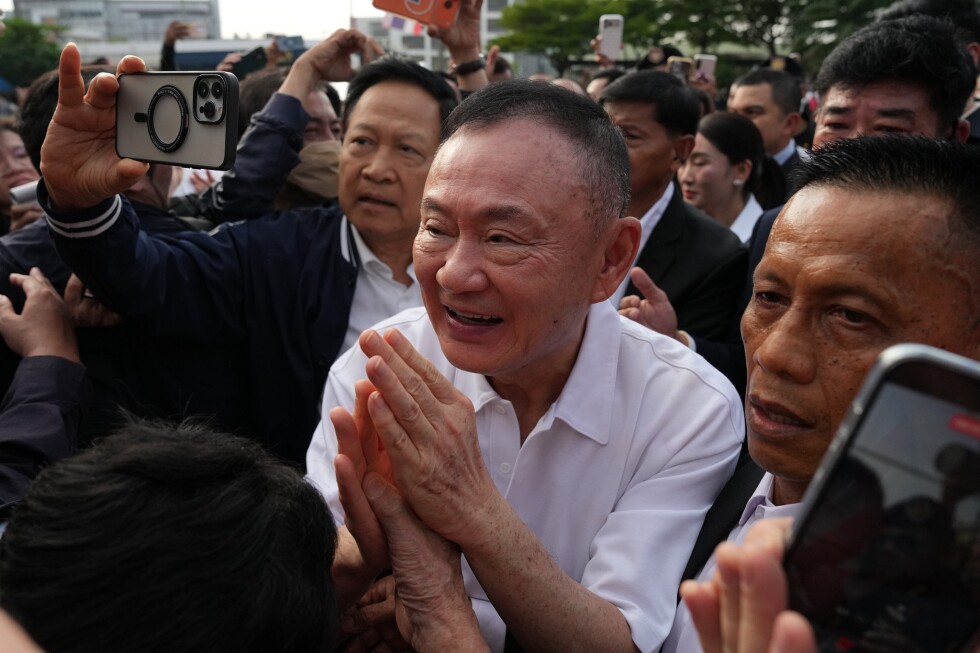
BANGKOK — Decades of polarizing Thai political drama took a new turn on Monday, as former Prime Minister Thaksin Shinawatra walked free from Bangkok’s Klong Prem Central Prison, eight months into a one-year corruption-related sentence. Hundreds of cheering supporters and political allies gathered outside the prison walls to welcome the 76-year-old populist billionaire, who has reshaped Thailand’s political landscape over the past 25 years.
Thaksin’s family, including his daughter Paetongtarn Shinawatra — the former prime minister and one of Thaksin’s three children — arrived hours early to wait for his release. When Thaksin emerged from the prison gate dressed in a white polo shirt and blue trousers, he was immediately embraced by his relatives. Smiling broadly, he walked through the crowd of supporters, who chanted “we love Thaksin” and presented him with red roses, a long-standing symbol of his political movement. He left the prison compound without addressing waiting reporters.
Roughly an hour after his release, Thaksin arrived at his private residence in western Bangkok. In live footage streamed by local outlet Thairath News, he rolled down his car window to greet a small group of well-wishers gathered outside his gate. When pressed by reporters shouting questions about his time in custody, he joked, “I was in hibernation, I can’t remember anything now.”
Thaksin’s political career traces a dramatic arc that fundamentally split Thai society. A successful telecommunications tycoon, he launched his own political party in 1998, won election in 2001, and made history as the first elected prime minister to complete a full four-year term. His signature policies — including a universal national healthcare program and infrastructure investments connecting remote rural regions — earned him fierce loyalty among working-class and poor communities across northern and northeastern Thailand. But his outsized popularity and blunt governing style created deep, enduring rifts with Thailand’s established power blocs: urban elites, royalist factions, and the military. These tensions boiled over in 2006, when a military coup ousted Thaksin while he was traveling abroad. He spent 15 years in self-imposed exile, arguing that the judicial cases filed against him were political persecution carried out by his opponents.
The 2006 coup set off nearly 20 years of intermittent political upheaval and deadly clashes between pro- and anti-Thaksin factions, even as successive iterations of his political machine repeatedly won general elections. Thaksin only returned to Thailand in 2023, as his latest political party, Pheu Thai, negotiated to form a new ruling government. He was immediately taken into custody to face the long-standing abuse of power convictions that had been handed down in absentia, which included charges of using his office to benefit his personal business empire and improperly approving a state lottery project that caused public financial losses.
Originally sentenced to eight years in prison, Thaksin saw his term commuted to one year by King Maha Vajiralongkorn. For months, he was allowed to serve his sentence in a private suite at Bangkok’s Police Hospital on medical grounds, sparking widespread public anger over claims of unfair preferential treatment. In September 2025, the Supreme Court ordered him to transfer to the general prison population to serve out the remainder of his term.
Last month, a Justice Ministry review panel approved Thaksin’s parole application alongside more than 900 other eligible inmates, justifying the decision by citing his good behavior behind bars, his advanced age, and the low risk he would reoffend. Following his release, Thaksin will serve a four-month probation period, during which he is required to live at his registered Bangkok address, wear an electronic monitoring ankle bracelet, and check in regularly with probation authorities.
Thaksin’s release comes at a turbulent moment for his political bloc. Paetongtarn, his daughter, became Thailand’s youngest prime minister in 2024, but was removed from office by the Constitutional Court in August 2025 after an leaked recording of a controversial phone call with former Cambodian Prime Minister Hun Sen was made public. In the most recent 2025 general election, Pheu Thai placed third overall, weakening the party’s position in coalition negotiations.