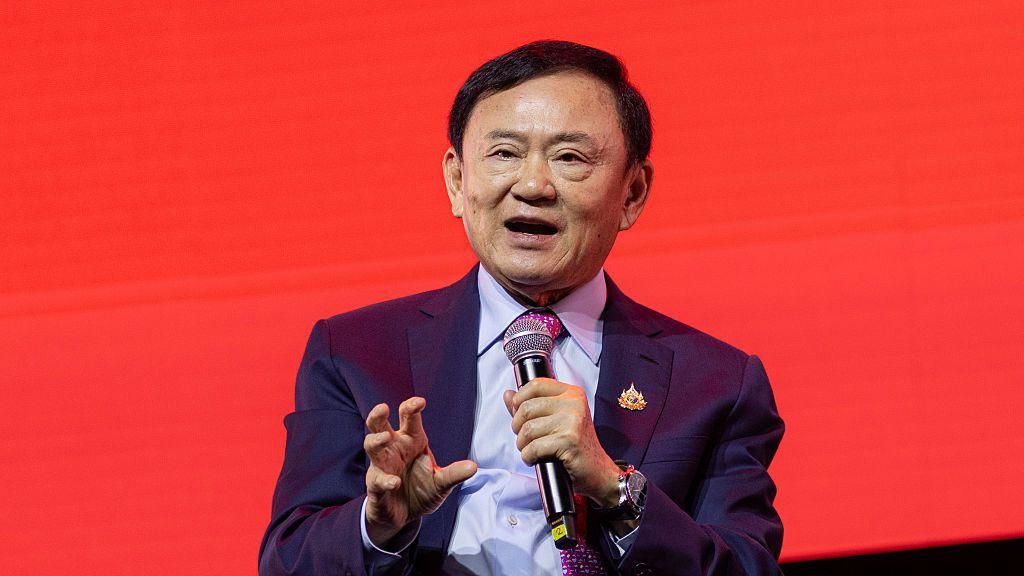
For nearly 30 years, no single figure has shaped Thai politics more profoundly than Thaksin Shinawatra – a former police officer turned business magnate turned prime minister, whose legacy remains one of the most divisive and influential forces in modern Southeast Asian politics, even decades after he first left office.
Thaksin’s path to power began in 1949, when he was born in the northern Thai city of Chiang Mai. He launched his professional career as a police officer, earning a government scholarship in 1973 to pursue a master’s degree in criminal justice in the United States. Upon returning to Thailand, he pivoted to the private sector, building a billion-dollar telecommunications empire by the end of the 1980s. In 1998, he launched his own political vehicle, the Thai Rak Thai (Thais Love Thais) Party, a movement that rapidly upended Thailand’s decades-old political order.
In the 2001 general election, Thaksin stormed to electoral victory in a landslide, defeating the long-dominant traditional establishment of the Democrat Party. His populist platform resonated deeply across class lines: low-income and rural voters flocked to his promises of low-cost universal healthcare and widespread debt relief, paired with his unapologetic criticism of the entrenched Bangkok elite and nationalist policy agenda. Meanwhile, big business embraced his CEO-style governance and pro-growth “Thaksinomics” policies, which pulled Thailand out of the economic stagnation left by the 1997 Asian Financial Crisis and sparked a new national economic boom. Thaksin also earned widespread praise for his swift, coordinated response to the 2004 Indian Ocean tsunami, which devastated large swathes of southwestern Thailand.
But his tenure was not without sharp controversy. He faced widespread public and international criticism for the 2003 war on drugs, which left more than 2,500 people dead in extrajudicial killings, as well as a scandal over his government’s decision to cover up an outbreak of avian flu. Thailand’s anti-corruption commission found he had failed to disclose his full personal wealth (though he was ultimately acquitted on that charge), and he faced heavy backlash over his government’s handling of rising separatist violence in the country’s Muslim-majority southern region. Backed by his loyal base of rural supporters, who adopted the color red and became known as the “red shirts” movement, Thaksin weathered every political storm: he made history as Thailand’s first elected prime minister to complete a full four-year term, and won a landslide re-election in 2005.
Even as he built unparalleled popular support, Thaksin emerged as a deeply polarizing figure, drawing fierce opposition from Thailand’s conservative establishment: the Bangkok elite, the royal military, and pro-monarchy activists, who adopted the color yellow and became known as the “yellow shirts” movement. It was a business deal that ultimately triggered his ouster: in early 2006, Thaksin’s family sold its stake in Shin Corp, the country’s largest telecommunications group, netting $1.9 billion. The deal sparked mass public anger, with critics arguing the family had illegally avoided tax obligations and transferred control of a critical national asset to foreign investors based in Singapore.
Amid months of massive street protests, Thaksin called a snap general election in April 2006 to force a popular verdict on his leadership. Main opposition parties boycotted the vote, and a large share of ballots were cast as informal “no votes.” Thaksin initially announced he would step down, only to return to office just a month later. By September 2006, with months of political gridlock and unrest paralyzing the country, the Royal Thai Army seized power in a military coup while Thaksin was traveling abroad.
What followed has been 18 years of political upheaval, with Thaksin pulling the strings of Thai politics from exile and through a dynastic line of proxy leaders. After briefly returning to Thailand following a 2007 election won by his allies, courts empowered by the new military-backed constitution opened a wave of corruption cases against Thaksin and his family. Convicted of corruption, Thaksin fled Thailand once again, beginning 15 years of self-imposed exile centered primarily in Dubai. Even from abroad, he retained control of his political movement: Thai Rak Thai was dissolved in 2007, its successor the People’s Power Party was dissolved in 2008, but the third iteration – Pheu Thai Party – survived. In 2011, Thaksin’s sister Yingluck Shinawatra led Pheu Thai to a landslide victory, becoming Thailand’s first female prime minister, before she too was ousted by a court disqualification and a second military coup. In the 2019 election, Pheu Thai won more seats than any rival party, but was blocked from forming government by conservative parties allied with the military.
It was not until the 2023 election that the Shinawatra political dynasty saw a shift in fortunes. In a major upset, the progressive Move Forward Party won the most seats in the lower house of parliament, forcing Thailand’s long-standing anti-Thaksin conservatives to strike a grand bargain with Pheu Thai to exclude Move Forward from power. As part of the deal, Thaksin returned to Thailand in 2023 after 15 years in exile, and was greeted by hundreds of cheering supporters upon landing in Bangkok.
He was immediately taken to the Supreme Court to begin serving an eight-year prison sentence for his decades-old corruption convictions, which Thaksin has always maintained were politically motivated. Within 24 hours, however, he was transferred to a luxury private ward at Police General Hospital after reporting heart complications. Following a formal plea for royal clemency, the King of Thailand commuted his sentence to just one year. Thaksin remained in the hospital for six months before receiving parole and returning to his private Bangkok residence.
That peace did not last. In September 2025, the Supreme Court ruled that Thaksin’s extended hospital stay had been unlawful, finding the former prime minister “knew or could perceive that he was not in a critical or emergency condition.” He was immediately taken to prison to serve out the remainder of his one-year sentence. In a separate high-profile case that same month, a court acquitted Thaksin of charges of lese-majeste – insulting the monarchy – which carry decades-long prison sentences in Thailand.
The same month that Thaksin was sent back to prison, his daughter Paetongtarn Shinawatra, who had become prime minister in 2024 after the coalition’s original leader was removed by the constitutional court, was also disqualified and removed from office over a leaked controversial phone call with Cambodian Prime Minister Hun Sen. A breakaway faction from the Pheu Thai-led coalition subsequently installed a new prime minister from outside the Shinawatra circle.
Despite the string of major political and legal setbacks, both Thaksin and his family have vowed to continue their political fight. In a public statement released to social media shortly after the Supreme Court ordered his return to prison, the 76-year-old former prime minister wrote: “even though I lose my physical freedom, I will still have freedom of thought for the benefit of my country and its people. I will maintain my physical and mental strength to spend the rest of my life serving the monarchy, Thailand and the Thai people.”
For three decades, Thaksin Shinawatra has dominated Thai politics, surviving coups, convictions, and exiles – and even behind bars, he remains one of the most powerful forces shaping the country’s future.