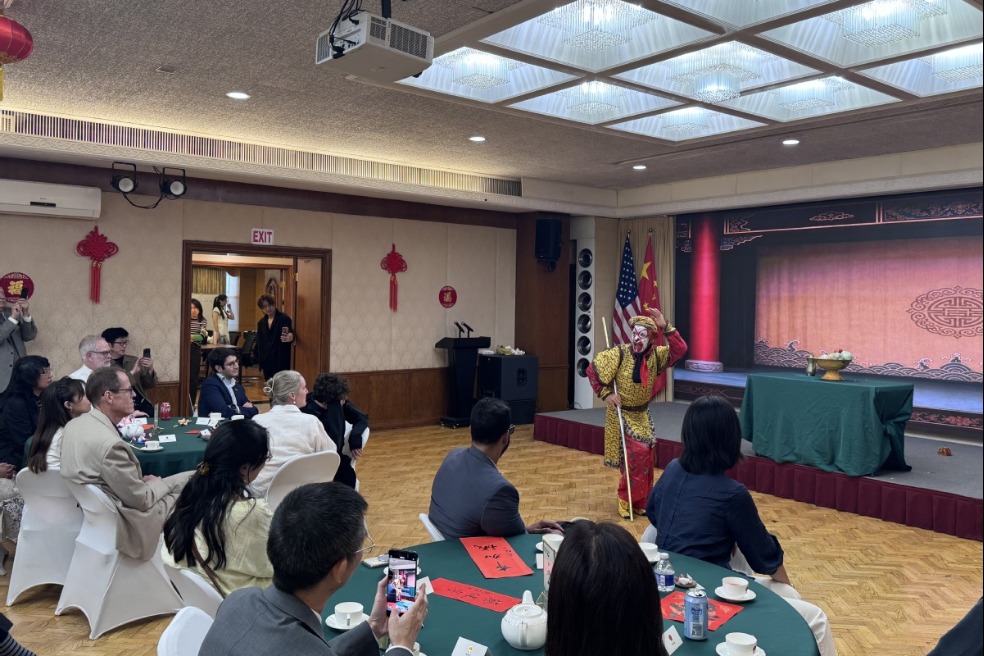
On the occasion of International Tea Day, the Chinese Consulate General in Los Angeles opened its doors to a diverse cross-section of attendees—from government officials and cultural creators to academics and local residents—for an immersive celebration that wove together traditional Chinese tea art, performing arts and grassroots dialogue, with the goal of strengthening mutual understanding between the Chinese and American peoples.
One of the event’s standout guests was Ghaffar Pourazar, a performer widely known by his affectionate nickname the “Western Monkey King”. Born to Azerbaijani-Iranian parents and raised in the United Kingdom, Pourazar once built a career as a computer animator in London. That all changed in 1993, when the then 32-year-old saw a Peking Opera performance for the first time, and made the life-altering decision to pivot entirely to the study and performance of the traditional Chinese art form.
“I put away my other life. I said goodbye to my friends and my family. I said I want to do this,” Pourazar shared during the celebration, after performing a stirring excerpt from *Uproar in Heaven*, the classic Peking Opera retelling of *Journey to the West*. For Pourazar, the iconic Monkey King character is far more than a stage role: it mirrors his own decades-long journey of chasing a cross-cultural passion. “The monkey follows the dream, and that’s why I love this character, but also that is why Chinese people love this character,” he explained.
Over decades of dedicated practice, Pourazar has become a leading cross-cultural ambassador for Peking Opera, drawn to the art form’s one-of-a-kind fusion of martial arts philosophy, acrobatics, vocal performance and dramatic storytelling. “For hundreds of years, Chinese culture has brought the philosophy of martial arts like tai chi together with opera action,” he noted. “The actors are not only able to sing and dance, but they’re also martial acrobats.” Today, his deep bond with Chinese culture is a core part of his personal identity: “I am Azerbaijani, Iranian, British, I was raised in England, but I feel more Chinese than others,” he said.
Beyond performances, the event centered tea—an iconic Chinese cultural export that organizers framed as both a symbol of shared history and a practical platform for people-to-people dialogue. In his opening remarks, Guo Shaochun, Chinese Consul General in Los Angeles, emphasized tea’s unique role as a bridge between cultures, and expressed hope that the event would help more Americans gain nuanced insight into Chinese culture and the Chinese people’s shared aspirations for a better life.
Attendees had the chance to sample a range of Chinese teas, including aged Pu’er from Yunnan province, a region celebrated for its centuries-old tea cultivation traditions and diverse ethnic cultural heritage. Guo highlighted that just as Chinese people have long cherished tea and American people favor coffee, the two nations each hold distinct cultural traditions, lifestyles and values. Rather than creating division, he argued, these differences should be celebrated as a source of mutual enrichment.
“The people of China and the United States are both great peoples,” Guo said. “It is these differences that make our world rich and colorful, and inspire us to better understand and appreciate one another.” He also referenced the recent high-level meeting between Chinese President Xi Jinping and US President Donald Trump during Trump’s state visit to China, noting that both leaders had reaffirmed their commitment to building a constructive China-US relationship rooted in strategic stability.
Leticia Perez, a member of California’s Kern County Board of Supervisors, reaffirmed her support for continued people-to-people and economic collaboration between the two nations. “I’m a big fan of Chinese culture,” Perez said. “I want to reaffirm my own commitment to be part of the ongoing conversation of peace building and mutually beneficial economic cooperation between the United States and China.” She also praised China’s consistent call for peace and cooperation amid rising global geopolitical tensions.
The full day of cultural programming included additional performances of traditional Chinese folk songs and instrumental pieces played on the pipa and bamboo flute, alongside hands-on demonstrations of Chinese calligraphy and traditional dough figurine folk art. Senior tea master and Chinese tea culture ambassador Luo Ping guided attendees through a formal traditional tea ceremony, walking guests through the classification of Chinese teas and explaining their deep cultural roots and documented health benefits.
For many American attendees, the event offered a rare, intimate opportunity to engage with Chinese culture beyond mainstream media narratives. Joshua Goldhaber, vice-dean of graduate research education at Cedars-Sinai Health Sciences University, said he left with a new appreciation for tea’s cultural meaning and the shared values of friendship and cooperation between the two countries. “It was a very warm feeling,” Goldhaber said. “I look forward to more opportunities to immerse in Chinese culture and educational exchange.”
Douglas Smith, a visual effects supervisor with experience working on both Hollywood and Chinese film productions, echoed that optimism for future cross-cultural and creative collaboration. “Communication between countries is always the best thing that can happen,” Smith said. “Misunderstandings happen with the lack of communication, so whenever that can happen, it’s a very positive thing.”