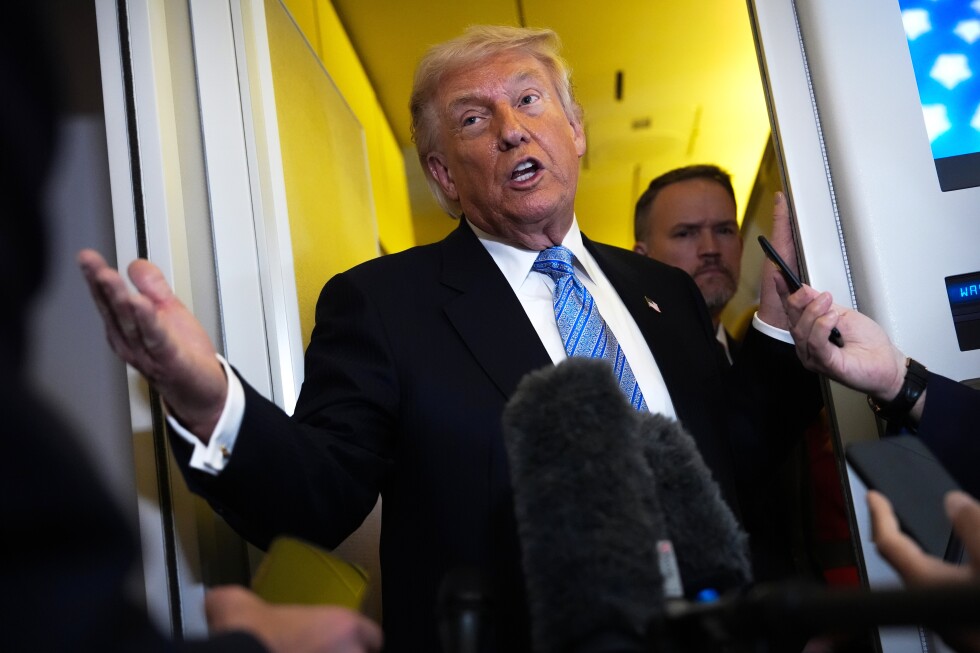
After three days of uncharacteristic public restraint during his official visit to China, former U.S. President Donald Trump broke his silence on the most sensitive topic of the trip only after departing Beijing for Washington. What was expected to center heavily on trade and the U.S.-Israel conflict in Iran instead became dominated by urgent discussion of Taiwan, the flashpoint that continues to shape the core of U.S.-China bilateral relations.
Chinese President Xi Jinping opened the high-stakes summit with a clear, firm warning: any misstep by Washington in its approach to the self-governing island, which Beijing claims as an inalienable part of its territory, could lead to open confrontation between the two global powers. While Trump made no public response to the warning during his time on Chinese soil, he opened up about the conversation to reporters aboard Air Force One once en route home, revealing that Xi’s strong opposition has pushed him to reconsider a previously planned major U.S. arms sale to Taipei.
### Taiwan Policy: Strategic Ambiguity Remains, Arms Sale Decision On Hold
Heading into the trip, Trump had already signaled growing ambivalence toward U.S. support for Taiwan during his second term, sparking widespread speculation that he might scale back long-standing American backing for the island democracy. Secretary of State Marco Rubio had publicly reaffirmed that there was no shift in Washington’s approach, but observers warned that Trump, famous for unscripted off-the-cuff remarks, could trigger unintended major consequences with a single comment. In the end, he remained publicly silent on the issue while in Beijing, even after Xi framed it as the most critical issue in bilateral ties.
The $11 billion weapons package for Taiwan was authorized by Trump’s Republican administration back in December, but it has not yet been implemented. A separate $14 billion arms sale was approved by Congress in January, and it cannot move forward until Trump formally submits it for congressional review. When asked if he would move ahead with the sale, Trump told reporters: “President Xi and I talked a lot about Taiwan. He does not want to see a fight for independence because that would be a very strong confrontation. I heard him out, but I didn’t make a comment.”
Trump struggled to recall the name of Taiwanese President Lai Ching-te during the press exchange, and emphasized that “The last thing we need right now is a war that’s 9,500 miles away.” When pressed on whether the U.S. would intervene militarily if China attacked Taiwan, he declined to give a direct answer — a position that aligns with decades of U.S. “strategic ambiguity” policy, which commits Washington to ensuring Taiwan has the means to defend itself but does not explicitly state what military action the U.S. would take if Beijing launches an attack.
### Iran Conflict: Beijing Offers Potential Mediation
The conflict in Iran, initially expected to dominate the summit agenda, was discussed in substantive terms between the two leaders. The war has already driven a sharp spike in global oil prices, and a prolonged conflict threatens to push the global economy into recession. Trump told reporters that Xi agreed a nuclear-armed Iran would pose a dangerous threat to global security, and that both sides agreed the Strait of Hormuz — a critical global oil chokepoint — must be reopened. Trump added that Xi even offered to help broker a diplomatic end to the conflict.
Chinese officials have not yet confirmed that mediation offer publicly. Beijing’s public stance has been that any resolution must “take into account the concerns of all parties on the Iran nuclear issue.” Trump has argued that China should play a larger role in ending the conflict, given its heavy dependence on energy imports from the Middle East. If Beijing does step up its engagement, it could mark a major breakthrough for U.S. efforts to reach a sustainable resolution to the war.
### A New Framework for Bilateral Ties
Following the summit, Chinese authorities announced that the two leaders had agreed on a new vision for bilateral ties: a “constructive China-U.S. relationship of strategic stability.” According to the Chinese Foreign Ministry, this framework will guide relations for the remainder of Trump’s current term, focusing on expanding areas of cooperation, setting boundaries for competition, and managing differences through dialogue.
Helena Legarda, a China analyst at the Berlin-based Mercator Institute for China Studies, described the framework as an effort “to keep the relationship on an even keel” after years of rising tensions. George Chen, a partner at global consultancy The Asia Group, noted that this framing represents a shift from the previous Democratic administration of Joe Biden, which framed the U.S.-China relationship primarily as one of strategic competition.
### Trade Deals: Big Promises, Few Concrete Details
Trump traveled to Beijing accompanied by a delegation of top U.S. business leaders, including Boeing CEO, Nvidia chief Jensen Huang, and SpaceX CEO Elon Musk. The president announced that major new trade agreements had been reached, including a pending deal for China to purchase 200 Boeing aircraft. But he left Beijing without any formal, signed announcement of the deal. Earlier proposals for large Chinese purchases of U.S. soybeans and beef also remain pending.
Speaking to reporters aboard Air Force One, Trump added that China could eventually purchase up to 750 Boeing aircraft if the initial order proceeds smoothly, with 450 General Electric engines included in any expanded deal. Like all large bilateral accords, the final details will determine the actual impact of any agreements. During Trump’s first term, he oversaw a high-profile signing ceremony in Beijing for nearly $250 billion in deals, but not all of the pledges made at that time were ultimately fulfilled.
### Diplomatic Tone: Trump’s Unreciprocated Praise for Xi
From the start of his visit, Trump offered consistent, effusive praise for Xi Jinping, with no matching level of public flattery in return from the Chinese leader. Trump called Xi a “great leader,” said the two countries would share a “fantastic future together,” and described it as an “honor” to be Xi’s friend, calling the Chinese leader “warm.”
Xi is not known for public effusiveness, and Trump himself acknowledged in a pre-trip Fox News interview that Xi is “all business.” In his public remarks, Xi called Trump’s visit “landmark” and said it had deepened mutual trust, and offered a more subtle gesture of goodwill: he promised to send rose seeds to the White House, matching the variety grown in the garden of his Beijing residence where the two leaders held talks over tea. Xi noted that hosting Trump at the residence was a gesture to reciprocate the hospitality Trump extended when Xi visited his Mar-a-Lago estate in Florida back in 2017.
Reporting for this article was contributed by Leung in Hong Kong, Mistreanu and Wu in Bangkok, and Superville in Washington.