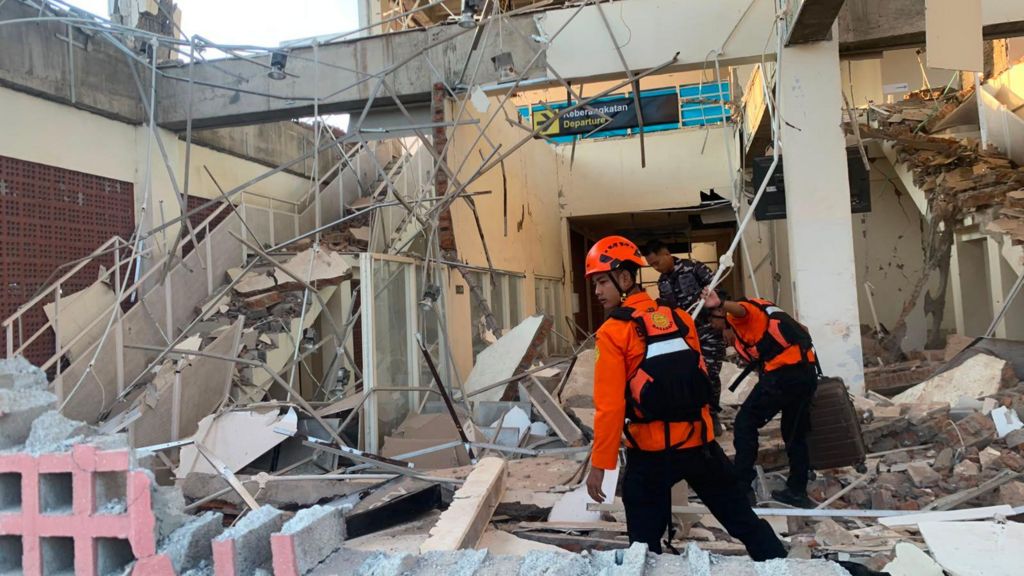
In the pre-dawn hours of a recent Saturday, a powerful 7.7-magnitude earthquake jolted the Flores region of East Nusa Tenggara, Indonesia, leaving at least two people dead and widespread structural damage across the remote, mountainous island area.
The seismic event, which struck just before 5:00 a.m. local time at a shallow depth of 15 kilometers around 1,000 kilometers from Indonesia’s popular tourist hub of Bali, sent panicked residents of Maumere — Flores’ largest population center — spilling into open streets in fear.
One of the hardest-hit infrastructure sites was Lorens Say Port in Maumere, where dramatic eyewitness footage captured large sections of concrete breaking free from the terminal building and crashing down onto passengers waiting to board an inter-island ferry. The collapse of the ship’s gangway threw multiple waiting travelers into the surrounding sea.
Immediately following the main quake, Indonesian officials issued a nationwide tsunami warning, prompting thousands of coastal residents to flee inland on motorbikes and foot for higher ground. The warning was later lifted after no large waves materialized, but lingering anxiety has kept many communities on edge.
Indonesia’s National Disaster Management Agency (BNPB) confirmed the two fatalities so far are one man and one woman, though agency officials note that casualty data is still undergoing verification by on-the-ground response teams. “The victim data is still being verified and further data collection is being conducted by the field team,” the BNPB said in an official statement.
Search and rescue teams from the country’s Basarnas disaster response agency have already deployed to Maumere to locate and extract anyone trapped in collapsed or damaged structures, but the region’s remote, mountainous terrain has slowed efforts to map the full scale of destruction. Multiple strong aftershocks have continued to rattle the area in the hours after the main quake, including one 6.1-magnitude tremor that has added to risks for residents and first responders alike.
In a public advisory, the BNPB outlined its immediate priorities: protecting public safety, preventing additional casualties from aftershocks and secondary hazards, and completing a rapid needs assessment across the affected zone. The agency urged local residents to remain calm, stay clear of low-lying coastal areas, and avoid entering any structures that have already sustained cracks or visible structural damage. “A rapid assessment is currently underway to determine the number of casualties and the extent of the impact. We will provide that information after the data has been verified,” the statement added.
Arnold Welianto, a resident of Talibura village in Sikka, East Nusa Tenggara, shared his firsthand account of the disaster with the BBC. Welianto said he was asleep in his home when the “very strong shaking” jolted him awake. “I was startled awake and immediately went to my child’s room,” he recalled. “Once we were outside, residents in our neighbourhood, which is located close to the shoreline, had already fled their homes and were heading toward the hills and crowding the roads, while some other residents were standing along the roadside because the sea had also receded.”
“The water remained low for quite some time, so everyone panicked and ran – I went around to the community health centre, and the people there had already been evacuated,” Welianto added. He noted that most area residents are still choosing to stay outdoors for safety, as ongoing aftershocks have left them too afraid to return to potentially unstable homes.