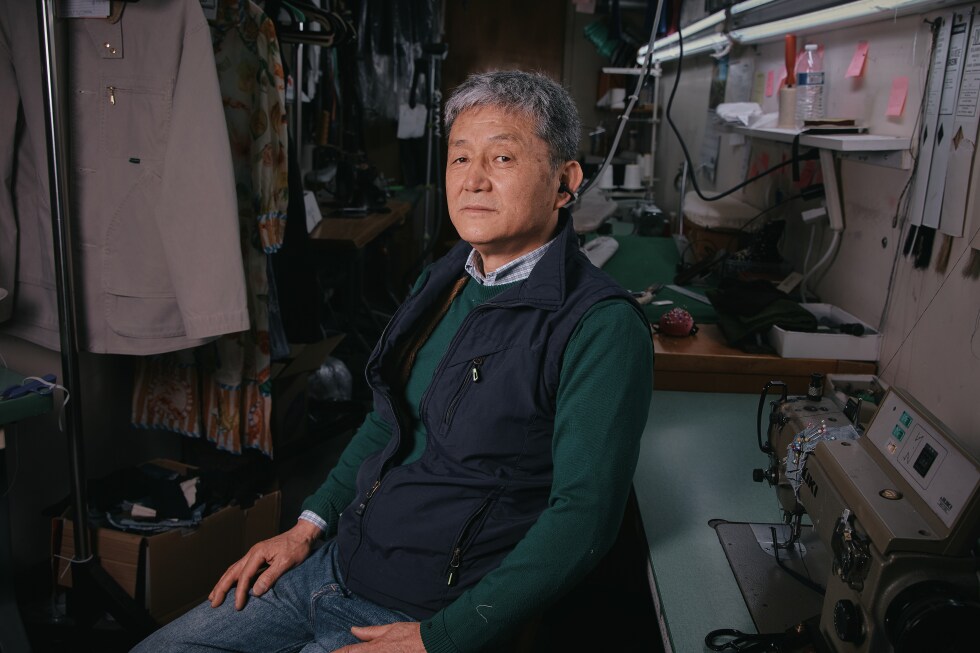
NEW YORK — Inside Kil Bae’s compact Manhattan one-man shop 85 Custom Tailor, the 63-year-old artisan leans over his sewing machine, carefully hemming a custom dress, when a new request interrupts his work: a customer is ready to pay $280 to alter a $20 vintage Tommy Hilfiger reversible bomber jacket he picked up from a local thrift store. For Bae, this price disparity, once unheard of, has become an increasingly common source of revenue that keeps his small business running today.
Bae, who began honing his tailoring craft at 17 in his native South Korea, examines the cotton jacket, pins its seams, and moves around his client with the focused precision of a sculptor shaping raw marble. He is just one of thousands of aging professional tailors, sewers and dressmakers across the United States: the entire trade is shrinking as veteran artisans retire, even as consumer demand for custom alteration work surges to multi-year highs.
Fashion industry analysts trace this new wave of demand to shifting consumer attitudes and changing health trends. A generation of shoppers raised on low-cost disposable fast fashion are now turning to skilled tailors to refine mass-produced ready-to-wear pieces, add one-of-a-kind personal touches to off-the-rack garments, breathe new life into thrifted secondhand finds, and extend the lifespan of their existing wardrobes. Beyond that, Bae notes that the rising popularity of weight-loss medications including Wegovy and Zepbound has driven a sharp increase in requests for resized waistbands, tapered sleeves and other body-altering adjustments to existing clothing.
Unlike many traditional skilled trades, tailoring has a unique advantage that will protect it from technological disruption, Bae argues: “I recommend this job to young people because this one cannot be AI’d. Artificial intelligence has automated pattern making, but it cannot replicate the handcrafted nuance a tailor brings to every job. Every body is different, every shape is unique. AI can’t copy that kind of personalization. If I close this shop today, I can walk out and find another tailor job tomorrow.”
Even with that stability, however, the trade has failed to attract enough new entry-level workers to replace the generation of artisans set to retire in the coming decade. The trend mirrors labor gaps seen in other hands-on skilled trades from custom engraving to musical instrument repair, where decades of under-recruitment have left widespread workforce shortages.
U.S. Bureau of Labor Statistics (BLS) data underscores the scale of the decline. Almost two years ago, the agency counted fewer than 17,000 tailors, custom sewers and dressmakers working at formal business establishments across the country — a 30% drop from 10 years earlier. When including self-employed artisans and workers in private households, the median age for all tailors and sewers hit 54 in 2024 — 12 years higher than the median age for the entire U.S. employed workforce.
Industry experts point to pay and working conditions as the key barriers drawing young people to the trade. The mean annual wage for tailors, dressmakers and custom sewers was $44,050 as of May 2024, according to BLS calculations, far below the $68,000 average annual income for all U.S. workers. The job also requires hours of hunched, detail-focused work that takes a significant physical toll over a career. Most modern fashion education programs also prioritize training for mass industrial production rather than hands-on custom craft work, says Scott Carnz, provost at LIM College, a New York-based institution that offers fashion business degrees: “Most of fashion training is really aimed at mass production, not spending time in a shop handmaking a garment. The work is also tedious.”
Despite the overall decline in the total workforce, online job postings for tailors have stayed remarkably stable in recent years, says Cory Stahle, a labor economist with Indeed’s research division. Between February 2020 and February 2024, advertised tailor openings dropped by just 2%, compared to a nearly 30% drop in marketing and software development postings over the same period. “There is a kind of craftsmanship here that I think is an important piece that we can’t ignore,” Stahle, who specializes in U.S. labor market analysis, said.
For more than a century, immigrant workers have been the backbone of America’s custom garment and tailoring trade. Julia Gelatt, associate director of the U.S. Immigration Policy Program at the nonpartisan Migration Policy Institute, says an analysis of recent U.S. census data finds roughly 40% of all tailors, dressmakers and sewers are foreign-born, with the largest shares hailing from Mexico, South Korea, Vietnam and China.
To address the deepening labor shortage, industry and education leaders have begun partnering to cultivate a new generation of master tailors. Nordstrom, North America’s largest employer of tailoring and alteration specialists, has teamed up with New York’s Fashion Institute of Technology (FIT) to launch a nine-week intensive training program focused on advanced sewing and alteration techniques.
“Customarily, tailoring has never been part of the American skill set,” said Michael Harrell, an FIT instructor and Broadway costume builder who teaches the program. The course received more than 200 applications for its inaugural 15-student cohort, which began coursework in October 2023 and graduated with completion certificates in February 2024, according to Jacqueline Jenkins, executive director of FIT’s Center for Continuing and Professional Studies. The hands-on curriculum is designed specifically to prepare graduates for full-time roles at Nordstrom, which employs 1,500 alteration and tailoring specialists across its luxury department store locations to handle everything from basic jean hemming and rip repair to custom suit fitting and evening gown reworking. So far, 10 graduates from the first cohort have already been hired by Nordstrom or are in the final stages of the hiring process, said Marco Esquivel, Nordstrom’s director of alterations. “We owe it to the broader industry to ensure that this is an art form that exists for years and years to come, and continues to serve customers both within our walls as well as outside,” Esquivel said.
Other major retail brands are also expanding their custom tailoring services to match growing consumer demand. Brooks Brothers, the iconic American luxury menswear brand that has offered custom garments since the 1800s, launched a test of bespoke women’s tailoring at five locations in 2023. This year, the brand rolled out the service to 40 additional stores, with pricing starting at $165 for custom shirts and $1,398 for custom suits.
Back at Bae’s Manhattan shop, 33-year-old client Jonathan Reiss confirms he is certain he wants to move forward with the $280 alteration of his $20 thrifted jacket. Reiss says he plans to wear the jacket regularly, and has shifted away from the fast fashion habits of his younger years: “I think I fell victim to buying cheap stuff, and then you realize it just falls apart or shrinks or it just doesn’t last long.”
Like many veteran tailors, Bae has struggled to find a successor to carry on his craft. He tried to persuade his son, now 34, to learn the trade, but his son left a career in tech to open his own bagel shop. “Young people. They just want to find a job in computers,” Bae said. “I think that’s too boring. I think this is very interesting. Every time, I am drawing in my head. I am like an artist.”
Bae got his start training under his older sister and brother at their custom apparel shop outside Seoul, South Korea. After five years of apprenticeship, he moved to Seoul to work on custom orders and designer samples for major domestic brands. He later relocated to the New York City area, where he worked as a pattern maker for iconic design houses including Ralph Lauren and Donna Karan. He opened his first own shop in Connecticut in 2011, but was forced to close the location after a decade when the COVID-19 pandemic gutted local small business revenue. He reopened at his current Manhattan address a year later, and now works with three specialized sewing machines: a basic all-purpose model, a heavy-duty machine for thick materials like denim and leather, and an overlock machine to finish raw fabric edges.
For now, Bae says he plans to keep working as long as his hands stay steady enough to handle the fine work of tailoring: “I’m always learning,” he said.