标签: Oceania

大洋洲

  • Groundbreaking: ‘Controlled’ quakes triggered under Swiss Alps

    Groundbreaking: ‘Controlled’ quakes triggered under Swiss Alps

    Deep beneath the snow-capped peaks of the Swiss Alps, a team of European scientists has pulled off a world-first seismology experiment: intentionally triggering thousands of small, controlled earthquakes to unlock long-held secrets of tectonic activity that could one day prevent dangerous man-made quakes across the globe.

    The ambitious project, led by Domenico Giardini, a geology professor at Switzerland’s prestigious ETH Zurich, is hosted at the custom-built BedrettoLab, a cutting-edge underground research facility carved into a 5.2-kilometer ventilation tunnel that connects to the iconic Furka railway tunnel. Accessible only via specially modified electric vehicles navigating damp, dark passages beneath 1.5 kilometers of solid mountain rock, the lab offers a one-of-a-kind setting to observe fault activity up close — a stark departure from traditional seismological research, where scientists typically install monitoring sensors along known faults and wait for natural quakes to occur.

    For the second iteration of the experiment, dubbed Fault Activation and Earthquake Rupture (FEAR-2), dozens of researchers from across European institutions spent four days in late April executing a carefully planned procedure: they pumped 750 cubic meters of water into pre-drilled boreholes targeting an existing geological fault, with the goal of prompting a magnitude 1 earthquake. Unlike common misconceptions, the team did not create a new fault; instead, the water injection only lubricated existing fractures to encourage natural movement. For safety, no personnel remained in the tunnel during the active phase of the experiment, with all operations remotely controlled from ETH Zurich’s main laboratory 100 kilometers to the north.

    During the experiment, the research team experienced a brief moment of disruption when a sudden power cut hit the underground tunnel, forcing scientists in Zurich to scramble to resolve the issue. The glitch was resolved quickly, and water pumping resumed within minutes. When the trial concluded, the results exceeded many expectations: the team had successfully induced around 8,000 distinct seismic events along the target fault, as well as unexpected activity along secondary faults running perpendicular to the main fracture. Event magnitudes ranged from -5 to -0.14, falling just short of the team’s 1.0 magnitude target, a outcome Giardini called a resounding success.

    Never before has a controlled seismic experiment been conducted at this scale and depth, Giardini explained. Even the smaller events generated by the trial offered unprecedented data that no previous laboratory study has been able to collect. Even the smallest measured events hold valuable insight: Giardini noted that the largest induced quake, at magnitude -0.14, would generate a 1.5 G acceleration strong enough to lift a person standing near the fault off the ground into the air. Crucially, no seismic activity was detected at the surface, and Giardini emphasized that the trial added only one percent additional seismic risk to the region, making it completely safe for local communities.

    The groundbreaking work carries major implications for global industrial safety. Researchers note that unplanned induced seismicity has caused major damage around the world in recent decades, from large quakes linked to fracking wastewater disposal in Texas to the 5.4 magnitude 2017 Pohang earthquake in South Korea, which was triggered by unregulated water injection at an experimental geothermal power plant that damaged thousands of buildings. Giardini argues that by mastering the mechanics of controlled fault movement, scientists can develop better safety guidelines for all kinds of underground activity, from mining to geothermal energy development. The team plans to build on the current findings and run a second trial in June, adjusting injection parameters to hit their target magnitude 1 goal and collect even more detailed data on fault rupture dynamics. As Giardini puts it, the core goal of the research is not to create earthquakes, but to learn how to avoid dangerous accidental quakes: “If we master how to produce quakes of a certain size, then we know how not to produce them. We need to learn how to do underground activity more safely.”

  • Nazi-looted portrait found in home of Dutch SS leader’s family: art sleuth

    Nazi-looted portrait found in home of Dutch SS leader’s family: art sleuth

    Dutch art investigator Arthur Brand, globally recognized for cracking high-profile stolen art cases, revealed a groundbreaking discovery Monday: a long-lost painting looted by the Nazis from the iconic Goudstikker collection has been found in the possession of the descendants of one of the Netherlands’ most infamous Nazi collaborators. The work, *Portrait of a Young Girl* by 20th-century Dutch artist Toon Kelder, is believed to have hung unnoticed on the walls of the Seyffardt family home for more than 75 years, in what Brand calls the most extraordinary case of his entire career.

    The discovery echoes a 2025 global headlines-making find, where another Nazi-plundered piece from the Goudstikker collection was uncovered in an Argentine property listing, reigniting global interest in the hundreds of artworks still missing from the legendary collection. Jacques Goudstikker, a prominent Jewish art dealer based in Amsterdam, fled the Netherlands for England in 1940 as Nazi forces invaded, leaving his entire 1,300-piece collection behind. Top Nazi official Hermann Göring seized the entire collection within months, dispersing many works at public auctions later that year.

    The current case was set in motion when an anonymous descendant of Hendrik Seyffardt reached out to Brand with two startling revelations: he came from a line of high-ranking Nazi collaborators, and his family had kept the stolen artwork for generations. The anonymous man told investigators he spotted the painting hanging in the hallway of Seyffardt’s granddaughter. Hendrik Seyffardt, who led a Dutch volunteer Waffen-SS unit deployed to the Eastern Front, was the highest-profile Dutch collaborator assassinated by Dutch resistance fighters in 1943. His death made the front page of *The New York Times*, and the Nazi regime held a state-funded funeral in The Netherlands’ capital The Hague, where Adolf Hitler personally sent a wreath to honor his death.

    Brand’s investigation confirmed the artwork’s provenance: the painting bears an original Goudstikker collection label on its back, and the number 92 is carved directly into its frame. Cross-referencing with archives from the 1940 Nazi auction of looted Goudstikker works matched the number and description to Kelder’s portrait. Brand concluded Seyffardt acquired the piece at that auction, and it was passed down through his family over the decades. According to testimony from the anonymous descendant, Seyffardt’s granddaughter acknowledged the painting was stolen Jewish property, noting it was “unsellable” and instructing family members to keep its existence secret. But the anonymous descendant, who says he feels deep shame over the family’s connection to the stolen work, pushed to make the story public, telling Dutch daily *De Telegraaf* “the painting should be returned to the heirs of Goudstikker.”

    Seyffardt’s granddaughter has pushed back against claims she knew the work was looted, telling the outlet she inherited the piece from her mother and did not know of its stolen origins. “Now that you confront me like this, I understand that Goudstikker’s heirs want the painting back. I didn’t know that,” she said.

    Lawyers representing the Goudstikker heirs have already confirmed the artwork was looted and formally demanded its return. But legal avenues for recovery are limited: the theft falls far outside the Netherlands’ statute of limitations, leaving police with no authority to seize the piece. The Dutch Restitution Committee, the national body that advises on the return of Nazi-looted art, also lacks the legal power to compel private individuals to surrender stolen works. The anonymous descendant has chosen public exposure as the best path forward to pressure the family to return the portrait to its rightful owners.

    Brand, who has been nicknamed the “Indiana Jones of the Art World” for his track record of recovering high-value stolen art, said this find outstrips any other discovery in his career. He has previously recovered Nazi-looted works from major institutions including the Louvre and the Dutch Royal Collection, but said “discovering a painting from the famous Goudstikker collection, in the possession of the heirs of a notorious Dutch Waffen-SS general, truly tops everything.”

  • US citizen from hantavirus ship tests positive

    US citizen from hantavirus ship tests positive

    A multi-day international repatriation operation for passengers and crew of the cruise ship MV Hondius, the center of a deadly hantavirus outbreak, stretched into Monday, with U.S. health officials confirming one American passenger has tested positive for the rare virus.

    The outbreak has already claimed three lives: a Dutch couple and a German citizen, with multiple other people falling ill. Hantavirus, a pathogen most commonly carried and spread by rodents, has no licensed vaccines or targeted treatments currently available. The strain confirmed among infected people on board is the Andes virus, the only hantavirus variant capable of human-to-human transmission, a detail that has spurred global public health concern. The ship originally departed Ushuaia, Argentina in early April, where the virus is endemic.

    Despite the outbreak, global and Spanish public health officials have emphasized that the broader risk to global public health remains low, pushing back against unnecessary comparisons to the global COVID-19 pandemic. The Canary Islands regional government had initially refused to allow the vessel to dock, only granting permission for it to anchor offshore when it arrived early Sunday, with authorities stressing there would be no uncontrolled contact between evacuees and the local population of Tenerife.

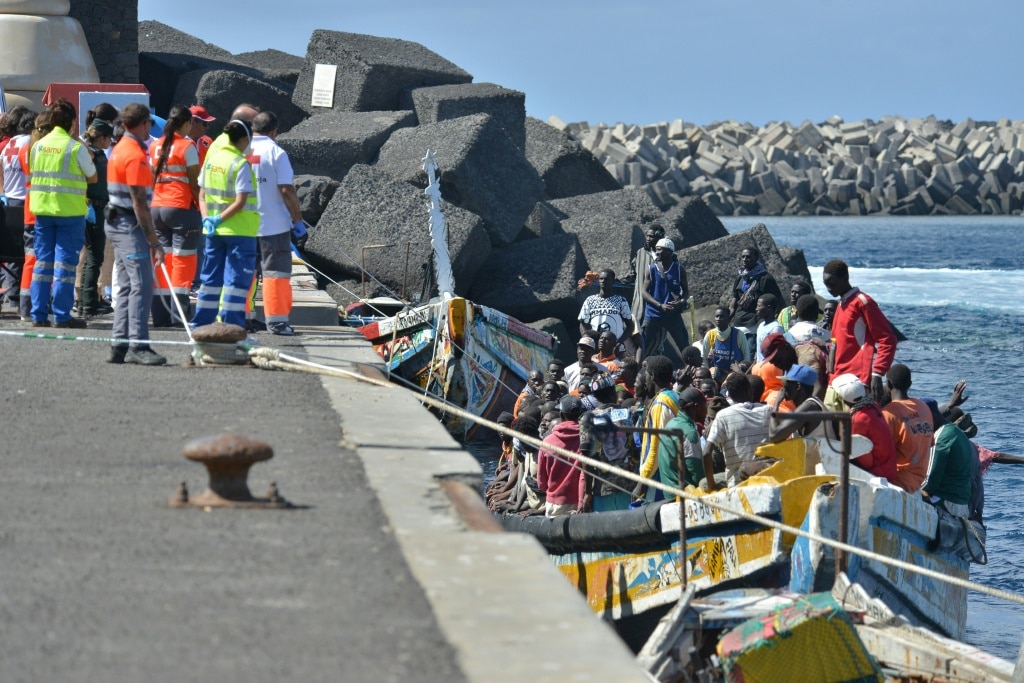
    On Sunday, 94 people from 19 different nationalities were evacuated from the ship, which carries a total of nearly 150 passengers and crew spanning 23 nationalities. Spanish Health Minister Monica Garcia confirmed that all passengers who disembarked on Sunday were asymptomatic and passed a final medical screening before leaving the vessel. AFP journalists on the ground observed evacuees, clad in blue protective medical suits, disembarking at Granadilla de Abona’s industrial port before being transported via Spanish military buses in a convoy to Tenerife South Airport for repatriation flights.

    Evacuation operations were scheduled to conclude by Monday, after which the ship will refuel and depart for the Netherlands with roughly 30 remaining crew members that evening. Adverse weather forecast for later Monday forced authorities to accelerate the repatriation timeline to avoid endangering the operation.

    Even with pre-departure screenings in place, multiple countries have reported cases among evacuees. Shortly after the first evacuations began, French Prime Minister Sebastien Lecornu announced on social platform X that one of five French evacuees returning to Paris showed active hantavirus symptoms, and all five were placed into immediate strict isolation. Late Sunday, U.S. health authorities confirmed the positive mild PCR test result for one American passenger, noting a second American passenger has mild symptoms.

    By Sunday evening, repatriation flights had already carried groups of passengers to dozens of countries across the globe. A flight carrying dozens of passengers of multiple nationalities landed in the Netherlands, while other flights departed for Canada, Turkey, the United Kingdom, Ireland, and the U.S., among other destinations. A plane carrying 20 UK passengers landed in Manchester Sunday, with all passengers transferred to a Liverpool-area hospital for testing and 72 hours of quarantine. Greece’s health ministry confirmed a Greek male evacuee will complete a 45-day mandatory quarantine in an Athens hospital, while 14 Spanish citizens will isolate at a military hospital in Madrid.

    The World Health Organization has recommended a 42-day quarantine period and active daily symptom monitoring for all evacuees, per Maria Van Kerkhove, the WHO’s director of epidemic and pandemic preparedness and prevention. However, the U.S. has adopted a more flexible approach: acting CDC Director Jay Bhattacharya noted that the 17 American passengers on board would not be required to quarantine at Nebraska’s specialized medical center by default. Instead, passengers will be able to complete isolation at home based on individual risk assessment, as long as they do not put other people at risk during travel. WHO Director-General Tedros Adhanom Ghebreyesus, who was on Tenerife observing the evacuation operation, warned that this U.S. policy carries potential public health risks. A group of American passengers was expected to land in Omaha, Nebraska early Monday local time.

    Investigations into the origin of the outbreak are still ongoing. The WHO believes the initial infection occurred before the cruise departed Argentina, with subsequent spread between passengers on the cramped vessel. However, Argentine provincial health official Juan Petrina pushed back on this narrative, arguing that based on the virus’ multi-week incubation period and other evidence, the Dutch patient linked to the initial outbreak had an almost zero chance of contracting the virus in Ushuaia. Health authorities across multiple nations are currently tracking all passengers who have already disembarked the vessel, as well as any close contacts that may have been exposed to the virus.

  • Federal budget to get major windfall from high prices hitting Australian households

    Federal budget to get major windfall from high prices hitting Australian households

    Ahead of next week’s highly anticipated Australian federal budget, new analysis from Oxford Economics Australia has projected a far stronger fiscal position than earlier forecasts, driven by sky-high commodity prices and persistent inflation that are simultaneously squeezing household budgets across the country.

    The independent research firm estimates the federal budget for the current financial year will come in $11.4 billion ahead of previous projections, with cumulative upgrades to the bottom line reaching $71 billion over the next four years, all tied to the recent global surge in energy and raw material costs. Harry Murphy Cruise, Oxford Economics Australia’s head of economic research and global trade, explained that the cost-of-living crisis battering household budgets is delivering an unexpected short-term boost to national government coffers.

    “All of the pressures that are hurting household bottom lines actually work in the federal budget’s favor in many respects,” Murphy Cruise told NewsWire. “Higher inflation and elevated commodity prices both push up total tax revenue, which is why we’re seeing such a large improvement to this year’s budget balance.”

    Much of this unexpected windfall traces back to the volatility in global oil markets triggered by escalating Middle East tensions between the U.S. and Iran that began in late February. Brent crude prices climbed from roughly $56 USD per barrel in January to a temporary peak of $120 USD, before settling around $100 USD in recent weeks. For every $10 USD rise in oil prices, Australian motorists pay an extra 10 cents per liter at the fuel pump, which has directly driven up overall inflation: the national consumer price index jumped to 4.6% in March, up from 3.4% in February.

    Beyond oil, key export commodity iron ore has also traded well above forecast levels this year. The higher commodity prices lift federal revenue through three key channels: increased royalty payments to the government, higher corporate profit tax from mining firms, and increased consumption tax and GST revenue from higher overall prices for goods and services across the economy. As of May 8, Australian gross national debt stood at $964.2 billion, with net debt (calculated as gross debt minus government cash holdings, investments and loans) at $587.5 billion according to the most recent Mid-Year Economic and Fiscal Outlook. Even with the massive projected upgrades to the budget, Oxford Economics notes no consistent surpluses are expected over the next four years, and the revenue boost is only a temporary gain rather than a long-term improvement to the nation’s fiscal position.

    The short-term fiscal gain comes at a steep cost for broader economic growth, new projections from the Reserve Bank of Australia (RBA) show. The central bank has downgraded its 2026 GDP growth forecast by 0.5 percentage points to just 1.3%, and lifted its 2024 headline inflation projection to 4% from the earlier 3.6% forecast. RBA governor Michele Bullock warned that the ongoing conflict in the Middle East has created significant new uncertainty for the Australian and global economies, with two adverse scenarios modeled by the RBA showing just how severe the fallout could be.

    In both downside scenarios, prolonged tensions keep the critical Strait of Hormuz — through which roughly 20% of global oil supplies pass — closed, triggering a sharp near-term spike in global energy prices. Under these conditions, underlying inflation could peak as high as 5.2%, and the unemployment rate would rise to 5.1% as economic activity stalls. Even in these worst-case scenarios, the RBA does not project a technical recession, and still expects inflation to return to its 2-3% target range by June 2027. Bullock emphasized that the commodity price shock stemming from the conflict has worsened the already difficult trade-off between taming inflation and supporting growth. “Developments in the Middle East remain highly uncertain, but under a wide range of possible scenarios the conflict adds to global and domestic inflation,” Bullock said. “The shock to oil and some other commodity prices has worsened the trade-off between inflation and growth.”

    With the budget set to deliver better-than-expected revenues, leading economists are urging the federal government to avoid broad-based cash handouts to ease household cost-of-living pressures, warning that excessive spending would only add to inflation and force the RBA to keep interest rates higher for longer. AMP chief economist Shane Oliver is calling for deep, targeted spending cuts to get the budget back on track, capping any new cost-of-living relief at $5 billion, or roughly 0.2% of national GDP. Oliver argues the government needs to find $100 billion in cumulative savings over the next four years to bring government spending back to its long-term average of around 25% of GDP, down from the current 26.9%.

    “My wishlist is that any stimulus from the government is limited, well-targeted towards businesses and households that need it most, and also temporary and modest,” Oliver said. “If you pump too much stimulus in, you’re just going to make the Reserve Bank’s inflation challenge worse and lead to even higher interest rates. It might sound harsh, but the problem is all this extra government spending has increased aggregate demand in the economy, crowded out home construction, business investment and consumer spending, and created an inflation problem that didn’t need to exist.”

  • A teacher has been jailed following a knife attack on a principal

    A teacher has been jailed following a knife attack on a principal

    A violent, unprovoked attack that shook a suburban Australian school has concluded with a fixed prison sentence for the perpetrator, as courts praise the quick-thinking bravery of staff who stepped in to stop further harm.

    On Monday, 37-year-old Kim Ramchen, a former information technology teacher at Melbourne’s Keysborough Secondary College, was handed a 15-month prison term by the Melbourne Magistrates Court for a coordinated knife attack on the school’s principal, Aaron Sykes, that occurred late last year. Ramchen had already entered a guilty plea to three criminal charges: intentionally causing bodily injury, assault with a dangerous weapon, and unlawful assault.

    The details of the December 2 incident paint a disturbing picture of violence within a space meant to be safe for students and staff alike. Shortly after 3 p.m., not long after Ramchen had finished marking attendance in his classroom, he left his teaching space and walked to the administration wing’s shared kitchen, where he grabbed a four-inch kitchen knife. He then proceeded directly to Sykes’ office, entered the space, and immediately pointed the blade at his superior. When Sykes asked Ramchen what was happening, the former teacher launched his first attack.

    Prosecutor J.J. Jassar told the court that screams for help from the office drew nearby staff to the scene, who arrived to find Ramchen standing over the injured principal, continuing to swing the knife. After colleagues pulled Ramchen away from Sykes, he left the office – only to return minutes later with a larger chef’s knife he had also retrieved from the school kitchen, launching a second assault on the downed principal.

    It was only the quick intervention and courageous action of assistant principal Matthew Sloan and a team of other staff members that allowed them to restrain Ramchen until responding law enforcement officers arrived on site. Deputy Chief Magistrate Tim Bourke, who delivered the sentence, noted that the quick, brave action from Sloan prevented what could have been a far deadlier, more devastating outcome for Sykes.

    When questioned by police after his arrest, Ramchen told investigators he had “mentally snapped” before the attack, saying “my blood just went to my head and I just became incredibly angry and emotional.” Sykes survived the attack but sustained multiple serious injuries: a two-centimeter laceration on his neck, cuts to his left cheek and right forearm, and dozens of additional abrasions and bruises across his body.

    In his ruling, Bourke emphasized that the attack was completely unwarranted, taking place in a school – a location that must remain a safe space for all students, employees and community members. “The offending has occurred in what should only ever be a safe place not just for students, but co-workers and the broader school community,” Bourke said. “You have attacked the school principal twice, and a work colleague who bravely came to his aid.”

    Bourke did note that he accounted for several mitigating circumstances when handing down the sentence, including Ramchen’s confirmed diagnoses of autism spectrum disorder, recurrent depressive disorder with anxious distress, documented substance abuse issues, and the defendant’s early guilty plea that avoided a lengthy trial.

    Along with the 15-month total prison sentence, Bourke set a non-parole period of eight months and 14 days. Factoring in the 159 days Ramchen has already spent in pre-sentence detention, he will become eligible for parole in approximately three months.

  • ISIS-linked mother and daughter Kawsar Ahmad and Zeinab Ahmad reveal new bail effort on slavery charges

    ISIS-linked mother and daughter Kawsar Ahmad and Zeinab Ahmad reveal new bail effort on slavery charges

    In a surprising development in an Australian human trafficking and slavery case, a mother-daughter pair facing multiple slavery and crimes against humanity charges have withdrawn their immediate push for bail, just days after their arrest on arrival back in Australia from a Syrian refugee camp.

    Fifty-four-year-old Kawsar Ahmad and her 31-year-old daughter Zeinab Ahmad appeared before Melbourne Magistrates Court on Monday afternoon, four days after federal officers took them into custody at Melbourne Airport last Thursday. The two Australian citizens are among 13 people – four women and nine children – repatriated to Australia from the Al Roj camp in northern Syria, where they had been held by Kurdish forces since March 2019. The camp holds relatives of people alleged to be affiliated with the ISIS terror group.

    Court documents detail that the pair traveled to Syria originally in 2014. Prosecutors allege that in June 2017, Kawsar Ahmad aided in the purchase of a 20-something-year-old Yazidi woman for $10,000 USD. Between that purchase and November 2018, both women allegedly held the victim in their home in Syria’s Deir ez-Zor province, exercising full ownership over her in conditions that meet legal definitions of slavery.

    Kawsar Ahmad, who also goes by the name Kawsar Abbas, faces four separate counts covering enslavement, holding a person as a slave, exploiting a slave, and participating in slave trading – all classified as crimes against humanity under Australian law. Zeinab Ahmad, alternatively listed as Zeinab Ahmed, faces two counts of enslavement and exploitation of a slave. Arrest warrants for the two women were first issued back on February 17 this year, after authorities confirmed they planned to return to Australia after years detained overseas.

    The charges outline that the alleged conduct was carried out knowingly as part of a systematic, widespread attack targeting the civilian population in the war-torn region. Prior to Monday’s hearing, court observers had confirmed the pair’s legal team was preparing immediate bail applications to secure their release ahead of trial. But in a sudden shift, Chief Magistrate Lisa Hannan told the court the defendants had withdrawn their immediate applications, instead requesting that bail hearings be scheduled at a later date next month.

    After a short adjournment, Hannan set Zeinab Ahmad’s bail hearing for June 5, and Kawsar Ahmad’s for June 16. The two defendants were supported in court by Kawsar Ahmad’s brother, Abraham Abbas, who attended in a show of family support. The repatriation of the group from Syria already sparked unrest last week, when supporters of the returning group clashed with journalists covering the arrival at Melbourne Airport.

    Under Australian law, the media is prohibited from publicly naming the Yazidi woman who is the alleged primary victim in the case. Hannan has also issued an interim suppression order blocking the identification of a second woman who will serve as a witness for the prosecution in the trial. Prosecutors confirmed on Monday that they would file an application to have this second witness designated a “special witness” under Australia’s criminal procedure rules, which would extend the lifetime ban on any publication that could reveal her identity. The witness is alleged to have also been a victim of slavery-related offenses separate from the charges against Ahmad and her daughter, but will give testimony covering her interactions with the two accused. A preliminary hearing on the special witness designation is scheduled to take place in the same court on Tuesday.

  • Contractor accused of attack at Adelaide Hills school

    Contractor accused of attack at Adelaide Hills school

    A contract worker employed at a South Australian school has been formally charged with aggravated indecent assault against a student following an alleged incident in late April, and is scheduled to appear before a local court early next month. The accused, a 30-year-old man from Adelaide’s eastern suburbs, was taken into custody on the same day that law enforcement responded to reports of the assault, according to official statements from South Australia Police.

    The reported attack unfolded on Monday, April 27, at a school located in the Adelaide Hills region. Authorities have not released the name or exact location of the campus involved in the case to protect the privacy of the victim and the broader school community. After completing initial investigative work, police took the suspect into custody and formally charged him with the aggravated offense. He has since been released on bail, with his first court appearance set for July 2 at the Mount Barker Magistrates Court.

    South Australia Police is now calling on members of the public who may hold additional information connected to the incident to come forward to assist with the ongoing investigation. Anyone with relevant details can reach out to Crime Stoppers South Australia through the organization’s official website at www.crimestopperssa.com.au, or by placing a free call to 1800 333 000, and should reference case number 111502 when submitting information.

  • Man accused of Bunnings dog attack in ‘irritating’ court no-show

    Man accused of Bunnings dog attack in ‘irritating’ court no-show

    A new development has unfolded in a widely shared animal cruelty case out of South Australia, where an arrest warrant is now active for a man accused of kicking a tethered dog in a suburban Bunnings Warehouse carpark, after he failed to appear for a scheduled court hearing.

    The incident first made headlines across Australia on March 1, when a security camera clip captured a man striking a four-year-old Staffordshire bull terrier twice outside the Parafield Bunnings location, north of Adelaide. The video spread rapidly across social media, sparking widespread public anger over the treatment of the defenseless animal, which was tied to a ute parked in the lot at the time.

    Authorities identified 48-year-old Nathan Bradwell of Smithfield as the suspect, and he was formally charged with ill-treatment of an animal in violation of South Australia’s Animal Welfare Act. Bradwell made his first court appearance on April 14, where he told reporters he was seeking legal counsel and planned to argue he acted in self-defense, claiming he was trying to move the dog away from his vehicle. He kept his face hidden under a jacket while speaking to the press outside the courtroom following that initial hearing.

    Bradwell was scheduled to make his second appearance in the case at the Elizabeth Magistrates Court on Monday, but he never arrived. After noting Bradwell’s absence, Magistrate David White authorized the issuance of an arrest warrant to compel the suspect to attend a future hearing. Court officials confirmed that if Bradwell is convicted on the current charge, he could face a maximum custodial sentence of two years behind bars. The entire hearing lasted just over one minute.

    Attending the hearing in Bradwell’s place were the dog’s current owners, Hayden Palkovics and Tyler Wright, along with the animal’s previous owner, who is a friend of the couple. In comments to reporters after the hearing, Wright expressed deep frustration and disappointment over Bradwell’s no-show, an action she said has left the pair unsettled.

    “It is frustrating, annoying and irritating. I find it laughable that he did not show up,” Wright said, adding that the absence left the couple “really sad” that the case has been dragged out further. On a more positive note, she confirmed the dog that was attacked has fully recovered and is back to her normal, friendly temperament.

    The case will be called back to court at a future date once Bradwell is taken into custody on the active arrest warrant.

  • Under-threat UK PM Starmer to attempt reset after disastrous polls

    Under-threat UK PM Starmer to attempt reset after disastrous polls

    British Prime Minister Keir Starmer is facing the most serious threat to his leadership since taking office less than two years ago, after a catastrophic showing in last week’s local and regional elections that has left his Labour Party reeling and open rebellion brewing among its ranks. On Monday, the 63-year-old prime minister is set to attempt a desperately needed political reset, addressing a public that has grown increasingly frustrated with incremental policy progress, with plans to announce a bolder policy agenda focused on three core areas: boosting sluggish national economic growth, forging closer ties with the European Union, and accelerating progress on energy policy.

    The scale of Labour’s electoral defeat last week has sent shockwaves through the party. For the first time in the 27-year history of Cardiff’s devolved parliament, Labour lost control of the Welsh government, a historic upset that signaled deep voter dissatisfaction with the party’s performance. Across England, Labour shed nearly 1,500 local council seats, while the right-wing, anti-immigration Reform UK party led by Brexit figurehead Nigel Farage exploded from fewer than 100 seats to more than 1,400, a surge that has reshaped the UK’s political landscape. In Scotland, SNP leader John Swinney seized on the results to call for a new independence referendum, framing the move as a safeguard against a potential future Reform UK national government.

    The poor performance comes just 20 months after Starmer led Labour to a landslide general election victory, ending 14 consecutive years of Conservative rule and raising widespread hopes for a new era of governance. Since taking office, however, Starmer’s tenure has been marked by a string of policy missteps and growing public discontent. Most recently, he has been engulfed in controversy over the short-lived appointment of Peter Mandelson as UK ambassador to Washington, who was quickly sacked after new revelations emerged about his past ties to convicted sex offender Jeffrey Epstein. Beyond the scandal, Starmer has failed to deliver on promises of faster economic growth, leaving British households still grappling with the ongoing fallout from a years-long cost-of-living crisis that has eroded disposable incomes and pushed up housing and energy costs. He has, however, earned cross-partisan praise for his firm stance against former U.S. President Donald Trump’s policy on Iran, a rare bright spot in an otherwise fraught term so far.

    In the aftermath of the election drubbing, multiple Labour MPs have publicly called for Starmer to step down, breaking ranks to challenge his grip on the party leadership. Former junior minister Catherine West has issued an ultimatum: if no sitting cabinet member launches a challenge by Monday, she will initiate the process to trigger a leadership contest herself, a move that would open the door for other dissident MPs to join the challenge. Former Starmer loyalist Josh Simons became one of the most high-profile defectors from the prime minister’s camp, saying that Starmer has “lost the country” and must resign. Veteran Labour MP Clive Betts added to the pressure, arguing that the party must find a “proper and constructive” path to install a new leader in the coming months.

    Under Labour Party rules, any challenger must secure the public support of 81 sitting Labour MPs – 20 percent of the party’s parliamentary caucus – to trigger a formal leadership contest. For weeks before the election, British media was rife with speculation that top party figures including former deputy prime minister Angela Rayner and Health Secretary Wes Streeting would launch challenges if the results went poorly. Neither has yet announced a bid, and both lack the unified support within the party needed to hit the nomination threshold. Rayner stopped short of calling for Starmer’s resignation on Sunday, but issued a sharp rebuke of his current approach, writing on social media platform X that “this may be our last chance… the current strategy isn’t working and it needs to change.”

    Other popular potential contenders, such as Greater Manchester Mayor Andy Burnham, are ineligible to launch a bid because they do not hold a parliamentary seat. That has sparked speculation that the party’s anti-Starmer camp could rally behind a so-called unity candidate, such as Defence Secretary John Healey or Armed Forces Minister Al Carns. The absence of a clear, consensus challenger means Starmer still has a path to hold onto power, and the prime minister himself has repeatedly rejected calls to step aside. When asked by the *Sunday Mirror* whether he intended to lead Labour into the next general election (expected by 2029 at the latest) and serve a full five-year term, Starmer answered plainly: “Yes, I will.” He reaffirmed his long-stated commitment to delivering a “decade of national renewal” and said he intended to see that project through.

    The potential of a leadership challenge carries major risks for Labour, as it would almost certainly spark a damaging period of internal infighting, with MPs from the party’s left and right wings jockeying to advance their preferred candidates or shore up support for the incumbent. Many in the party are also wary of triggering a leadership change so soon after the chaotic 2022 Conservative leadership crisis, which saw the party go through three prime ministers in just four months, a period of instability that remains fresh in the minds of voters and MPs alike. For now, the country waits to see whether Starmer’s planned reset can defuse the rebellion within his own party and win back disillusioned voters ahead of the next national election.

  • Is risk-averse Hollywood running scared of Cannes critics?

    Is risk-averse Hollywood running scared of Cannes critics?

    For more than a decade, the Cannes Film Festival’s iconic red carpet has been a launching pad for Hollywood’s biggest franchises, from *Star Wars* and *Indiana Jones* to *Top Gun*. But as the 2026 edition of the world’s most famous cinema gathering prepares to kick off this Tuesday, a striking absence has sparked widespread industry debate: not a single major Hollywood blockbuster is featured on the official lineup, leaving top studio executives unaccounted for and industry observers questioning what has driven American moviemaking’s most high-profile players to ghost the event.

    For decades, Cannes has built its programming around a delicate balance: boundary-pushing, often challenging independent art house cinema forms the core of its competitive lineup, while big-budget Hollywood blockbusters and their A-list leading stars bring global media attention, mass audience interest, and glamour to the Croisette. Megastars from Tom Cruise to Harrison Ford have turned out to walk the same red carpets as revered auteur directors and little-known indie casts, all in a collective effort to prop up the global film industry that has long navigated financial and structural uncertainty.

    When festival director Thierry Fremaux—who has centered American cinema as a priority since taking the helm 25 years ago—unveiled the 2026 lineup in April, he was forced to directly address the gap left by major studios. He noted that independent American filmmaking, not tied to the big Los Angeles studio system, still has a strong presence at this year’s event: two U.S. independent features will compete for the Palme d’Or, including James Gray’s *Paper Tiger* starring Adam Driver and Scarlett Johansson, and Ira Sachs’ *The Man I Love* featuring Rami Malek. Even so, all of Hollywood’s biggest power players—Universal, Disney, Warner Bros., Sony, Paramount, and even streaming giants Netflix and Amazon—have opted to skip the 2026 festival entirely.

    This blockbuster drought is not unique to Cannes this year. February’s Berlin International Film Festival faced the same gap, with no major American tentpole films on its schedule. Berlin director Tricia Tuttle has framed the absence not as a side effect of political estrangement between the U.S. and Europe under the Trump administration, but rather as a product of shrinking risk tolerance and mounting commercial pressures across the film industry.

    “There’s a nervousness in a very difficult marketplace: nervousness about reviews coming out long before release and about controlling the way films of that scale are launched because there’s so much at stake,” Tuttle explained in a January interview with *The Hollywood Reporter*. She pointed directly to the 2024 Venice Film Festival premiere of *Joker: Folie a Deux* as a turning point: the film received scathing critical reviews ahead of its theatrical release, and ultimately flopped at the global box office. “We’ve seen more reticence since,” Tuttle added.

    In an earlier era of more consistent box office profits and steady studio output, a single commercial flop could be absorbed without major upheaval. Today, however, with studios hyper-focused on cutting unnecessary costs and protecting multi-hundred-million-dollar investments, a bad early critical reception is seen as an unacceptable risk that can sink a film before it even reaches wide release.

    Los Angeles-based film critic and long-time Cannes attendee J. Sperling Reich echoed that analysis, noting that major studios are producing fewer films that fit the festival’s timeline, and increasingly prefer to control their own promotional rollouts rather than cede that control to a festival schedule. “They’re essentially flying in talent, trying to figure out a publicity narrative… two, three, sometimes four months early (before launch), and then they expose that film to the world’s toughest critics,” Reich told AFP. “If it doesn’t fly in Cannes, it’s going to be tough to recover from that.”

    Recent high-profile blockbusters, including the Michael Jackson biopic *Michael* and *The Devil Wears Prada 2*, have already forgone festival premieres in favor of tightly controlled, influencer-driven promotional events tailored to social media. While Reich noted that major anticipated films like Christopher Nolan’s upcoming ancient Greek action epic *Odyssey* and Steven Spielberg’s sci-fi thriller *Disclosure Day* would once have been considered shoo-ins for a Cannes premiere, those projects do not need the exposure the festival provides. “But the reality is those films don’t need Cannes,” he said.

    Not all industry analysts believe the 2026 absence signals a permanent break between Hollywood and the Cannes Film Festival. Observers point out that just six months after the *Joker: Folie a Deux* flop, the 2025 Venice Film Festival still hosted a packed slate of big-budget American films, suggesting the trend is not permanent.

    Eric Marti, head of box office analytics firm Comscore’s French division, noted that Hollywood has always taken a pragmatic, transactional approach to participating in Cannes. “It’s a tremendous showcase, as it’s one of the most watched events, but they also have a very well-oiled promotional machine. If the Cannes dates and their launches line up, the two come together,” he explained.

    Marti added that Hollywood is not entirely absent from this year’s festival: organizers have added a special 25th-anniversary screening of the Universal-owned *Fast and Furious* franchise, with original stars Vin Diesel, Michelle Rodriguez, and Jordana Brewster all set to attend the event. For many in the industry, the 2026 blockbuster gap is just a temporary pause, not a permanent split: Hollywood may be sitting out this year, but it is widely expected to return to the Croisette in 2027.