A high-stakes defamation trial has commenced in a Sydney court, pitching Hollywood star Rebel Wilson against rising Australian actress Charlotte MacInnes, the lead of Wilson’s recently released musical comedy *The Deb*. At the center of the legal clash are a series of Instagram posts Wilson published in 2024 and 2025, which MacInnes’ legal team argues are baseless, malicious lies that have permanently damaged her professional reputation.\n\nThe events under scrutiny trace back to September 2023, when MacInnes and *The Deb* producer Amanda Ghost spent an afternoon at Sydney’s iconic Bondi Beach. After Ghost experienced a sudden allergic reaction to the cold ocean water — a condition called cold urticaria that triggered painful red welts and uncontrollable shaking — the pair retreated to Ghost’s nearby beachfront apartment. MacInnes ran a hot bath to help Ghost warm up, with both women remaining in their swimsuits while sharing the oversized tub, the court heard. Ghost’s assistant even stayed in the bathroom preparing hot drinks for part of the time, and the two never made physical contact, according to MacInnes’ senior counsel Sue Chrysanthou.\n\nWilson has claimed that MacInnes originally told her she felt sexually uncomfortable following the shared bath, filed an implicit complaint, then later retracted the claim in exchange for a plum lead theater role and a major record deal. But MacInnes’ legal team refutes every part of this narrative, arguing the actress never made any complaint of sexual harassment at all. Instead, they say Wilson twisted a passing comment about the situation being “bizarre” into a false harassment narrative to gain leverage in a separate dispute with *The Deb* producers over budget and contract terms. The defamation claims, Chrysanthou told the court, are nothing more than “completely false, fantasy, malicious concoctions.”\n\nOpening arguments on the first day of the trial included the presentation of private text exchanges between Wilson, Ghost and MacInnes, as well as email chains detailing the competing accounts of the 2023 incident. Court documents show Wilson even acknowledged in an early text to Ghost that “Charlotte says all good. She just meant ‘it was a bizarre situation’ not that she personally felt uncomfortable.” The three women even attended a Boy George concert together the same night the text was sent, the court confirmed.\n\nWilson’s legal team has pushed back against MacInnes’ claims, arguing that the young actress deliberately lied about ever making an initial complaint to win professional favor from Ghost. Since the incident, Wilson’s lawyer Dauid Sibtain noted, MacInnes has landed the lead role in a Boston production of *Gatsby* and secured a record deal, with new music expected to release imminently. “She’s suffered no harm to her reputation, indeed, her career has progressed,” Sibtain told the court, adding that MacInnes’ changed story was a calculated move to advance her career by aligning with Ghost’s version of events.\n\nFor MacInnes, a 2021 graduate of a Western Australian acting academy who rose to prominence through the stage version of *The Deb* before landing the film role, the allegations have destroyed her core reputation for honesty and integrity, and she is seeking unspecified damages in the case. *The Deb* premiered in Australian theaters earlier this month, marking Wilson’s latest project following her breakout roles in *Pitch Perfect* and *Bridesmaids*. This trial is not the only legal trouble Wilson is currently navigating: she is already involved in a separate contract dispute with *The Deb* producers in an Australian court, and faces another defamation lawsuit from the same producers in the U.S., where she has also filed a countersuit. The Sydney trial, which opened Monday, is scheduled to run for nine days as the court hears full arguments from both sides.
标签: Oceania
大洋洲
-

Iran says no plan for US peace talks
# Iran Rejects New US Peace Talks Amid Escalating Regional Tensions
Fresh uncertainty has engulfed Middle East diplomatic efforts to end a weeks-long regional war after Iran publicly ruled out participating in a planned new round of peace negotiations with the United States, scheduled to convene in Islamabad, Pakistan, this week. The breakdown of momentum comes amid a flurry of mutual accusations of ceasefire violations, rising military tensions in the strategic Strait of Hormuz, and new disruptions to global energy markets that have reignited fears of a full resumption of hostilities.
Iranian foreign ministry spokesman Esmaeil Baqaei confirmed the position on Monday, stating bluntly: “We have no plans for the next round of negotiation, and no decision has been made in this regard.” Baqaei argued that Washington’s recent actions contradict its public claims of commitment to diplomacy, pointing to a US naval blockade of Iranian ports and the early Monday seizure of the Iranian cargo ship *Touska* as clear breaches of the two-week truce that is set to expire overnight Tuesday.
US President Donald Trump, who first announced plans to send a US negotiating delegation to Pakistan, has framed the reverse accusation. Trump claims Iran has effectively choked off the Strait of Hormuz, a critical global energy chokepoint through which roughly 20% of the world’s oil supplies pass, in a deliberate violation of the ceasefire. In a Sunday social media statement, Trump defended the seizure of *Touska*, saying the vessel had attempted to break the US blockade. He added that a US destroyer damaged the ship’s engine room before Marines boarded and seized control, and warned Iran that Washington is offering a “very fair and reasonable DEAL” that Tehran should accept, while repeating threats to strike Iran’s energy infrastructure if no agreement is reached.
Iran has vowed to retaliate for what it calls “armed piracy” by the US. Iran’s state-owned Tasnim news agency reported that Tehran has already deployed drones toward US naval vessels operating near the seized ship, while the Islamic Revolutionary Guard Corps issued a stark warning that any commercial vessel attempting to transit the Strait of Hormuz without Iranian permission would be classified as enemy cooperation and targeted. The mutual threats have thrown into doubt the entire diplomatic push to end the conflict, which began on February 28 when US-Israeli joint strikes killed Iran’s longtime supreme leader Ali Khamenei.
The unfolding crisis has already roiled global energy markets. After Iran briefly reopened the strait last Friday to honor the new Lebanon ceasefire, it reversed course and closed the waterway again over the weekend. On Monday, international oil prices jumped sharply on fears that hostilities will resume once the current truce expires, extending months of market volatility tied to the regional conflict.
Even as talks are now set to not happen, Pakistani authorities have heavily bolstered security in Islamabad and neighboring Rawalpindi, announcing widespread road closures and traffic restrictions to prepare for the expected US delegation. A White House official confirmed that the delegation, which will still travel to Islamabad, will be led by Vice President JD Vance — Trump originally ruled out his own attendance citing security concerns. Vance will be joined by Middle East envoy Steve Witkoff and Trump’s son-in-law Jared Kushner, the official confirmed.
Beyond the immediate clash over the ceasefire and ship seizure, multiple core sticking points continue to divide the two sides. One major point of contention is the status of the Lebanese ceasefire, which went into effect Friday between Israel and Hezbollah, the Iranian-backed militant group that entered the war in support of Tehran. Iran argues that Israeli failures to fully implement the truce, including ongoing military operations in southern Lebanon, constitute a separate violation of the broader regional truce.
On Monday, Israel’s military warned Lebanese civilians against returning to dozens of southern Lebanese villages, claiming Hezbollah’s presence in the area violates the ceasefire. Thousands of displaced Lebanese residents have already begun returning to their homes since the truce took effect. Israeli Defense Minister Israel Katz reiterated Sunday that the Israeli military will use “full force” to respond to any threats in Lebanon during the ceasefire, and vowed to demolish structures allegedly used by Hezbollah — Lebanese state media has confirmed demolition operations are already underway in the region.
Another irreconcilable sticking point in any potential future talks is the fate of Iran’s 440-kilogram stockpile of enriched uranium. Trump claimed last Friday that Iran had agreed to transfer the entire stockpile to US control, saying “We’re going to get it by going in with Iran, with lots of excavators.” But Baqaei refuted that claim entirely Monday, saying the issue was never raised in initial talks in Islamabad earlier this month, and that the stockpile — which Iran says is protected from airstrikes after being buried following US bombing in June 2025’s 12-day war — will “not be transferred anywhere.” “It was never raised as an option for us,” he added.
Trump has faced growing domestic and international pressure to find an exit ramp from the conflict since Iran first moved to close the Strait of Hormuz. But the escalation of US pressure via the blockade and ship seizure has only prompted renewed threats from Tehran, rather than pushing Iran back to the negotiating table as the Trump administration had hoped.
-

Pope Leo visits Angola’s diamond-rich northeast
Pope Leo XIV began the eighth day of his ambitious 11-day, four-nation African pilgrimage on Monday, traveling to Angola’s remote, diamond-abundant northeastern region — the third stop on his journey that has centered on addressing systemic inequality and extractive harm across the continent.
Departing from Angola’s capital Luanda, the pontiff flew 800 kilometers east to Saurimo, the capital of historically marginalized Lunda Sul province. This region sits adjacent to Catoca, Angola’s largest diamond mining operation, which accounts for roughly 75% of the country’s total diamond output.
Angola holds a position as one of Africa’s leading producers of both crude oil and diamonds, yet widespread prosperity remains out of reach for much of its population. Official World Bank data indicates that nearly one-third of Angolans live below the international poverty line. Lunda Sul exemplifies this gap: despite sitting atop the country’s most valuable mineral reserves, the province struggles with pervasive poverty, decades of underinvestment in public infrastructure, and severe environmental degradation linked to unregulated mining activity.
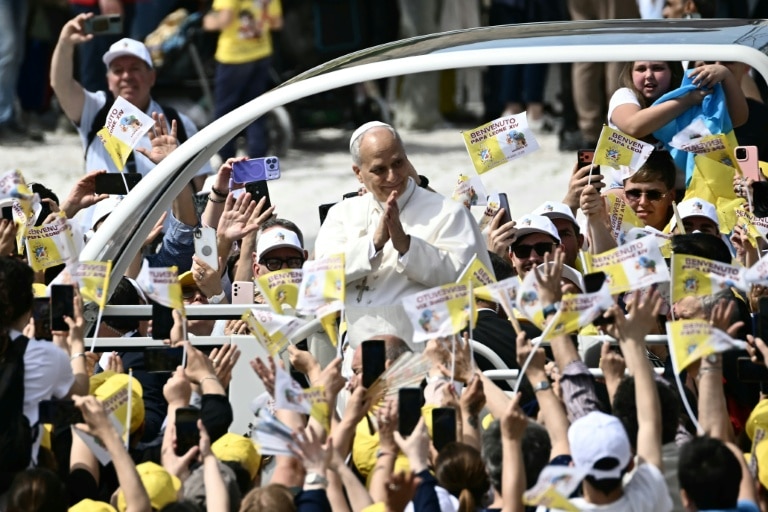
The 70-year-old pontiff’s first scheduled activity in Saurimo was an open-air mass held mid-morning, which organizers projected would draw an estimated 30,000 worshippers from across the surrounding region. Following the service, Leo is set to visit a local residential facility for elderly residents, a stop designed to highlight the Catholic Church’s outreach to communities underserved by limited public services in the province.
Since arriving in Angola on Saturday, the pope has doubled down on a core theme of his African tour: condemning the damaging impacts of unchecked natural resource extraction. During his opening address to senior government officials, including Angolan President Joao Lourenco, Leo questioned the human and ecological cost of prioritizing profit over community well-being. “How much suffering, how many deaths, how many social and environmental disasters are caused by this logic of exploitation,” he told the assembled audience.
On Sunday, one day before his trip to Lunda Sul, Leo led a mass in Luanda attended by more than 100,000 people. There, he urged Angolans to move beyond the deep divisions left by the country’s decades-long civil war, calling for collective action to build a more equitable future. He specifically called for systemic change to root out graft, saying he hoped “the scourge of corruption will be healed by a new culture of justice and sharing.”
Later on Monday, the pontiff is scheduled to meet with local Catholic clergy to discuss pressing challenges facing the Church in Angola, including limited institutional resources and the rapid growth of evangelical Protestantism across the country.
Leo XIV is only the third sitting pope to visit Angola, following trips by John Paul II in 1992 and Benedict XVI in 2009. The country only emerged from a brutal 27-year civil war in the 2000s, a conflict that broke out immediately after it gained independence from Portugal in 1975 and left deep economic and social scars that persist to this day.
The pope’s 18,000-kilometer African tour launched one week ago in Algeria, continued with a stop in Cameroon, and will conclude with a three-day visit to Equatorial Guinea from April 21 to 23.
-

Oil price jump fails to lift Australian sharemarket as Middle East conflict hits banks
Escalating geopolitical tensions between the United States and Iran, sparked by the seizure of an Iranian vessel near the strategically critical Strait of Hormuz, sent global oil prices jumping by as much as 8% on Monday — but the move failed to lift Australian equities, which closed barely changed in a choppy session of mixed sector performance.
The benchmark S&P/ASX 200 eked out a marginal 6.4-point gain, or 0.07%, to settle at 8,953.30, while the broader All Ordinaries index added an even smaller 5.4 points, equivalent to 0.06%, to end the day at 9,174.10. The Australian dollar also posted a minor uptick, rising 0.24% to buy 71.51 U.S. cents by market close.
Across the benchmark’s 11 sectors, the day split evenly: six finished in positive territory while five closed lower. The most counterintuitive movement came from the energy sector, which led the declines despite Monday’s dramatic surge in Brent Crude prices. The global oil benchmark climbed as high as 8% intraday before settling at $95.50 U.S. ($133.30 Australian) as investors priced in growing supply risk from the disrupted Strait of Hormuz, through which roughly 20% of global oil supplies transit daily.
Major Australian energy stocks posted steep losses: Woodside Energy fell 2.93% to $31.77, Santos dropped 1.31% to $7.55, and fuel retailer Ampol slid 3.19% to $31.88. Viva Energy was an even bigger laggard, plummeting 9.09% to $2.30 after resuming trading following a major fire at its Geelong refinery the previous week.
Losses across energy were largely offset by strong gains in consumer-facing stocks and most of the financial sector. Retail giant Wesfarmers, which owns brands including Bunnings and Kmart, led consumer discretionary gains with a 2.44% jump to $74.63. Electronics retailer JB Hi-Fi added 0.55% to $76.49, and furniture chain Harvey Norman gained 0.88% to $4.61.
Among the big four banks, three closed higher: Commonwealth Bank of Australia rose 1.08% to $180.15, Westpac added 0.73% to $40.02, and ANZ nudged up 0.03% to $37.93. The outlier was National Australia Bank, which tumbled 3.60% to $41.02 after the lender disclosed it was boosting provisions for bad debt ahead of its first-half results, citing rising risk from the ongoing Middle East conflict involving the U.S., Israel and Iran. The bank now forecasts total impairment costs of up to $706 million, up from a previous projection of $485 million before the escalation of regional tensions.
Another company caught in the crossfire of Middle East uncertainty was engineering firm Worley, which dropped 5.84% to $11.13 after warning that ongoing conflict would delay operational activities and contract awards, dragging down its full-year 2026 financial outlook.
The only major standout on the day was buy now, pay later provider Zip Co, which extended a Friday rally with a 7.73% gain to $2.51 on Monday. The surge followed a bullish quarterly update released Friday that showed third-quarter cash earnings before interest and tax jumped 41.5% year-over-year, driven primarily by robust revenue growth in the U.S. market. The stock had already rallied 13.66% on Friday.
Market analysts noted that overall trading sentiment remained muted as investors adopt a wait-and-see approach to evolving geopolitical developments. “Markets are in a holding position as they await more news out of the US and Iran conflict,” said Tony Sycamore, market analyst at IG. “Either the data will break or the blockade will break. When you talk about the data breaking, we aren’t at that point although Japan, New Zealand and the UK inflation will give an indication. We also have a ceasefire coming up and I don’t think anyone thinks the ceasefire won’t be extended.”
Additional uncertainty filtered through markets following conflicting reports around planned regional peace talks: U.S. officials confirmed Vice President JD Vance would join a diplomatic delegation traveling to Pakistan for talks, but Iranian state media has already indicated Tehran will not attend the negotiations, dashing early hopes of a near-term de-escalation of tensions.
-

War in the Middle East: latest developments
Less than two months after a new round of open conflict erupted across the Middle East, a cascade of interconnected developments has deepened instability, derailed planned diplomatic efforts, and sent global markets reeling this week. From violated ceasefire understandings on the Lebanon-Israel border to tit-for-tat maritime seizures in the Gulf of Oman, the region remains mired in rapidly shifting conflict that threatens to spill beyond its borders.
Along the tense Israel-Lebanon frontier, a fragile ceasefire that took effect last Friday has already come under significant strain. Thousands of Lebanese displaced by weeks of fighting had begun returning to their southern communities when the Israeli military issued a stark warning, barring civilians from returning to dozens of villages. The military claimed that Hezbollah militant activities in the area already violate the terms of the truce. Despite the ceasefire, Israel’s Defense Minister Israel Katz doubled down on the country’s stance, warning that the Israeli military would deploy “full force” against Hezbollah even during the truce if any threat to Israeli troops emerges. In a small sign of post-conflict recovery, Lebanon’s military has reopened a key damaged road and bridge between the southern cities of Nabatieh and Khardali. Meanwhile, a separate incident has sparked international outcry: the Israeli military confirmed that a viral social media video showing one of its soldiers destroying a crucified Jesus statue in southern Lebanon is authentic. In an official statement posted to X, the military said it views the incident with “great severity,” emphasizing that the soldier’s actions run entirely counter to the ethical values the force expects from all personnel.
In Iran, a wave of convictions and executions linked to alleged Israeli espionage continues, with two more men put to death at dawn this week. Iran’s judiciary affiliate Mizan Online confirmed that the death sentences for Mohammad Masoom-shahi and Hamed Validi were carried out, marking the latest in a growing string of such executions since open hostilities broke out between Iran, Israel, and the United States.
Energy markets were rocked by sudden shifts in maritime access over the weekend: after briefly reopening the Strait of Hormuz, a critical chokepoint for 20% of global oil supplies, Iran closed the waterway again in response to what it described as a U.S. blockade of its ports. The resulting escalation sent global oil prices surging, while European stock markets opened sharply lower on Monday. The closure of the strait was followed by a dramatic maritime confrontation in the Gulf of Oman: former U.S. President Donald Trump announced Sunday that the U.S. guided missile destroyer USS Spruance fired on and seized the Touska, an Iranian-flagged cargo vessel. Trump added that U.S. Marines were in the process of searching the ship’s cargo and compartments. Iran quickly retaliated, with state-owned Tasnim News Agency confirming that Tehran launched drone strikes toward U.S. military vessels in response to the seizure.
Planned diplomacy between the U.S. and Iran has been thrown into complete disarray, just as Pakistan was preparing to host a new round of talks in Islamabad. Hours after Trump confirmed he was sending U.S. negotiators to the Pakistani capital, Iranian state broadcaster IRIB cited official sources saying Tehran has no current plans to participate in the proposed negotiations. Pakistan, which has positioned itself as a neutral mediator between the two sides, has moved to bolster security in Islamabad ahead of the expected talks. Pakistani Prime Minister Shehbaz Sharif confirmed Sunday he held a “warm and constructive” phone call with Iranian President Masoud Pezeshkian, and reaffirmed his government’s full readiness to continue mediating talks between Tehran and Washington.
In southern Syria, along the border with the Israeli-occupied Golan Heights, Syrian interior ministry officials announced Sunday that security forces foiled a cross-border sabotage attack by a militant cell linked to Iran-backed Hezbollah. Syrian officials claimed the cell planned to launch rockets from a civilian vehicle carrying hidden launching equipment to destabilize the region. Hezbollah has since issued a formal denial of the accusation.
Diplomatic efforts are also underway in Lebanon, where a French peacekeeper was killed last week amid ongoing clashes. The Elysee Palace announced that French President Emmanuel Macron will meet with Lebanese Prime Minister Nawaf Salam in Paris on Tuesday, as international powers work to shore up the fragile 10-day truce between Israel and Hezbollah. On the domestic front in Iran, civil aviation authorities confirmed that Mashhad International Airport, located in the country’s northeast, will resume all international flight operations starting Monday after a temporary closure.
-

Fair Work Commission orders retailers, supermarkets compensate truck drivers for fuel shocks
A landmark ruling from Australia’s Fair Work Commission (FWC) has mandated the nation’s largest retailers, supermarket chains, and other major businesses across manufacturing and mining to adjust road transport payment rates starting Tuesday, forcing big business to absorb soaring fuel costs that have disproportionately hit independent truck drivers and small fleet operators amid ongoing Middle East conflict-driven market volatility.
This binding order marks the first official intervention under the Albanese government’s fuel pricing amendments, which were fast-tracked through federal parliament earlier this year to address sudden global energy market shocks. Australian Workplace Relations Minister Amanda Rishworth framed the decision as a critical step toward advancing workplace fairness, noting that truck drivers should never be forced to absorb the cost of global fuel disruptions that are entirely outside of their control.
“By requiring fuel price changes to be reflected in transport rates, this order helps protect hard working truckies and small businesses from being pushed to the brink,” Rishworth said. She added that the mandate complements the government’s existing National Fuel Security Plan, which aims to mitigate fuel supply disruptions and keep essential goods moving across the country’s domestic supply chains.
The FWC built in targeted flexibility and safeguards to avoid unnecessary market disruption: the compensation requirements will automatically lapse when diesel prices drop below AU$2 per litre, and the commission will conduct a full review after the first month of implementation, with follow-up reviews every three months to confirm the order remains appropriate for current market conditions. The commission also acknowledged that existing industry-specific payment arrangements can be accommodated where they meet the core requirement of passing through fuel price adjustments.
In its published ruling, the FWC detailed the severe financial pressure that skyrocketing diesel costs, amplified by Middle East tensions between the U.S. and Iran despite a soon-to-expire ceasefire, have inflicted on owner-drivers, small fleet operators, and non-employee road transport workers. Historically, fuel costs made up 20% to 30% of total operational costs for road transport businesses; that share has now surged to between 40% and 50%, according to the commission’s findings.
“For those who have been unable to recover the increased cost of fuel (either for a period or at all), the effect has been significantly detrimental to them,” the FWC’s ruling stated. “Generally, it has seriously reduced the incomes and living standards of owner-drivers and road transport employee-like workers, with consequential effects on their families, and has affected the capacity of small fleet operators to generate any returns on their businesses. For many, it has been or will be necessary for them to ‘park their trucks’ and cease operating their businesses since otherwise they will be operating at a loss.”
The commission also warned that widespread business collapse among small road transport operators would trigger broader national supply chain disruption, reducing the industry’s overall capacity to meet the transportation needs of the entire Australian economy.
Notably, the ruling does not explicitly exclude rideshare and on-demand delivery workers for platforms such as Uber, Uber Eats and DoorDash, even though they are not named directly in the published order. The three platforms submitted formal arguments to the FWC requesting that their workers be excluded from the mandate, or that their existing temporary fuel adjustment policies be recognized as compliant. Earlier this month, Uber rolled out a temporary 5% fuel surcharge for customers to offset higher fuel costs for its drivers. The FWC also rejected procedural fairness claims from industry groups including the Australian Industry Group and NatRoad, which argued they had not been given adequate opportunity to contribute to the ruling process.
-

Watch: Trapped boy dangles from moving bus in Australia
A terrifying incident has stunned communities across Australia after a young boy escaped with no injuries despite being trapped between the rear doors of a moving school bus and dangling outside the vehicle for hundreds of meters.
Emergency services and eyewitnesses have confirmed that the child’s arm and school backpack became caught in the closing mechanism of the bus’s back doors as the vehicle pulled away after a routine stop. Instead of stopping immediately, the bus continued along its route, dragging the boy along for a total distance of 350 meters while he hung exposed outside the moving vehicle.
Footage of the incident, which has circulated widely in local media, shows the child dangling precariously beside the bus as it traveled, prompting shock and concern from onlookers who watched the scene unfold. Miraculously, once the bus finally came to a stop and the doors were opened to free the boy, emergency responders confirmed he had not suffered any physical harm from the terrifying ordeal.
Local education and transport authorities have launched an immediate investigation into the incident, focusing on how the safety failure occurred and what steps can be taken to prevent similar near-tragedies from happening in the future. The incident has also sparked renewed conversation about school bus safety protocols, including pre-departure checks and door maintenance, to protect student passengers across the country.
-

Hit reality show helps rev up Japan’s delinquent youth subculture
Decades after Japan’s iconic 1980s delinquent subculture faded from the streets, a surprise global hit reality dating series on Netflix has sparked a resurgence of fascination with the ‘yankii’ counterculture, drawing both new fans and enduring criticism across the country. Today, young Japanese enthusiasts like 15-year-old Reona are embracing the iconic aesthetic of the original yankii movement: towering Elvis-inspired pompadours, altered school uniforms that emphasize a rebellious silhouette, and baggy trousers designed to project an imposing, tough persona. For Reona, the allure lies in the unapologetic boldness of the 1980s generation of rebels. ‘I think their hardcore manliness on full display is so cool,’ he told reporters, drawing a sharp contrast between the original yankii movement and the shallow, online-focused delinquency that dominates modern youth culture. Born from the economic boom and social unrest of 1980s Japan, the original yankii movement was defined by hot-blooded teens who rejected rigid social conformity through reckless motorcycle rides, inter-school clashes, and large-scale street brawls. The movement’s signature ‘bosozoku’ motorcycle gangs, flamboyant custom bikes, and embroidered military-style ‘tokkofuku’ jackets became cultural symbols, alongside widely celebrated traits like loyalty to friends, chivalry, and unfiltered straightforwardness. Despite longstanding disapproval from Japan’s generally conformist mainstream society, yankii culture has remained a staple of Japanese pop fiction, spanning hit anime, manga, and feature films. Now, Netflix has broken new ground by bringing the subculture out of fiction and into unscripted reality with its series *Badly in Love*, which follows 11 young people with past delinquent ties, including former bosozoku members, as they navigate dating. To coincide with the show’s viral success, a yankii-themed exhibition is currently running in Tokyo, recreating the chaotic energy of the 1980s movement through displays of custom motorcycles and authentic tokkofuku garments. The resurgence of interest in classic yankii culture comes as many young Japanese people openly dismiss modern youth delinquency as cowardly and unprincipled. Unlike the 1980s rebels, who fought openly and faced consequences for their actions, modern delinquents are often criticized for chasing TikTok clout through petty pranks, engaging in online bullying, and running ‘black market part-time jobs’ that scam vulnerable elderly citizens. High-profile incidents like the so-called ‘sushi terrorism’ pranks, where teen customers posted viral videos of unhygienic stunts at conveyor-belt sushi restaurants, have drawn particular condemnation from classic yankii fans. ‘Getting arrested for riding around your motorcycle may have some honour, but getting arrested for those sushi pranks is plain lame,’ Reona said. Even many parents of young yankii enthusiasts draw clear lines between embracing the subculture’s aesthetic and endorsing harmful behavior. Hirotaka Sotooka, a 43-year-old Tokyo resident whose 8-year-old son has developed a fascination with gangster-style yankii fashion, says he tolerates the aesthetic and even appreciates the culture’s focus on loyalty, but sets firm boundaries. ‘I don’t want him to bully the weak, be violent toward women or do anything purely evil,’ Sotooka explained during a February visit to the Tokyo yankii exhibition, where he watched his son pose for photos in front of a vintage bosozoku-style motorcycle. ‘Otherwise it’s his life to enjoy.’ While interest in the yankii aesthetic has grown, the actual bosozoku biker gangs that defined the 1980s movement have all but disappeared. Official Japanese police data shows the total number of bosozoku members has plummeted nearly 90% from the 1982 peak, dropping to just 5,880 active members in 2024. Kenichiro Iwahashi, a former bosozoku biker who now works as a delinquency researcher, says widespread surveillance is the biggest driver of the decline. ‘Surveillance cameras are now everywhere and everyone films you on an iPhone and leaves proof of your act,’ he explained. As a result, the hardcore, unlicensed, helmet-free bosozoku gangs that dominated 1980s streets are ‘almost non-existent today.’ In mainstream Japanese society, real-world yankii culture still remains deeply stigmatized, with many critics arguing that it normalizes rule-breaking and can lead to lifelong criminal activity. Satoru Saito, a popular 33-year-old comedian who performs under a yankii persona complete with a towering quiff, shaved eyebrows, and authentic tokkofuku, says he regularly faces online harassment from people who condemn his ‘anti-social’ aesthetic. ‘For some people, this is a hard no,’ he said. ‘Most of these yankii folks are doing things like fighting or committing crimes, and the act of riding motorcycles at midnight can be extremely noisy, so I get why they are hated.’ That stigma makes *Badly in Love* a particularly audacious project that no mainstream Japanese TV network would have agreed to produce, according to veteran entertainment journalist Motohiko Tokuriki. While yankii-themed fiction like *Tokyo Revengers* and *Crows* has long been popular as escapist fantasy, airing unscripted content featuring real former delinquents would have ‘risked exposing TV stations to criticism from the public that they are endorsing the yankii culture,’ Tokuriki explained. Aware of the public backlash risk, Netflix took extra steps to avoid sensationalizing or glorifying delinquency, going far beyond basic legal compliance to contextualize cast members’ past mistakes. ‘We had extensive internal discussions… to ensure the production would not be perceived as glorifying or condoning the violence,’ said Dai Ota, the show’s executive producer. The gamble has paid off: *Badly in Love* has spent weeks on Netflix’s global top 10 most-watched list, earning large audiences across South Korea, Taiwan, Hong Kong, and other international markets, with a second season set to premiere later this year. Ota says the show’s core goal is not to celebrate delinquency, but to humanize young people who have long been marginalized as social outcasts. ‘Our hope was to show that these young people — who have often been marginalised or labelled as ‘social outcasts’ — are simply youths who worry, struggle and genuinely grow,’ he explained. For many cast members, that framing aligns with their own perspective on their pasts. Otoha, a 23-year-old Season 1 participant who has the tough, heavily tattooed exterior stereotypical of yankii culture, says she is actually an introvert who now sees her past delinquent behavior as embarrassing. ‘I’d like people not to admire us, but take us as their anti-role model,’ she told reporters.
-

Australian businesses urge government to slash $160bn red tape burden
A coalition of almost 30 leading Australian business industry groups is pushing for sweeping regulatory reform ahead of the federal government’s upcoming budget, warning that crippling red tape currently costs the national economy $160 billion annually and is pushing struggling businesses to the breaking point.
Leading the coalition’s pre-budget submission, Business Council of Australia chief executive Bran Black told reporters that businesses of all sizes, just like household consumers, are grappling with mounting cost pressures amid global economic uncertainty. He laid out the startling example of overburdened licensing requirements that illustrate the scope of the problem: cafes in New South Wales must secure 25 separate permits just to operate and serve a basic cup of coffee, while Victorian food service businesses are forced to obtain 37 distinct licences to open their doors.
“We’re seeing that there are extraordinary costs that businesses are incurring right across the economy, and it doesn’t matter if you’re in farming or in retail or in small business, you’re seeing those challenges,” Black said.
Black is calling on the federal government to adopt an official national target to cut unnecessary red tape by 25% by 2030, a goal aligned with ongoing regulatory reform efforts across European nations that have struggled with their own bureaucratic bloat. He emphasized that the timing for reform is critical, as global economic volatility driven by ongoing conflicts such as the crisis in the Middle East has amplified existing cost pressures for Australian businesses.
Wes Lambert, director of the Council of Small Business Organisations Australia (COSBA), echoed Black’s urgency, noting that small operators across the country are “drowning” under overlapping bureaucratic requirements that show no sign of easing despite government claims of progress. Lambert cited research from the Australian Institute of Company Directors, which confirms that overlapping rules and regulations from local, state and federal levels of government combine to create the $160 billion annual drag on Australian business output.
Black added that the upcoming May federal budget represents a make-or-break opportunity to address longstanding complaints about regulatory burden, a demand the business community has raised for years but that has grown more urgent amid global market instability.
In response to the coalition’s proposal, Finance Minister Katy Gallagher confirmed that the current government plans to prioritize targeted regulatory reform in the upcoming budget, but rejected calls for broad, across-the-board cuts. “One of the things about regulatory reform is the government’s keen to do something where it makes sense, where it improves outcomes, where it delivers better regulation,” Gallagher told ABC Radio on Monday. “It’s not just a ‘cut all regulation and see how it goes’, so we’re working with their ideas as well as ideas across the government.”
-

AFL 2026: St Kilda CEO Andrew Bassat defends Ross Lyon’s media style
A fresh controversy has erupted in Australian Football League (AFL) circles following a fiery post-match exchange between coach Ross Lyon and reporters, with St Kilda’s top executive stepping forward publicly to back the embattled coach. The drama unfolded after the Saints suffered a gut-wrenching one-point defeat to Adelaide on Saturday night, where Lyon pushed back against media questioning in a tense press conference that quickly divided opinion across the football community.
In the tense press briefing, Lyon stood by his claim that the St Kilda side had shown clear improvement despite underwhelming early season results that leave the club with a 2-5 win-loss record halfway through the opening round of fixtures. The coach went as far as pressing reporters to recall the final ladder positions of each of the Saints’ opponents from the previous season, a standoff that sparked widespread debate across the sport.
The criticism reached a peak when former AFL player and prominent player agent Liam Pickering called on sports journalists to boycott Lyon’s future press conferences in response to the coach’s confrontational approach. But St Kilda president Andrew Bassat has doubled down on the club’s support for Lyon, defending both the coach’s stance and his unfiltered style of media engagement in an interview with ABC Melbourne on Monday.
“Ross is a fascinating guy, and I personally love working with him. He’s incredibly driven, hungry to win, and has that relentless edge every top coach needs,” Bassat explained. “It’s worth remembering just how unforgiving the position is: we walked away from a one-point heartbreaker, with almost no luck down the stretch, and immediately he has to stand in front of a room of reporters to answer questions.”
Bassat acknowledged that Lyon reacts very differently depending on the quality of questioning he receives, confirming that the coach’s famous line — “ask stupid questions, win stupid prizes” — is a genuine reflection of his approach to media interactions. “He’s far more responsive when the questions are intelligent and fair, that’s no secret. I’ve been on the receiving end of that sharpness myself when I’ve asked a question he thinks misses the mark,” Bassat said. “The truth is, he’s just more honest than most coaches when he thinks a question isn’t worth answering. That’s just who he is.”
Beyond the controversy over the press conference, Bassat also opened up about his mixed views on the AFL’s new Opening Round concept, which gave selected clubs early starts to their home-and-away season this year. St Kilda was chosen to feature in the opening round, drawing the club’s largest ever home-and-away crowd for a match against Collingwood at the Melbourne Cricket Ground. The big turnout was a win for the club, even if they walked away with a loss, but Bassat still has lingering reservations about the restructured opening to the season.
“I’m a bit torn on the whole idea, to be honest,” Bassat admitted. “I don’t love that it creates an uneven start to the season for different clubs and messes with the structure of bye rounds later in the year. That said, if the league is going to have an Opening Round, we absolutely wanted to be part of it — we asked the AFL for a spot, and they agreed. It gave us a fantastic chance to play in front of a huge crowd, even if we didn’t get the result we wanted. If I’m being honest, I’d rather we didn’t have the concept at all, but if we’re going to have it, I’m glad we were included.”