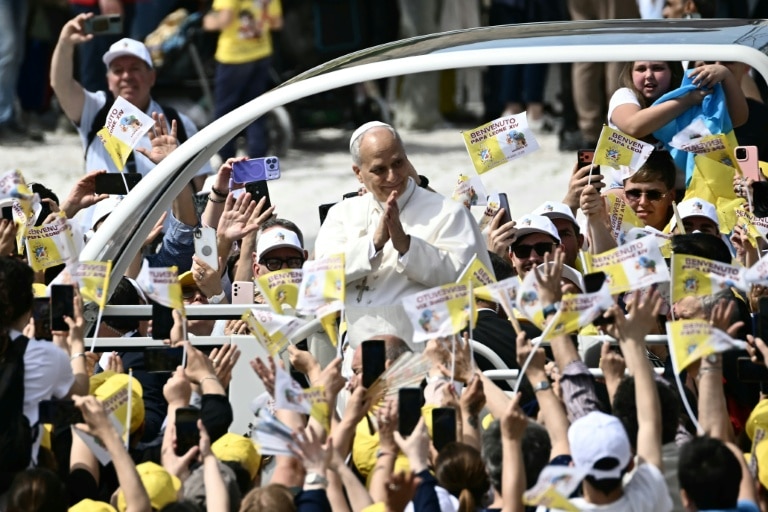
On a historic Saturday visit to one of Europe’s most devastating environmental disaster zones, Pope Leo XIV delivered a blistering rebuke of the criminal networks and systemic negligence that have turned southern Italy’s Campania region’s ‘Land of Fires’ into a public health crisis that has plagued local communities for nearly 40 years.
Known alternately as the ‘Triangle of Death’, the territory stretching around the city of Acerra, roughly 15 kilometers northeast of Naples, has been exploited since the late 1980s as an illegal dumping and incineration ground for hazardous industrial waste. Most of the toxic material originates from wealthy industrial regions in northern Italy, where corporate entities avoid the steep costs of compliant waste disposal by paying off the local Camorra mafia to eliminate the waste illegally. The illicit operation has buried or burned everything from asbestos panels and used vehicle tires to barrels of concentrated industrial chemicals, leaching heavy metals, dioxins, and asbestos into local soil, groundwater, and air across decades.
Today, the region is home to roughly three million residents, and public health data has consistently recorded cancer rates far above the Italian national average, alongside elevated rates of fetal and neonatal developmental malformations. Multiple Italian parliamentary inquiries launched since 2013 have confirmed widespread official negligence, and in some cases, direct political complicity with the criminal waste racket. A 2018 Senate report formally labeled the crisis an ecological catastrophe driven by organized crime and years of government inaction. Most recently, Europe’s highest human rights court ruled in 2025 that the Italian state had failed in its legal duty to protect local residents, ordering the national government to implement comprehensive remediation measures within a two-year deadline.
Arriving in Acerra’s Piazza Nicola Calipari via popemobile, Pope Leo drew thousands of excited local worshippers and onlookers. For many residents, the pontiff’s visit marked a rare high-profile moment of global attention for a crisis that has long been overlooked by national and international leaders. ‘The pope is maybe the only person who can awaken the conscience a little bit of all the people who have harmed this territory,’ 60-year-old local worshipper Giuseppina De Francesco told Agence France-Presse during the visit.
Speaking to clergy and family members of pollution victims at Acerra’s cathedral, the U.S.-born pontiff condemned what he called ‘a deadly mix of obscure interests and indifference toward the common good, which has poisoned the natural and social environment.’ He noted that the contaminated land ‘has paid a heavy price. It has seen many of its children buried. It has borne witness to the suffering of children and innocents.’ Pope Leo also extended recognition to local environmental activists, honoring their ‘courageous commitment’ that he described as pioneering work to raise public awareness of the ongoing poisoning of the region.
The pontiff’s trip was deliberately timed to coincide with the 11th anniversary of *Laudato Si’*, the landmark climate change encyclical released by his predecessor Pope Francis. That 2014 document, which denounced humanity’s unbridled and exploitative treatment of the natural world, was widely praised by climate scientists for its commitment to evidence-based environmental advocacy. Echoing the core message of his predecessor’s manifesto, Pope Leo emphasized that ‘In life, we understand that the more fragile beauty is, the more it requires care and responsibility.’