
Global pop superstar Ariana Grande has launched a high-profile legal action against two unknown hackers, accusing them of orchestrating a years-long scheme to steal and leak her unreleased creative work, including dozens of unheard songs and private studio footage. The lawsuit, filed in Los Angeles and first reported by major U.S. entertainment outlets, details how the defendants have systematically targeted the digital accounts of Grande’s collaborators—including producers, photographers and production team members—to access confidential content that they later sold for large sums on the dark web. Court documents outline a clear pattern of escalating illegal activity spanning more than a decade, stretching all the way back to the early years of Grande’s music career. Since her public debut in 2011, the filing claims, hundreds of separate leaks of her unreleased material have taken place, with 45 unfinished songs stolen and released online in 2023 alone. The most recent alleged breaches took place in 2024 and 2025: in 2024, the hackers created a fake email account impersonating a professional photographer who works with Grande, tricking a digital technician into turning over private, unreleased photos of the artist. The following year, they gained unauthorized access to a collaborating producer’s mobile device, pulling out unreleased song masters, demo recordings and behind-the-scenes video from Grande’s recording sessions. Grande has long been vocal about her frustration with the ongoing leaks, and has previously called out bad actors for stealing her work. During a 2024 interview on the Zach Sang Show, she spoke publicly about the unauthorized leak of an unreleased track called *Fantasize*, which she wrote with legendary pop producer Max Martin. The track went viral on social media after it was leaked, and Grande joked at the time, “Before I left for Wicked – [there were] a few studio sessions that I did which are all over TikTok, thank you so much, I’ll see you in jail. Literally. Those were all written for a TV show, for something that was not for me, so Fantasize comes out, crazy, was stolen… These pirates, crooks, illegal!” In her legal filing, Grande emphasizes that the leaks have violated the intimate, trusting bond between her and her fanbase, an outcome she describes as particularly harmful. She is pursuing the case on multiple counts, including invasion of privacy, violation of California state computer fraud and hacking laws, and civil conversion of stolen property. Her legal team argues that the repeated malicious intrusions into her private creative work have caused substantial, irreparable harm to both her privacy and her professional career. The lawsuit comes at a pivotal moment for Grande, who is balancing a major world tour with the upcoming release of new music and a high-profile acting project. After a multi-year hiatus from recording to film the two-part film adaptation of the hit Broadway musical *Wicked*, Grande returned to music this year. Her eighth studio album, *Petal*, is scheduled to drop this Friday, just days after the court filing was made public. Currently, she is in the middle of her *Eternal Sunshine* world tour, which is scheduled to bring shows to the United Kingdom starting in August. Grande has previously hinted that this run of concerts will be her last for an extended period. Appearing on Amy Poehler’s *Good Hang* podcast, she shared, “I’m going to give it my all and it’s going to be beautiful. I think that’s why I’m doing it because I’m like: ‘One last hurrah’ – for now.” The primary goal of the current legal action, Grande’s legal team confirms, is to uncover the true identities of the two hackers behind the leaks, putting an end to the ongoing pattern of digital theft that has disrupted her career for more than a decade.
标签: North America
北美洲
-

Chip stocks slide in US and Asia as AI jitters rattle investors
A deepening sell-off in artificial intelligence-linked equities has triggered sharp share drops for leading semiconductor manufacturers across U.S. and Asian markets this week, sending benchmark indexes into steep declines and activating market safety mechanisms.
On Tuesday morning, South Korea’s primary Kospi Index saw trading temporarily suspended after plummeting 8% early in the session. The 20-minute circuit breaker halt failed to stem the downward momentum, with the index closing down a dramatic 10.8% for the day. The collapse was led by the country’s giant technology and chip sectors: Samsung Electronics and SK Hynix, two of the world’s largest memory chip producers, both recorded declines of more than 13% by market close. This is not the first time the tech-heavy Kospi has triggered a circuit breaker this year; the mechanism is explicitly designed to slow panic-driven selling during periods of extreme market volatility. Year-to-date, the index had surged more than 100% from January to mid-June, but has now surrendered roughly a third of that peak value. South Korean stock markets have seen unusually high volatility in recent months, driven by a flood of new retail investors entering the market.
The global AI stock downturn was sparked by Monday’s trading on Wall Street, where leading AI chip designer Nvidia dropped 5%, erasing its title as the world’s most valuable publicly traded company and handing the top position back to Apple. The decline came following a Wall Street Journal report that Nvidia is in advanced discussions to contribute up to $250 billion to a massive data center infrastructure project developed in partnership with OpenAI, the creator of ChatGPT. The BBC has reached out to both Nvidia and OpenAI to request comment on the reported deal.
SK Hynix, which held a record-breaking initial public offering on the Nasdaq just three weeks ago, saw its U.S.-listed shares drop 7.5% on Monday, falling well below its $149 per share offer price. Across the East China Sea, Japan’s tech-heavy Nikkei 225 index followed the regional downward trend, closing nearly 4% lower on Tuesday. Apple, which has seen its shares climb roughly 25% so far this year, benefited from Nvidia’s decline to retake the top valuation spot.
Jun Bei Liu, founder of investment advisory firm Ten Cap, told the BBC that two key factors are driving the pullback: growing investor anxiety over the massive volumes of capital flowing into AI development, and rising competition from Chinese chip manufacturers. Against this uncertain backdrop, Liu noted that institutional investors are currently “taking some profit off the table” after the months-long AI stock rally, but many plan to reinvest in AI-related equities following the upcoming U.S. holiday season.
In a striking contrast to the broader global sell-off, China’s largest domestic memory chip manufacturer ChangXin Memory Technologies (CXMT) saw its shares skyrocket nearly 470% during its trading debut on the Shanghai Stock Exchange on Monday. The firm produces dynamic random-access memory (DRAM) chips, a critical component for AI data centers, smartphones, personal computers, tablets and a wide range of other consumer electronics. CXMT announced it plans to allocate the majority of proceeds from its IPO to expanding production capacity and accelerating research and development into next-generation memory chip technologies.
-
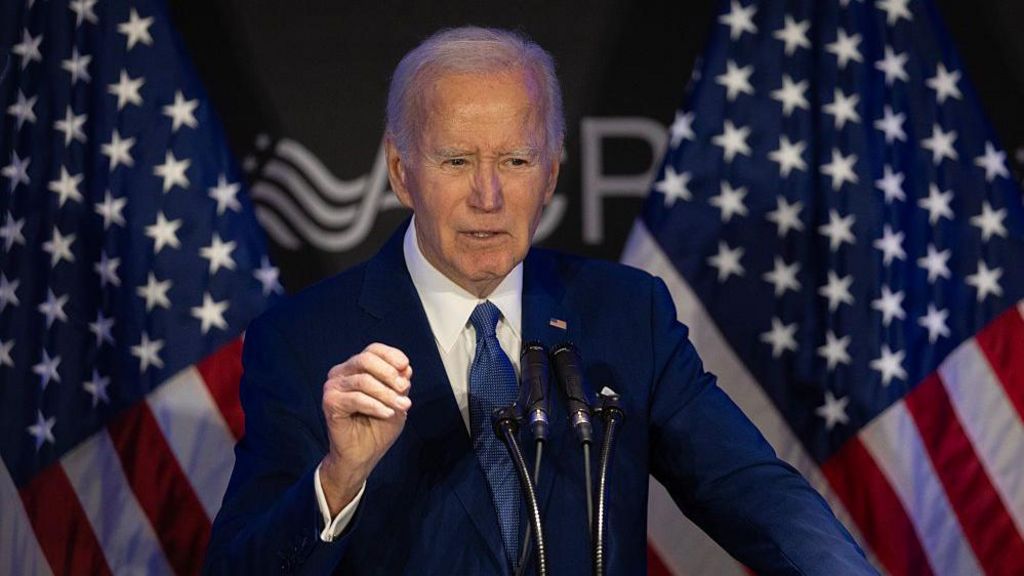
‘I just found all the classified stuff downstairs’ – Biden to ghostwriter
A years-long legal battle over sensitive audio recordings tied to President Joe Biden has reached a new turning point, as House Republicans have publicly released tapes that Biden’s legal team repeatedly sought to keep out of the public domain. The recordings, captured during interview sessions between Biden and a ghostwriter working on his 2017 memoir *Promise Me, Dad*, contain explicit comments from the 83-year-old commander-in-chief acknowledging he retained classified government materials after his vice presidency ended in 2017.
The first of the recorded conversations dates back to October 2016, when Biden was still serving as vice president under the Obama administration. During that session, Biden told co-writer Mark Zwonitzer, “I have extensive notes over this period of time… They [the White House] didn’t know I have this.” A second recording, made in February 2017 just one month after Biden left the White House, captures him stating plainly, “I just found all the classified stuff downstairs.” Later in the more than two hours of tapes published Monday, he again acknowledges, “The next thing I have here is, um, this is classified.”
House Republicans partnered with the conservative nonprofit Oversight Project to launch a legal battle for access to the tapes, which were originally turned over to the Department of Justice as part of a 2024 probe into Biden’s handling of classified national security records. During Biden’s presidential tenure from 2021 to 2025, the DOJ repeatedly refused to release the materials. In May of this year, Biden’s personal legal team filed a lawsuit against the Department of Justice to block the release, but after a series of court losses, the team was forced to drop their legal challenge.
The released recordings remain heavily redacted, a detail that House Oversight Committee Republicans argue is intentional to hide the full scope of Biden’s disclosures of sensitive classified information. In 2024, Special Counsel Robert Hur accessed the recordings and their transcripts during his official investigation into Biden’s retention of classified documents. Hur’s final report concluded Biden had improperly held onto the government records, but the special counsel declined to recommend criminal charges. Hur cited multiple factors for the decision, including widespread concerns that a jury would perceive Biden as “a sympathetic, well-meaning, elderly man with a poor memory” and decline to deliver a conviction.
This controversy mirrors a parallel case involving former President and now returning President Donald Trump, who faced criminal charges for illegally retaining classified documents at his Mar-a-Lago resort in Florida. Those charges were ultimately dismissed after Trump won the 2024 presidential election and returned to the White House.
In a formal statement responding to the release, Biden’s spokesperson TJ Ducklo framed the move as a partisan political attack. “Releasing the tapes was just the latest example of this Administration weaponizing the DOJ for political retribution,” Ducklo said. He added that while President Biden disagrees with the court ruling that cleared the release, “he also respects the courts and the vital role an independent judiciary plays in a healthy democracy.”
-

Johnson & Johnson offers up to $5.5bn to settle baby powder lawsuits
After decades of costly, reputation-damaging legal conflict over allegations that its iconic talc-based baby powder caused ovarian cancer, healthcare conglomerate Johnson & Johnson has tabled a $5.5 billion landmark settlement proposal to put tens of thousands of outstanding U.S. claims to rest. The multi-billion-dollar offer marks the company’s latest attempt to close a chapter of legal wrangling that has hung over the New Jersey-based pharmaceutical and consumer health giant for more than 15 years, even as the firm continues to staunchly deny all allegations of wrongdoing.
Under the terms of the proposal revealed this week, the settlement will cover approximately 76,000 active ovarian cancer claims linked to J&J’s talc products, accounting for the vast majority of all remaining unresolved talc-related litigation in the U.S. Payment terms are structured to ease near-term financial pressure on the company: up to $3 billion will be disbursed next year, with no additional payout obligations due before 2028. For the agreement to move forward, legal representatives for at least 95% of the affected claimants across both state and federal court systems must approve the deal, J&J clarified.
Erik Haas, J&J’s vice president of litigation, emphasized in an official statement that the company maintains all allegations against its talc products are entirely meritless. He noted that J&J has prevailed in the majority of talc-related cases that have gone to trial to date, and remains confident it would win in any further litigation. The decision to settle, he explained, is driven by a strategic goal to move past the long-running dispute rather than any admission of guilt. “This proposed resolution allows the company to put this matter behind it and enable J&J to remain focused on its mission to develop medicines and devices that save lives,” Haas said.
The roots of the current litigation stretch back to 2009, when the first claims against J&J’s talc products were filed. Plaintiffs and their families have long alleged that the company’s talc-based products were contaminated with asbestos, a known carcinogen that naturally occurs in geological seams adjacent to talc deposits, and that this contamination caused plaintiffs to develop ovarian cancer. J&J has repeatedly rejected these claims, maintaining that decades of scientific research confirm talc is safe, does not contain asbestos, and does not cause cancer. As recently as earlier this month, the company secured a major legal victory when a federal judge raised questions about whether individual plaintiffs could prove talc was the direct cause of their cancer diagnoses.
In response to ongoing legal and public pressure, J&J wound down U.S. sales of talc-based baby powder in 2020, and made a full global exit from the product line in 2022, transitioning its entire baby powder portfolio to cornstarch-based formulas. Liability for J&J baby powder operations outside North America now rests with Kenvue, the former consumer health division of J&J that was spun off as an independent publicly traded company in 2022. Kenvue owns a stable of well-known global consumer health brands including Band-Aid, Listerine, and Calpol.
-

BBC outside court as judge rules singer D4vd will face murder trial
In a key legal development that has drawn widespread public attention, a judge has ruled that rising singer D4vd will proceed to a murder trial, following the discovery of a 14-year-old girl’s body inside the trunk of his registered electric vehicle last year.
The case first emerged in September of the previous year, when law enforcement officials found the remains of Celeste Rivas Hernandez, a teenager, in the locked trunk of a Tesla car. Vehicle registration records confirm the car is officially linked to D4vd, the singer who has gained growing recognition in the contemporary music industry in recent years.
Outside the courthouse following the ruling, a BBC reporting team was present to document the proceedings, capturing initial reactions from legal representatives and community members following the judge’s decision. The ruling clears the way for a full public trial, where prosecutors will present their evidence connecting the singer to the teenager’s death, while the defense will have the opportunity to challenge the prosecution’s case and present their own arguments.
Local communities have expressed shock over the case since the body was first discovered, with many calling for a transparent and thorough judicial process to deliver justice for Hernandez. Court officials have not yet announced a formal start date for the trial, but legal observers expect proceedings to get underway in the coming months as both sides prepare their cases.
-
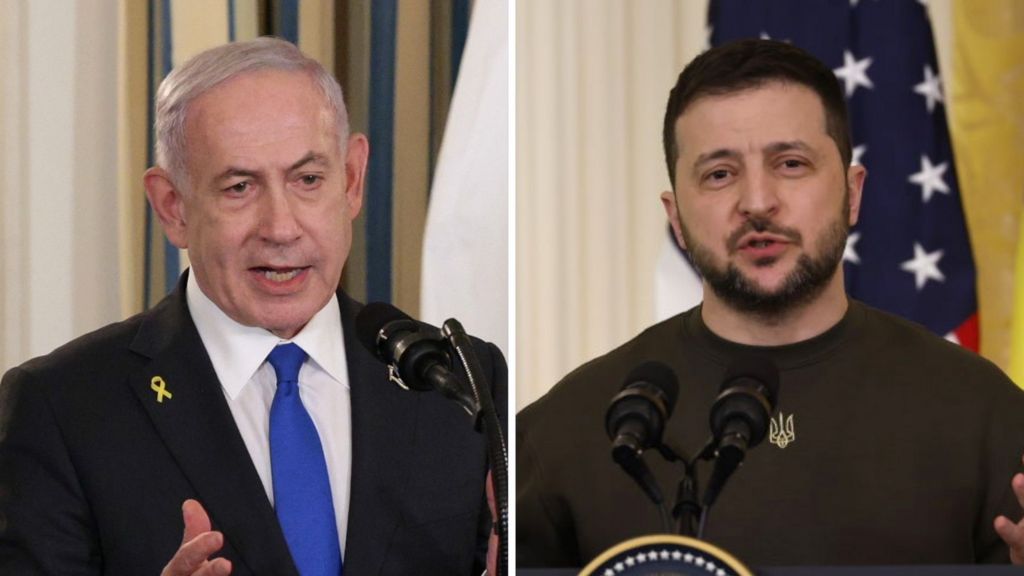
What to expect from Zelensky and Netanyahu’s visit to Washington
Two of the most high-profile global leaders, Ukrainian President Volodymyr Zelensky and Israeli Prime Minister Benjamin Netanyahu, are both heading to Washington D.C. this week, with their visits coordinated around the funeral service for longtime Republican Senator Lindsey Graham. While the memorial service serves as the formal occasion bringing both figures to the U.S. capital, the trip will include key bilateral engagements at the White House that carry major implications for two of the world’s most urgent active conflicts.
Neither leader will hold a joint meeting with U.S. President Joe Biden; instead, each will sit down separately with the American commander-in-chief to delve into the ongoing wars shaping their respective regions. For Zelensky, the discussions will center on Ukraine’s 3-year defense against Russia’s full-scale invasion, with priorities likely including continued U.S. military aid, new security commitments, and coordination on Kyiv’s latest battlefield strategies amid shifting frontline dynamics.
For Netanyahu, the agenda will focus heavily on Israel’s ongoing military campaign in Gaza against Hamas, as well as rising cross-border tensions with Hezbollah in northern Israel and broader regional security risks linked to Iranian-backed militant groups. The separate visits come at a politically sensitive moment for the Biden administration, which has maintained strong support for both Ukraine and Israel while facing growing domestic pressure over the scale and direction of U.S. involvement in both conflicts.
The overlapping visits also put a spotlight on U.S. foreign policy priorities across two critical geostrategic regions, as the Biden administration works to shore up alliances while navigating competing political pressures at home heading into the next U.S. election cycle.
-

US singer D4vd to go on trial for murder in death of teen
A Los Angeles judge has formally ordered rising U.S. musician D4vd, born David Anthony Burke, to face a criminal trial on charges of murder and sexual abuse connected to the 2025 death of 14-year-old Celeste Rivas Hernandez. The binding ruling caps a five-day preliminary hearing that saw prosecutors call 12 witnesses, present graphic photographic evidence, and lay out their case as the victim’s family observed court proceedings.
Authorities first discovered Hernandez’s remains last September inside a Tesla registered to an address linked to 21-year-old Burke. The emerging music artist has repeatedly denied all charges against him, entering a not guilty plea earlier in the legal process. His formal arraignment is scheduled for August 31, with the full trial set to kick off no later than 90 days after that court appearance.
Prosecutors have laid out a detailed narrative of the alleged crime, claiming Burke carried out a prolonged pattern of sexual abuse against the teen before murdering her. They argue the killing was motivated by Hernandez’s threat to expose his inappropriate relationship with a minor, an act that would have ruined Burke’s multi-million dollar entertainment career. Court records introduced during the hearing include threatening text messages Hernandez sent to Burke on April 22, 2025, amid a heated argument over his friendship with another girl. The messages, laced with expletives, included threats to kill Burke, strangle him, fabricate lies to tell her father, and end both his career and his life.
According to prosecution testimony, the day after sending those messages, Hernandez traveled to Burke’s private residence in Hollywood via an Uber that Burke himself arranged to pick her up. Prosecutors allege that immediately after she arrived at the property, Burke fatally stabbed her before dismembering her body to cover up the crime.
The case has sent shockwaves through the U.S. music industry, where Burke had built a growing fanbase and commercial success in recent years. Legal proceedings are moving forward on a tight timeline as both sides prepare for a high-profile trial that will draw widespread public and media attention.
-
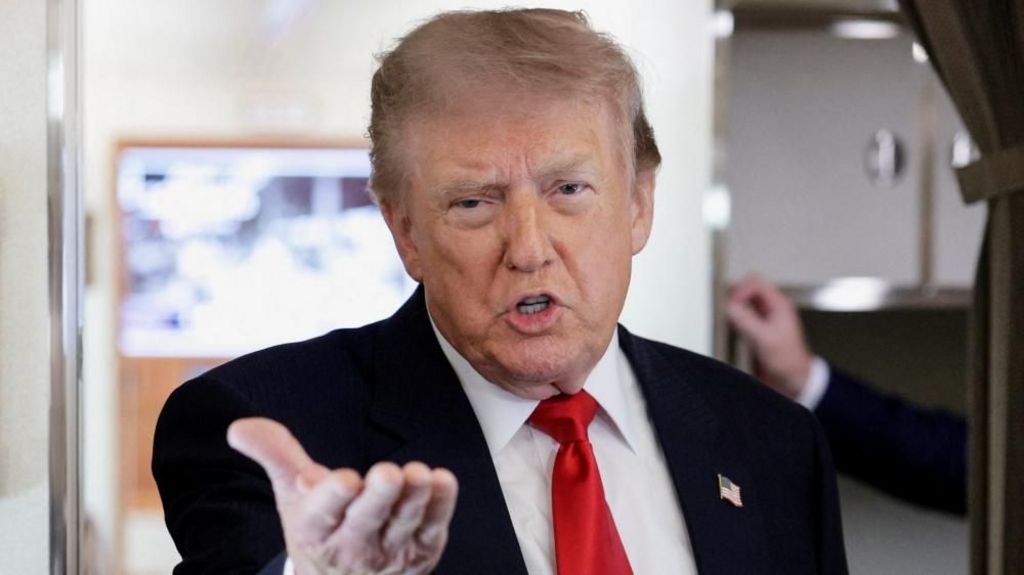
Trump says Iran war talks taking place during lull in strikes
Three full days have passed without direct military exchanges between the United States and Iran, and U.S. President Donald Trump has announced that what he describes as “very friendly negotiations” are underway to de-escalate the ongoing regional conflict, expressing public optimism that a lasting end to hostilities could be reached soon.
Speaking to reporters traveling with him aboard Air Force One this Monday, Trump laid out his outlook for the diplomatic process. “I think there’s a good chance that something positive could happen,” he stated. But the president also issued a clear warning: if the current negotiating efforts collapse, the U.S. will immediately resume the large-scale military operations it was conducting before the current lull in fighting began.
Iran’s government has directly pushed back on Trump’s claim, denying that any direct negotiations with the United States are taking place at this time.
Trump explained that he made the decision to halt U.S. airstrikes on Iranian targets last Friday at the request of third-party nations mediating between the two adversarial sides, who asked for additional time for diplomatic dialogue to progress. Following the U.S. pause, Iran also suspended its own cross-border and regional attacks, creating the current calm.
This de-escalation comes after nearly two consecutive weeks of daily U.S. airstrikes and tit-for-tat retaliatory attacks between the two powers, which completely unraveled the ceasefire agreement that was reached between the two sides back in June. At the time the U.S. resumed strikes, the U.S. military stated its operations were explicitly aimed at degrading Iran’s capacity to disrupt commercial shipping moving through the Strait of Hormuz, a critical global chokepoint that carries roughly a fifth of the world’s daily oil supplies.
Market hopes for a lasting de-escalation triggered a sharp drop in global crude oil prices on Monday, with benchmark prices falling more than 9% at one point to hit $87.59 per barrel as traders priced in lower risk of supply disruptions.
During his remarks on Air Force One, Trump also addressed recent media reporting suggesting that five months of continuous combat operations have left U.S. military ammunition stockpiles depleted. The president rejected these claims outright. “We have a lot of ammunition. We have a lot of the mid-level stuff too, more than we could ever use, no matter what,” Trump said. “But we have a lot. I’d like to have more.”
He added that U.S. defense manufacturers are ramping up production of a range of military equipment, most notably Patriot anti-ballistic missile systems, one of the most in-demand defensive weapons produced by the U.S. defense industry. “That system is going up. We have a lot,” he noted.
White House spokesperson Anna Kelly doubled down on the administration’s stance in a separate statement, saying the U.S. military “has more than enough munitions, ammo, and stockpiles to serve all of President Trump’s strategic goals and beyond.” She also emphasized that Operation Epic Fury, the codename for the U.S.-led military campaign against Iran, “has exposed what happens when you mess with the United States.”
“Even still, the president has urged our defence contractors to constantly produce more made-in-America weapons, which are the best in the world,” Kelly added.
The current round of open hostilities between the two powers dates back to February 28, when the United States and Israel launched coordinated opening strikes against Iranian targets. Tehran quickly retaliated, launching a wave of missile and drone attacks targeting U.S. military bases and other assets across Gulf Cooperation Council states, as well as military and civilian targets inside Israel.
In June, Iran and the U.S. signed a memorandum of understanding that committed both sides to halt all offensive military operations, reopen the Strait of Hormuz to commercial shipping, and work toward a comprehensive permanent peace agreement over the course of 60 days. That truce collapsed on July 13, after Iranian forces launched attacks on commercial tankers transiting the Strait of Hormuz. In response, Washington resumed large-scale air strikes against Iran and reimposed a strict naval blockade on all of Iran’s commercial ports.
Tehran retaliated with a series of coordinated attacks on U.S. military facilities and bases across the Middle East, which killed four active-duty American soldiers. According to Iran’s Ministry of Health, U.S. airstrikes carried out in the period since hostilities resumed have killed dozens of Iranian civilians and military personnel.
-
As the US pauses the war with Iran, is Trump really running out of weapons?
In a high-profile appearance earlier this month at the Pennsylvania Defense and Innovation Summit, U.S. President Donald Trump stood alongside chief executives of the nation’s largest defense contractors and delivered a clear, urgent call: ramp up weapons production and accelerate manufacturing timelines to rebuild dwindling stockpiles.
Addressing a gathering of arms industry leaders at the U.S. Army War College, with Secretary of Defense Pete Hegseth at his side, Trump emphasized, “We have the best quality in the world, but we need a little more speed.” The Trump administration framed the summit as a core component of a dual strategy to rejuvenate domestic defense manufacturing and strengthen the country’s warfighting capacity, what Hegseth has called America’s “arsenal of freedom.”
What went largely unmentioned during the summit, however, is the core driver of this new push: massive stockpile depletion from nearly 40 days of intense combat during this year’s Operation Epic Fury in Iran, paired with ongoing tit-for-tat cross-border strikes in the region. To date, the U.S. government pegs total war costs at $37.5 billion, the vast majority of which has gone toward expended munitions. By the time a fragile ceasefire took hold on April 8, U.S. forces had struck more than 13,000 targets across Iran and intercepted more than 1,700 Iranian drones and ballistic missiles, White House data shows.
Today, U.S. offensive strikes against Iran are paused to allow diplomatic negotiations to proceed. A recent New York Times report revealed that Trump’s military advisors urged him to abandon plans for conflict escalation, warning that further action would only deepen stockpile shortfalls. The president has pushed back on these concerns, telling The Wall Street Journal, “We have far more munitions than anyone in the world, and far more than we need.”
The issue of depleted stockpiles has been a point of internal tension within the administration for months. Last month, Hegseth rejected claims that supplies were running low. But his position shifted dramatically last week, when he told the Senate Appropriations Committee the Pentagon requires an additional $87 billion to address “critical shortfalls” in equipment and munitions.
While exact figures for expenditure and remaining stockpiles remain classified, publicly available analysis from the Center for Strategic and International Studies (CSIS), a Washington D.C.-based think tank, outlines a stark landscape of depleted inventories that cannot be quickly replenished. “It depends on the munition, but one to five years [to manufacture a single advanced missile] is the bottom line,” explained Mark Cancian, a retired Marine Corps colonel and senior CSIS adviser who researches defense stockpiles. “And there’s nothing you can do to speed that up.”
The munitions most heavily drawn down during the Iran conflict fall into two critical categories: long-range land-attack systems and air and missile defense interceptors used to neutralize incoming Iranian attacks. The most widely used offensive weapon was the Tomahawk Land Attack Missile (TLAM), a sea-launched precision weapon capable of striking targets more than 1,000 miles inland, allowing the U.S. to destroy hardened military sites like command bunkers without risking manned aircraft. CSIS estimates more than 1,000 Tomahawks were fired during the operation, and stockpiles may not return to pre-war levels until 2031. Each new TLAM variant costs approximately $2.6 million.
On the defense side, the Patriot interceptor — a ground-based missile designed to shoot down aircraft, ballistic missiles and cruise missiles — saw the heaviest use. CSIS estimates that as many as 1,430 Patriots were fired during the conflict, drawn from a pre-war stock of roughly 2,330. Each Patriot interceptor costs around $4 million, a steep price to pay to shoot down low-cost Iranian drones that only cost between $20,000 and $50,000 apiece. Like Tomahawks, Patriots require years to replace: “If you put funding into production today, you wouldn’t take delivery of finished missiles for three or four years. Sometimes even five,” Cancian said, noting that current deliveries are for missiles funded back in 2023.
The more advanced Terminal High Altitude Area Defense (THAAD) system, which offers longer range and higher-altitude intercept capabilities than the Patriot, was also deployed. Pre-war stockpiles of THAAD interceptors were already limited, with CSIS estimating that 190 to 290 interceptors were fired from a pre-war total of 360. Only nine THAAD batteries exist globally, seven of which are operated by the U.S. Sustained expenditure leaves open the risk that U.S. forces could lack this critical capability for defending against ballistic missile threats from major powers like Russia, China, or North Korea.
This depletion comes at a particularly sensitive geopolitical moment, ahead of the so-called “Davidson window” — a timeframe when many U.S. military planners assess that China is more likely to move to take control of self-governing Taiwan, which Beijing claims as a breakaway province. The concept originated from a 2021 congressional hearing where then-Indo-Pacific commander Admiral Philip Davidson warned a Chinese invasion could come “within six years,” and then-CIA Director William Burns echoed the assessment in 2023, predicting China would be militarily prepared by 2027.
Cancian warns that current stockpile shortfalls create a “window of vulnerability” that leaves the U.S. without the full inventory of preferred munitions it would need for a large-scale Pacific conflict. This unpreparedness, he argues, increases the risk that U.S. forces would be outmatched by China’s massive arsenal of advanced missiles and aircraft. U.S. officials note China has closely studied U.S. air defense operations during the Iran conflict, and has invested heavily in advanced missile technology including hypersonic glide vehicles far more capable than Iran’s conventional missiles and low-cost drones, alongside developing large-scale drone swarm tactics.
Not all analysts frame depleted stockpiles as a pure liability, however. Jacob Olidort, a former CIA analyst and former Middle East policy adviser at the Pentagon, argues that the use of these weapons in combat sends a powerful deterrent signal. “Weapons create deterrence, not merely because nations have them, but also because they demonstrate a willingness to use them,” said Olidort, now director for American security policy at the America First Policy Institute. He added that the U.S. campaign’s success in eroding Iran’s military capabilities in a compressed timeframe sends a clear message to other adversaries, including China, about American military prowess.
The tension between preserving U.S. stockpiles and supplying allied nations already played out publicly ahead of the Iran conflict, when Trump rejected Ukrainian requests for Tomahawk missiles in October 2025, citing the need to protect U.S. reserve inventories. That episode previewed the difficult trade-offs now shaping debate over U.S. global military posture. Ukrainian President Volodymyr Zelensky told the BBC in March that the Iran conflict has exacerbated critical weapons shortages for his country, which is facing relentless Russian drone and missile strikes and urgently needs additional Patriot air defense systems.
Zelensky outlined the stark mismatch between production and demand: the U.S. produces roughly 60 to 65 Patriot missiles per month, or 700 to 800 per year — and 803 Patriots were expended on the first day of Operation Epic Fury alone. More recently, Trump surprised European officials by announcing a deal that would allow Ukraine to produce Patriot missiles domestically, a licensing arrangement already in place with Germany and Japan.
Some defense analysts see the dual lessons from Ukraine’s war against Russia and the U.S. campaign against Iran as a catalyst for rethinking how the U.S. designs and produces air defense systems. Elaine McCusker, a 13-year veteran of the Pentagon who now works as an expert at the American Enterprise Institute, said these experiences could drive development of cheaper, mass-produced alternatives to complement high-cost advanced interceptors. “We’ve known for a long time that we don’t want to be shooting $6 million interceptors at $1,000 drones,” she said. “I think we now have more focus on that solution, and more people focusing on manufacturing more attritable solutions that don’t cost so much.”
Even with significant stockpile drawdowns, there is little immediate concern that the U.S. would run out of munitions if the Iran ceasefire collapses — not because U.S. stockpiles are unlimited, but because Iran’s stockpiles and production capacity are in far worse shape. “The United States military has more than enough munitions, ammo, and stockpiles to serve all of President Trump’s strategic goals and beyond, and Operation Epic Fury has exposed what happens when you mess with the United States,” White House spokesperson Anna Kelly said in a statement. “Even still, the president has urged our defence contractors to constantly produce more made-in-America weapons.”
Recent U.S. strikes carried out by Central Command have focused heavily on degrading Iran’s ability to disrupt shipping in the Strait of Hormuz, the vital global oil shipping lane that has seen repeated blockades by both sides. After waves of U.S. and Israeli strikes, Iran’s military losses far outpace American losses, and the country has almost no ability to quickly replenish its lost weapons systems. “A lot of commentary portrays Iran as having an almost unlimited amount of weaponry,” said Jason Brodsky, policy director of United Against Nuclear Iran. “I think we have to realise that there are limitations there, and that the U.S. has degraded their defence industrial base to a very significant extent.” Brodsky added that Iran’s capacity to mass-produce missiles, drones and other critical weapons has been largely destroyed.
Brodsky noted that Iran’s remaining stockpiles are now concentrated almost entirely on its ability to threaten shipping through the Strait of Hormuz, a capability that is rapidly fading. “The Iranian regime is running out of time here,” he said. For the Biden administration, the ongoing, manageable conflict with Iran remains the immediate priority, even as officials acknowledge that ignoring long-term stockpile challenges would be irresponsible. “The Indo-Pacific is a more distant threat right now,” Brodsky said. “Policymakers have to prioritise, and the Middle East right now has the president’s attention.”
For now, every missile fired against Iranian targets, delivered to Ukrainian frontlines, or held in reserve for a potential Taiwan conflict draws from a steadily shrinking national inventory. The U.S. is betting that it can manage current commitments while defense manufacturers ramp up production to replenish stockpiles over the coming years.
-
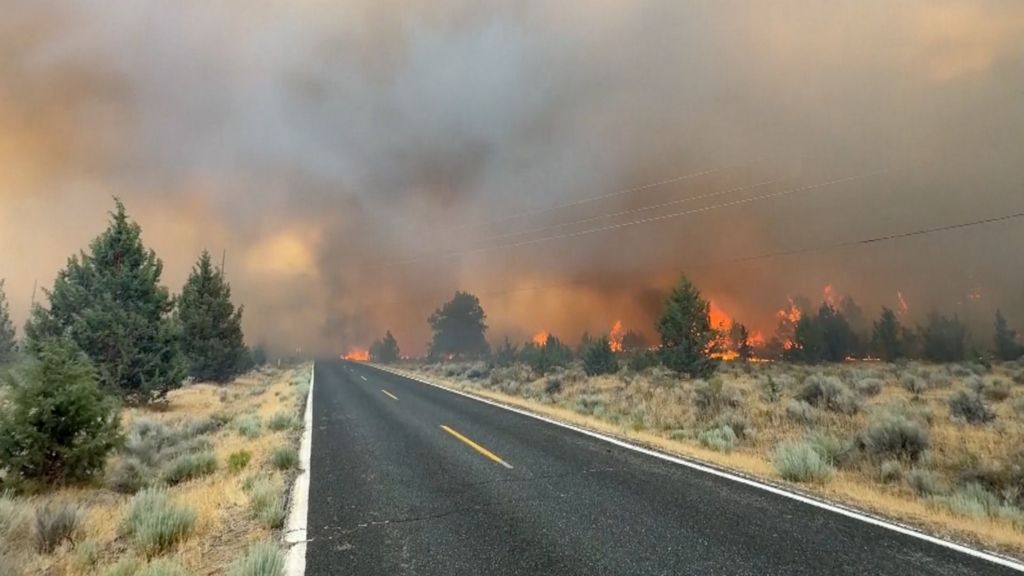
North America wildfires burn millions of acres in western US and Canada
Across the western expanse of North America, a growing climate-driven crisis is unfolding as dozens of intense wildfires scorch vast swathes of land in two major regions: the U.S. state of Oregon and Canada’s western province of British Columbia. Fueled by steadily climbing regional temperatures that have dried out vegetation and turned vast forested areas into tinder, these uncontrolled blazes have already consumed millions of acres of land, and show no signs of slowing their advance.
The ongoing wildfire season, which has become increasingly severe in recent decades amid global climate shifts, has put local communities, emergency response teams, and ecological systems under extreme strain. Rising temperatures create a feedback loop that exacerbates fire risk: higher heat evaporates moisture from soil and plant life, making even normally resilient forests far more flammable. With warm weather patterns persisting across the Pacific Northwest, fire managers have warned that the spread of active blazes will likely continue in the coming weeks.
This disaster is not contained within a single national border. Both Oregon and British Columbia share extensive ecological corridors and weather systems, meaning smoke and fire risk can cross international boundaries, impacting air quality and public health across a far wider area than the burned zones themselves. As emergency crews work around the clock to contain the blazes and evacuate at-risk communities, the event underscores the growing threat that climate change poses to wildfire frequency and severity across western North America.