标签: Europe

欧洲

  • Ukraine hits Russian energy targets and denies striking Kremlin-occupied nuclear plant

    Ukraine hits Russian energy targets and denies striking Kremlin-occupied nuclear plant

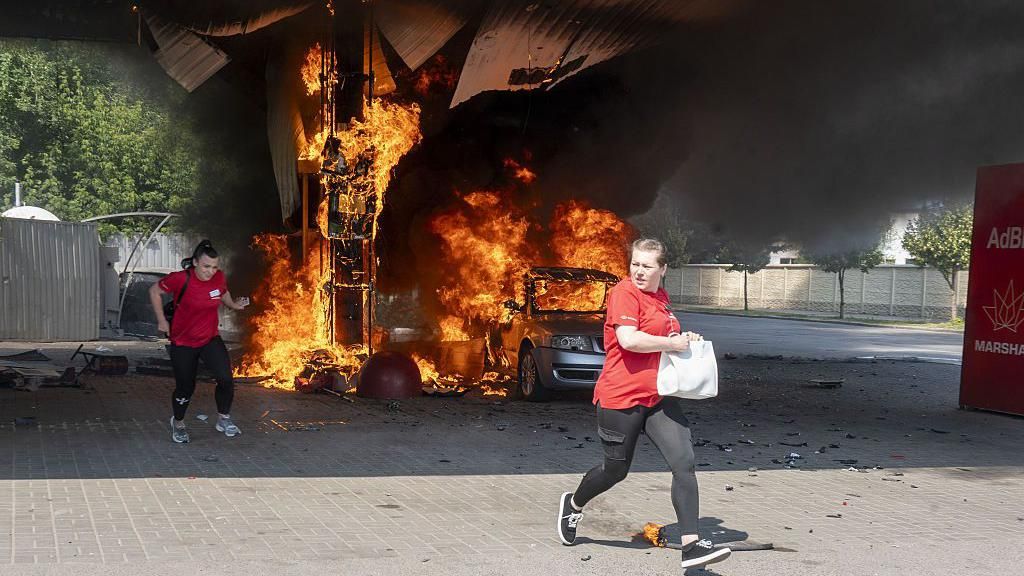
    Overnight attacks targeting Russian energy infrastructure marked a sharp escalation in cross-border strikes between Russia and Ukraine over the weekend, with Kyiv confirming successful hits on key fuel facilities while firmly rejecting Moscow’s accusations of an attack on Europe’s largest nuclear power station. Russian regional officials confirmed Sunday that descending drone debris sparked an inferno at a fuel storage depot in southwestern Russia’s Rostov Oblast, prompting emergency evacuations of nearby residential neighborhoods. A separate wave of drones inflicted damage to civilian infrastructure in neighboring Saratov Oblast, with independent Russian media outlet Astra reporting large flames engulfing a major oil refinery in the region’s capital city, also named Saratov.

    In a rare public confirmation of cross-border action, Ukraine’s General Staff acknowledged Sunday that its unmanned aerial vehicles successfully targeted the Saratov refinery, igniting a large-scale blaze that remains under assessment for total damage. The statement noted the facility, owned by Russian state-owned energy giant Rosneft, produces gasoline and diesel for domestic and military use, and has been a key supplier fueling Moscow’s full-scale invasion of Ukraine that launched in early 2022. Ukrainian officials have repeatedly justified stepped-up attacks on Russian oil, gas and refining infrastructure in recent months, arguing the energy sector generates billions in revenue to fund the war effort while also producing fuel for Russian military vehicles and equipment.

    Alongside the confirmed energy strikes, the weekend brought renewed tension over the Russian-occupied Zaporizhzhia Nuclear Power Plant, a facility that has been the site of repeated safety scares since Russian forces seized it in the opening weeks of the 2022 invasion. Russia’s state nuclear operator Rosatom claimed Saturday that a Ukrainian kamikaze drone detonated after piercing the exterior wall of the turbine hall for the plant’s sixth power unit. Rosatom CEO Alexei Likhachev called the incident a deliberate, pre-planned attack by Ukrainian forces, though he stressed no critical core equipment was damaged in the blast.

    Ukraine’s military swiftly dismissed the accusation as another disinformation propaganda effort, stating it had not launched any strikes targeting the plant and remains strictly committed to upholding international humanitarian law, which prohibits intentional attacks on civilian nuclear infrastructure. The military added that no offensive operations or weapons fire were conducted along the segment of the front line nearest the plant at the time of the reported incident. The Zaporizhzhia plant, which remains under Russian occupation close to active front lines in southern Ukraine, is one of four Ukrainian regions Russia has attempted to formally annex, a move that has not gained recognition from the global community.

    Rafael Grossi, director general of the International Atomic Energy Agency (IAEA), the United Nations’ nuclear watchdog, posted Sunday on social media platform X that he holds serious concern over the reported incident. Ukraine’s state nuclear regulatory agency has called for the damage alleged by Russian authorities to be independently verified by IAEA inspectors, who have maintained a permanent monitoring presence at the plant since 2022 to mitigate nuclear safety risks. Repeated shelling near the plant since the Russian occupation sparked global fears of a catastrophic nuclear accident, with Moscow and Kyiv repeatedly trading blame for deliberate strikes on the site.

    In a parallel wave of Russian strikes overnight into Sunday, Russian forces launched nearly 300 drones across Ukrainian territory, according to Ukraine’s Air Force. Air defense crews successfully intercepted and downed 212 of the incoming unmanned aerial vehicles, while 14 managed to reach their intended targets. Falling drone debris was reported in five separate locations across Ukraine. Russian strikes sparked fires at an apartment area in the central Ukrainian city of Dnipro and at an oil refinery in the western Rivne region, local Ukrainian authorities confirmed. Oleksandr Koval, head of Rivne’s regional military administration, reported no casualties at the refinery, with emergency response teams already on site working to contain the blaze.

    The cross-border strikes come as Ukraine continues to ramp up pressure on Russian energy supplies amid a grinding war that has stretched into its fourth year, with Kyiv actively lobbying Western allies for additional air defense systems and long-range strike capabilities to counter Russian offensive operations.

  • France detains hundreds of rioters after Paris Saint-German wins Champions League

    France detains hundreds of rioters after Paris Saint-German wins Champions League

    In the wake of Paris Saint-Germain’s dramatic penalty-shot victory over Arsenal in the 2025 UEFA Champions League final in Budapest, celebrations across France quickly devolved into widespread violent unrest Saturday night, leaving seven police officers injured and sparking more than 400 detentions nationwide, French Interior Minister Laurent Nuñez has confirmed.

    The chaos unfolded as tens of thousands of fans poured into public spaces across the country immediately after the final whistle. In Paris alone, roughly 20,000 supporters packed the iconic Champs-Élysées near the Arc de Triomphe, where crowds initially marched through tree-lined avenues, setting off celebratory flares and sounding vehicle horns. But the festive atmosphere quickly soured when small splinter groups split off from the main gathering, engaging in targeted vandalism, arson, and clashes with law enforcement.

    According to the Paris Police Prefecture, rioters damaged storefronts, set both rubbish bins and private vehicles on fire, and one small faction even attempted to force entry into a police station in Paris’ upscale 8th Arrondissement. The would-be attackers were quickly dispersed by responding officers, authorities confirmed. Nuñez called the outbreak of violence “absolutely unacceptable”, noting that unrest was recorded in roughly 15 French cities in total. As of Sunday morning, law enforcement had taken nearly 400 people into custody across the country, with almost 300 of those detentions occurring in the capital.

    Notably, this is not the first time a PSG Champions League victory has been marred by large-scale unrest. After the club claimed its first Champions League title in 2024, more than 500 arrests were made nationwide, and 201 people were injured in Paris alone. Despite the widespread violence that followed Saturday’s final, French officials have confirmed that pre-planned official victory events will proceed as scheduled. Thousands of fans are expected to gather for a public celebration Sunday afternoon at the Champ de Mars, the large public green space located just steps from the Eiffel Tower. Following the public gathering, the entire PSG squad will travel to the Elysee Palace for an official reception hosted by French President Emmanuel Macron.

  • Venice’s growing flamingo population finds refuge in recovering wetlands

    Venice’s growing flamingo population finds refuge in recovering wetlands

    VENICE, Italy — For generations, the iconic pale pink flamingo has been absent from local Venetian vocabulary, a quiet reflection of how recently these striking birds have made the Venetian Lagoon their home. Today, that narrative is shifting dramatically: flamingo numbers in this storied coastal ecosystem have hit all-time highs, as large-scale wetland restoration projects create new viable habitats that could soon support the first permanent, self-sustaining nesting colony in the region’s modern history.

    Flamingos, which have long established major nesting sites in Spain and France, first began appearing in the 550-square-kilometer Venetian Lagoon in the early 2000s. Initially, sightings were largely limited to remote fishing valleys and tidal mudflats along the lagoon’s outer edges, with almost no encounters in the canal-laced historic center that draws millions of global tourists each year. That pattern has shifted sharply in recent years, however. Last year’s official ornithological census counted nearly 24,000 wintering flamingos in the lagoon — an increase of 8,000 from the previous year’s total.

    “This count cements the Venetian Lagoon as one of the most critical wintering grounds for flamingos across their entire European range,” explained Alessandro Sartori, a leading ornithologist who monitors the lagoon’s bird populations weekly by boat. Over 90% of the counted flamingos currently congregate in the northern lagoon, where large expanses of intact natural salt marsh and semi-natural traditional fishing valleys provide abundant food sources. These managed embanked wetlands, however, have also created occasional conflict between the feeding birds and local fishing activity.

    Sartori has spent years searching for signs of successful nesting, a milestone that would confirm the establishment of a self-sustaining local colony. Two previous attempts in 2008 and 2013, in northern lagoon fishing valleys, ended in devastating setbacks: a severe hailstorm killed dozens of young birds, halting early colonization efforts. That could change soon, thanks to a landmark EU-backed wetland restoration project focused on rebuilding eroding salt marshes in the isolated southern lagoon, located beyond Venice’s historic center and the Marghera industrial port.

    Once, nearly half of the entire Venetian Lagoon consisted of natural salt marshes, known locally as *barene* in the Venetian dialect. Today, salt marshes make up just 7% of the lagoon’s total area, with only half of that remaining habitat naturally formed. Decades of erosion, accelerated by the dredging of shipping channels for the Marghera industrial port in the 1960s, has pushed the lagoon toward a worrying transition: without intervention, it could eventually degrade into an open marine bay, according to conservation leaders.

    The 23.6 million euro ($27.5 million) five-year WaterLANDS project, led in part by local conservation group We Are Here Venice, aims to reverse that trend by rebuilding salt marsh habitats at a scalable scale. Beyond creating new feeding and potential nesting grounds for flamingos, restored salt marshes deliver major climate benefits: they trap carbon dioxide, the primary greenhouse gas driving climate change, and buffer the lagoon against the impacts of rising sea levels. “This project is designed to prove that we can reverse centuries of erosion and change the trajectory of the lagoon,” said Jane da Mosto, executive director of We Are Here Venice.

    Conservation teams working on the southern lagoon project have already documented clear signs of increasing flamingo activity, from scattered pink feathers to regularly feeding flocks. Sartori has already observed a dramatic jump in flamingo numbers in the restored southern wetlands: over the past three years, counts have grown from just a handful of birds to between 300 and 400 during peak wintering periods. “Our hope is that just as flamingos have established nesting colonies in other parts of the Mediterranean, they will find suitable breeding ground right here on these restored barene,” Sartori said.

    Beyond conservation gains, the arrival of Venice’s pink newcomers offers a new opportunity to reframe the city’s ecological identity, adding a layer of natural significance to its already well-known historical and cultural heritage. While casual flamingo sightings remain rare for most tourists — the birds favor remote, shallow tidal reaches that require careful navigation through shifting channels, and they scatter quickly when disturbed by human activity — Sartori predicts that flamingo watching will become an increasingly popular sustainable activity as populations grow, with occasional sightings already possible from the shores of the popular lagoon islands of Murano and Burano. He emphasized that any wildlife viewing must prioritize the birds’ safety, with visitors maintaining a safe distance to avoid disrupting their feeding and resting routines.

    The Associated Press’ climate and environmental reporting is supported by funding from private philanthropic foundations, with AP maintaining full editorial control over all content.

  • Concerns mount that Belarus could be a launchpad for a new Russian offensive in Ukraine

    Concerns mount that Belarus could be a launchpad for a new Russian offensive in Ukraine

    More than three years after Russian forces launched their full-scale invasion of Ukraine from Belarusian territory, Kyiv and Western capitals are sounding new alarms that Alexander Lukashenko, Belarus’ long-ruling authoritarian leader, could open a new front for the Kremlin by allowing Moscow to again use his country as a launchpad for aggression.

    When Putin launched his full-scale invasion on February 24, 2022, tens of thousands of Russian troops massed in northern Belarus under the pretense of joint military drills, then launched a rapid push south toward Kyiv, just 90 kilometers from the Belarusian border. Putin’s bid for a quick capture of the Ukrainian capital crumbled in the face of fierce Ukrainian resistance, with stretched-out Russian armored convoys sitting vulnerable to ambushes along narrow highways. Just over a month into the invasion, heavily damaged Russian forces with crumbling supply lines retreated from northern Ukraine, a move the Kremlin framed as a “goodwill gesture” amid early peace efforts. Those early peace talks were actually hosted on Belarusian territory, bringing Russian and Ukrainian delegates together for the first negotiation before talks shifted to Istanbul, where no breakthrough agreement was ever reached.

    Unlike the opening days of the war, Belarus has not deployed its own troops to fight in Ukraine, but Lukashenko’s regime has become an integral, often overlooked pillar of Putin’s war effort. Over nearly three years of conflict, Minsk has opened its borders to host Russian military infrastructure, tactical nuclear weapons, and training grounds for Russian troops, offered its hospitals to treat wounded Russian soldiers, and integrated its domestic manufacturing sector into Russia’s war supply chain.

    Ukrainian sanctions envoy Vladyslav Vlasiuk confirmed that fragments of a Russian Oreshnik ballistic missile fired at Ukraine in May contained microchips manufactured in Belarus. The Belarusian opposition military monitoring group BELPOL, made up of former military and law enforcement officers who oppose Lukashenko, estimates more than 500 Belarusian industrial plants are currently involved in producing weapons components, repairing Russian military equipment, and providing logistics support for Moscow’s campaign. The group’s head, Uladzimir Zhyhar, told reporters that “Lukashenko’s regime is quite seriously involved in the war. Lukashenko is helping Russia in every way he can.”

    Zhyhar added that new infrastructure construction, including a large-scale firing range and barracks capable of housing thousands of troops, is already underway in Belarus’ Gomel region along the Ukrainian border. This ongoing military buildup has forced Kyiv to divert tens of thousands of troops from the main 1,000-kilometer front line in eastern and southern Ukraine to defend its northern border, stretching Ukrainian defensive resources thin.

    Beyond conventional military support, Belarus has become a core part of Russia’s nuclear deterrence posture in Europe. Geographically, Belarus shares borders with three NATO member states — Latvia, Lithuania, and Poland — making it a strategically critical outpost for the Kremlin. In 2024, Moscow updated its nuclear doctrine to place Belarus firmly under Russia’s nuclear umbrella, and announced that it had deployed its new nuclear-capable Oreshnik intermediate-range missile system to Belarusian territory. Russia has already used conventionally armed variants of the Oreshnik to strike targets inside Ukraine three times in the last six months. Earlier this month, Moscow and Minsk held large-scale joint nuclear force drills that simulated delivering nuclear warheads to missile units and preparing for a launch, with a joint Belarusian-Russian crew test-firing a nuclear-capable Iskander missile from a southern Russian range.

    “Belarus lacks military sovereignty, and as soon as Moscow sees it as necessary for its strategy, Moscow will naturally use Belarus as a launchpad for a new invasion of Ukraine or some kind of armed conflict with NATO countries,” Zhyhar explained, noting that Belarus offers a “very convenient springboard” for any new northern push toward Kyiv.

    Last week, Ukrainian President Volodymyr Zelenskyy confirmed that Kyiv’s intelligence services had detected a sharp increase in Russian efforts to push Belarus into deeper direct involvement in the war, and prepare for new offensive operations launched from Belarusian territory. Zelenskyy said potential targets include the Chernihiv-Kyiv corridor in northern Ukraine, or even a strike against a NATO member state sharing a border with Belarus. In response, Zelenskyy has ordered Ukrainian military and security agencies to strengthen northern border fortifications and prepare a coordinated defensive response.

    Both Lukashenko and senior Russian officials have rejected Kyiv’s warnings. Lukashenko has insisted Belarus has no plans to enter the war unless it is directly attacked, while Russian Security Council Secretary Sergei Shoigu dismissed Zelenskyy’s claims as a fearmongering tactic designed to pressure Western allies into sending more military aid to Kyiv.

    Even so, the growing risk has prompted unprecedented diplomatic outreach from Western powers. On May 24, French President Emmanuel Macron held his first call with Lukashenko since the 2022 invasion to warn of the severe risks if Belarus is dragged deeper into the conflict. Lukashenko responded by announcing he would host a French envoy the following week to discuss European security and potential easing of European Union sanctions on Minsk.

    Ukrainian border guard spokesperson Andrii Demchenko noted that while intelligence confirms Russia is increasing pressure on Lukashenko to enter the war directly, Ukrainian forces have not yet detected a large-scale buildup of Russian or Belarusian troops and equipment along the border. Belarusian opposition leader-in-exile Sviatlana Tsikhanouskaya, who visited Kyiv last week, emphasized that “Belarus must never again become a springboard for aggression. Russian tanks must never again march through Belarus to Chernihiv, Zhitomir, Rivne, or Kyiv. Ukraine is fighting for itself and for all the peoples who have lived in the shadow of empire for too long. It is fighting for the right to live in peace. And the fate of my country, Belarus, also depends on Ukraine’s success.”

    Independent military analysts based in Minsk argue that a large-scale offensive launched from Belarus is militarily unlikely at this stage. Belarus has just under 49,000 active-duty troops, a fraction of Russia’s 1.5 million active force, and while Minsk could theoretically mobilize up to 290,000 reservists, those forces lack modern weapons and sufficient training to conduct offensive operations. Minsk-based military analyst Alexander Alesin estimates an offensive would require mobilizing as many as 500,000 personnel — a move that would cripple Belarus’ domestic economy and require massive Russian arms supplies to equip the force.

    “Even with a small force, the Ukrainians can easily defend themselves and inflict heavy losses on the Belarusian army,” Alesin said, noting that Ukraine has already built layered heavy fortifications along the entire border and planted extensive minefields that would slow any incursion. Alesin added that Lukashenko has little incentive to pursue direct involvement, pointing out that the Belarusian leader benefits greatly from his current role as a quiet supplier to Russia’s war machine. “The last thing Lukashenko wants is to fight, and he’ll cling to his current position at any cost, so he can avoid fighting while profiting handsomely from the war,” Alesin said.

  • Hundreds arrested in France after wild Champions League celebrations

    Hundreds arrested in France after wild Champions League celebrations

    Paris Saint-Germain’s back-to-back UEFA Champions League victory over Arsenal ended in widespread chaos across France over the weekend, as violent clashes between celebrating fans and security forces left multiple people injured, caused extensive property damage, and resulted in more than 400 arrests nationwide. The unrest marked the second consecutive year that PSG’s European title win has devolved into large-scale public disorder, echoing the deadly violence that marred the club’s 2025 championship celebration.

    The trouble began even before the final whistle of the penalty shootout that secured PSG’s win, when clashes broke out between fans and police at the club’s home stadium, Parc des Princes, where thousands of supporters had gathered to watch the match broadcast on giant outdoor screens. Moments after the final penalty was scored, crowds of jubilant but unruly fans flooded onto Paris’s iconic Champs-Élysées, where the celebration quickly spun out of control.

    Video footage captured from central Paris shows revelers setting off flares and fireworks, igniting electric bicycles on public roadways, and smashing the glass storefront of a local business. According to official police accounts, the unrest left six vehicles, two commercial properties, and one bus shelter heavily damaged. Seven police officers were hurt in confrontations with crowds, prompting authorities to deploy thousands of additional law enforcement officers across the capital to restore order. Officers used tear gas to disperse unruly gatherings in central Paris, and the violence forced widespread disruptions to Paris’s public bus, train, and regional rail networks.

    France’s interior ministry confirmed that 416 people were taken into custody in the early hours of Sunday, with 280 of those arrests occurring within Paris city limits. Interior Minister Laurent Nuñez condemned the violence in a statement, calling the widespread unrest “absolutely unacceptable.”

    The disorder has sparked sharp political criticism, with far-right French leader Marine Le Pen taking to social media platform X to denounce the ongoing pattern of post-football violence in the country. “Only in France does a football club’s victory spark riots,” Le Pen wrote. “Only in France does everyone feel compelled to lock themselves in their homes on the evening of a victory to avoid being confronted with violence.”

    The unrest comes exactly one year after PSG’s 2025 Champions League victory was overshadowed by deadly clashes that left two people dead, including a 17-year-old boy. Despite the overnight violence, PSG’s planned victory parade is still set to go forward on Sunday afternoon. The parade will travel through the Champs de Mars, located adjacent to the Eiffel Tower, and will conclude with an official reception hosted by French President Emmanuel Macron at the Élysée Palace.

  • How Putin became master of the image

    How Putin became master of the image

    For more than a quarter of a century at the helm of Russian politics, Vladimir Putin has held an unwavering understanding of one core truth of modern governance: visual imagery shapes public perception, and public perception consolidates power. This instinct stretches back decades before his 1999 rise to the presidency, and it has evolved alongside his grip on Russia, transforming from a carefully curated brand to a tool that now underpins an increasingly authoritarian regime.

    In the very first BBC interview with Putin in 2001, moments before cameras went live, a member of his entourage rushed in and removed the small water glasses placed on the interview table. When asked why, the aide offered two reasons: no one should be allowed to misinterpret the glasses as holding vodka, and a spilled glass on live television was an unacceptable risk. “Television is a nuclear bomb when it comes to publicity,” the aide explained. Political analyst and author Peter Pomerantsev notes that this small incident reveals a widespread understanding among Russia’s political elite, particularly Putin, that controlled television imagery was the key to unifying and holding power in post-Soviet Russia.

    Putin’s journey to the center of Russia’s political stage began far from the limelight. Growing up in Leningrad (now St. Petersburg) as a child of the Soviet television age in the 1960s and 70s, he drew early inspiration from the tough, stoic spy heroes that dominated popular Soviet film and television series. By his own admission, these portrayals of agents fighting enemies of the state convinced him to pursue a career with the KGB, the Soviet Union’s notorious intelligence service. For decades, he operated in the shadows: as a KGB operative, he avoided public attention, and after the collapse of the Soviet Union in 1991, he rebranded himself as a quiet, loyal, and efficient bureaucrat, first in St. Petersburg’s city government, then in Boris Yeltsin’s Moscow presidential administration. Photos from this era consistently show him positioned at the back or edge of group shots, never looking directly at the camera, never claiming center stage. Nina Khrushcheva, great-granddaughter of Soviet leader Nikita Khrushchev, recalls that in 1990s KGB circles, Putin was nicknamed “the moth” — a man who could blend into any background and operate unseen.

    When Yeltsin unexpectedly catapulted Putin to the role of acting president in 1999, and he won election months later, Putin and his PR team immediately set to work constructing a public persona that would stand in stark contrast to his unpopular, ailing predecessor. Yeltsin’s public struggles with alcohol had become a source of national embarrassment for Russians, so the first step of image-building was to frame Putin as a disciplined, almost complete teetotaler. At annual meetings of the Valdai Discussion Club, where foreign experts are served fine wines, Putin sticks to a single cup of tea with honey. Even when he does drink in private settings, his minders go to great lengths to keep the information hidden. On one occasion, a local museum custodian who shared vodka-infused Russian pancakes with Putin begged a BBC correspondent not to report the interaction, warning that strict rules meant he could face severe punishment for the disclosure.

    Beyond framing himself as sober and disciplined, Putin set out to project an image of youthful, decisive masculinity — a sharp rebuke to the perception of Russia as a weak, declining state after the Soviet collapse. He posed for photos flying a fighter jet, released footage showcasing his competitive judo skills, and beginning in 2007, a series of viral images cemented this brand: bare-chested Putin riding a horse through Siberia, fly fishing in remote mountain rivers, or swimming laps to display his physical strength. Pomerantsev explains that this calculated visual messaging worked for two distinct audiences: for younger, media-savvy Russians, the stunts had a knowing, ironic edge that felt current; for traditionalist voters, they reinforced the narrative that Russia needed a hard, strong leader to return the country to great power status. “Putin was playing a very traditional Soviet leadership role, but he was doing it in the era of reality TV, MTV, and modern celebrity culture,” Pomerantsev notes. Fiona Hill, a leading Russia scholar and former advisor to multiple U.S. presidents, calls Putin a pioneer: “He shaped the image of the first populist president, the first acclaimed strongman of the 21st Century.”

    These over-the-top public stunts served multiple purposes beyond projecting strength abroad. Some, from scuba diving to “discover” pre-placed ancient relics in the Black Sea to flying a motorized hang glider alongside endangered Siberian cranes to petting a captive Siberian tiger cub, read as the fulfillment of childhood fantasies for a former Leningrad schoolboy who spent decades operating in the shadows. When he stepped down from the presidency to serve as prime minister between 2008 and 2012, the continued stream of attention-grabbing photos sent a clear signal: he, not sitting president Dmitry Medvedev, remained the ultimate center of power in Russia. Even the obvious effort behind the image hints at underlying insecurity, analysts argue: the relentless focus on physical fitness and strength is as much about reassuring Putin himself as it is about reassuring the Russian public that he remains the undisputed “main man” in the country.

    2011 marked a pivotal visual and political turning point for Putin. When he reemerged to run for a new presidential term, his face looked noticeably fuller, puffier, and far less expressive than before — sparking widespread speculation about undisclosed health issues, cosmetic treatments to reverse aging, or both. After his predictable election victory, he appeared at an open-air victory rally with streaks of tears running down his altered face. While the BBC correspondent who observed the scene concluded the tears were genuine, born of relief after widespread anti-Putin protests challenged his bid to return to power, some analysts argue the moment was yet another calculated performance, designed to evoke religious imagery of a weeping icon and frame Putin as Russia’s divinely anointed savior.

    Whatever the truth of that moment, it marked a clear shift in Putin’s rule. After 2012, his grip on Russian society tightened dramatically: what was once subtle discouragement of dissent became outright criminalization, political opposition was almost entirely eliminated, the national parliament was reduced to a rubber-stamp body that approved Putin’s every policy, and control over media and public expression became near-total. Nadya Tolokonnikova, a founding member of protest group Pussy Riot who was jailed and labeled a foreign agent for anti-Putin activism, calls this the turning point that created the Putin the world knows today: “Putin got obsessed with placing himself in history as the saviour, not just of Russia, but of the entire world.”

    Now aged 73, and more than 25 years after he first took power, Putin’s public image has shifted again, shaped by the Covid-19 pandemic and the 2022 full-scale invasion of Ukraine. He appears far less frequently in public, and every on-camera appearance is heavily scripted and choreographed, with Putin deliberately keeping distance from most people. Hill argues this new approach reflects growing paranoia: “He obviously wants to be careful that people can’t necessarily track him down. It shows someone who’s paranoid about his personal safety – from germs or assassination attempts.”

    Today, the war in Ukraine sits at the center of Putin’s public identity. Veteran Russian journalist Mikhail Fishman argues that after returning to the Kremlin in 2012, Putin still lacked a clear defining mission — the war gave him that purpose. But after more than four years of full-scale conflict, the war has become a trap. Ending the war carries huge political risks for Putin, but continuing it imposes growing costs on Russia’s economy and political system. The resulting portrait of Putin today is a far cry from the dynamic, action-oriented sportsman he once worked so hard to project: he is a remote, inflexible leader, trapped in the authoritarian system and cult of personality he spent a quarter-century building.

    This analysis is adapted from BBC InDepth, a series offering in-depth reporting and fresh perspective on global current affairs. The documentary *Putin: In Ten Pictures* is available to watch now on BBC iPlayer.

  • Man charged with murder of woman in County Galway

    Man charged with murder of woman in County Galway

    A fatal violent incident in western Ireland has led to a murder charge before the courts, after a woman’s body was discovered earlier this week near an asylum housing facility in County Galway. The victim has been identified as Masumeh Manojan, a 30-something woman originally from Iran, who was found with life-ending slash and stab injuries by those who discovered her remains on the morning of May 28. The 35-year-old man accused of her killing, Ali Sohrabi, who has no fixed abode in the area, appeared before Galway District Court following his arrest by the Irish national police, known locally as gardaí. When formally presented with the murder charge during processing by gardaí on the evening of May 30, Sohrabi entered a plea of “not guilty” by responding “no” to the charge. Gardaí escorted Sohrabi directly to the Galway court for his initial hearing, which remained short and procedural per Irish court protocol for murder cases. During the hearing, a detective testified that Sohrabi is accused of killing Manojan at some point between May 27 and May 28. Manojan’s body was located within close proximity to a facility operated by the International Protection Accommodation Services (IPAS), a government agency that provides housing to asylum seekers waiting for their international protection claims to be processed in the Republic of Ireland. Following the hearing, Judge agreed to remand Sohrabi in custody at Castlerea Prison, located in neighboring County Roscommon, ahead of his next court appearance. Sohrabi’s legal representative, a defence solicitor, submitted a formal request to the court that the accused be granted access to both routine medical care and psychiatric support during his time on remand, a request the judge granted. Sohrabi is scheduled to make his next appearance before Galway District Court via remote video link next Wednesday. Irish national public service broadcaster RTÉ first reported details of the court appearance and charges.

  • Ferrari wanted to take on Chinese EVs with the Luce – then the backlash started

    Ferrari wanted to take on Chinese EVs with the Luce – then the backlash started

    For decades, Ferrari has built its global legacy on roaring petrol-powered supercars, with a design language and driving experience that are instantly recognizable to enthusiasts around the world. That legacy is now at the center of a fierce public debate following the debut of the Ferrari Luce, the Italian luxury marque’s first all-electric vehicle and first five-seater model, conceived in collaboration with legendary iPhone designer Sir Jony Ive.

    The launch of the highly anticipated EV was framed as a landmark cultural and industrial event, with Italian President Sergio Mattarella and Pope Leo invited to preview the $640,000 vehicle before its public unveiling. But within hours of the reveal, a wave of criticism spread across social media, boardrooms, and political circles, dragging Ferrari’s share price down 8% in a single trading day as meme after meme mocked the car’s unconventional design.

    Unlike the low-slung, aerodynamic profile that defines classic Ferrari models, the Luce adopts a far more upright silhouette that has divided observers. Most notably for long-time fans, the electric powertrain eliminates the deep, roaring engine roar that has become synonymous with the prancing horse badge. That departure from Ferrari’s core identity has drawn condemnation from some of the brand’s most prominent insiders and supporters.

    Former Ferrari chairman Luca Cordero di Montezemolo has publicly warned that the Luce risks destroying the Ferrari legend, calling for the company to remove its iconic badge from the model. Italy’s Deputy Prime Minister and Transport Minister Matteo Salvini echoed that skepticism, questioning what Enzo Ferrari, the brand’s founder, would make of the new vehicle, adding that it “looks like anything but a car from the prancing horse”. Shaun Baker, an Australian high-end luxury car dealer and lifelong Ferrari collector who has owned more than 50 of the marque’s vehicles, went even further, rebranding the Luce (pronounced “loo-chay”) as the “Loser”. “Ferrari was the ultimate aspirational brand to own,” Baker explained in an interview with the BBC. “But with the Luce, they’ve hurt their image irreparably.”

    Social media critics have been equally scathing, with some describing the design as an “abomination” and others joking that Enzo Ferrari would rise from his grave to retake control of the company. Many compared the Luce’s design to far cheaper mass-market models, including the Nissan Leaf and Chinese budget EVs, claims that Ferrari CEO Benedetto Vigna has forcefully rejected. Other users have shared 10-second AI-generated redesigns of the Luce that they argue look far more like a traditional Ferrari than the official production model.

    While a small group of observers have praised the Luce as a bold design masterclass, the negative reaction to the vehicle fits into a broader pattern of growing pushback against rapid EV transition among legacy luxury automakers. This is not the first time Vigna, who has led Ferrari for five years, has faced controversy over a radical new model line: when the company launched its first SUV, the Purosangue, in 2022, critics warned it would tarnish Ferrari’s exclusive supercar identity. Ultimately, the model defied expectations and sold strongly, opening up an entirely new profitable market segment for the brand.

    Ferrari is also far from the first legacy luxury marque to face backlash over a radical electric concept. In 2024, Jaguar drew fierce criticism when it announced plans to transition to an all-EV luxury brand and unveiled the Type 00 concept, a model that bore little resemblance to the British carmaker’s classic design heritage. Like Vigna today, Jaguar’s leadership defended the radical shift, arguing that bold disruption was necessary to stand out in a crowded EV market.

    Today, the Luce’s debut comes at a moment of massive upheaval for the global auto industry, with legacy Western brands facing mounting pressure from multiple directions. Many major automakers, including Lamborghini, Porsche, Honda, and Ford, have recently scaled back or scrapped their all-electric development programs amid softer-than-expected consumer demand and persistent buyer preference for petrol and hybrid powertrains. Following the Luce’s controversial reveal, Lamborghini CEO Stephan Winkelmann said his company’s decision to prioritize hybrid technology over full electrification was “the right way to go”, though he acknowledged that every brand must choose its own path.

    On top of shifting demand, global luxury automakers also face unprecedented cutthroat competition from Chinese EV manufacturers, which benefit from lower production costs, aggressive government subsidies, and massive domestic supply chains that cut EV component manufacturing costs by at least 30% compared to production in other regions, according to the International Energy Agency. Chinese brands have rapidly expanded from the mass market into the premium luxury segment, launching high-performance electric supercars that undercut Western models on price while matching or exceeding their performance. For example, BYD’s $250,000 Yangwang U9 all-electric supercar accelerates from 0 to 60mph in just 2.3 seconds – faster than the Luce’s 2.5-second 0-60 time.

    Industry analysts have offered mixed views on the Luce and Ferrari’s long-term strategy. Singapore-based auto analyst James Wong praised the Luce’s high-quality interior design but noted that the model as a whole is “unrecognizable” as a Ferrari, adding that the company would have benefited from testing the design with loyal fans before launch. At the same time, Wong suggested the massive media attention generated by the backlash could have been an intentional strategic choice to draw attention to Ferrari’s new direction.

    Sustainable automotive industry expert Jessica Cheam noted that the Luce’s $640,000 price tag looks particularly steep at a time when consumers have access to increasingly luxurious, high-quality EVs at far lower price points. However, Cheam argued that the Luce is not aimed at Ferrari’s die-hard traditional fanbase: instead, it is targeted at younger, more EV-friendly buyers who may have never considered purchasing a Ferrari before. Wong echoed that logic, noting that the model’s radical departure from classic Ferrari design could help the brand attract entirely new customer segments that it has never reached before.

    Vigna has defended the pricing and design of the Luce, arguing that the six-figure price tag is a fair reflection of the innovation built into the vehicle, and confirming that the company has already seen strong pre-launch interest from potential buyers. The BBC has requested additional comment from Ferrari on the wave of public criticism, but has not yet received a response.

  • Paris police detain 45 after violence erupts during celebrations of PSG’s Champions League title

    Paris police detain 45 after violence erupts during celebrations of PSG’s Champions League title

    PARIS — Chaos erupted on the streets of Paris late Saturday after Paris Saint-Germain secured its second-ever UEFA Champions League title, as violent outbursts marred fan festivities, left one police officer injured, and led law enforcement to take 45 people into custody. The historic match, held in Budapest, Hungary, saw PSG edge out Arsenal in a tense penalty shootout that sent tens of thousands of supporters pouring into Parisian public spaces immediately after the final whistle.

    Initial gatherings across the capital started as peaceful celebrations: around 20,000 fans flocked to the iconic Champs-Élysées avenue, while dozens more marched along boulevards near the Arc de Triomphe, setting off flares and sounding car horns in collective excitement over the club’s long-awaited win. Police were deployed early to manage crowds and keep movement flowing through the busy tourist district.

    But the mood shifted quickly when small, unruly factions split off from the main groups to launch coordinated disturbances across multiple neighborhoods. The Paris Police Prefecture confirmed that vandals targeted local businesses, damaging a nearby bakery and a restaurant, while groups also set unauthorized fires in public areas. In one of the most serious incidents, a crowd attempted to force entry into a police station located in the upscale 8th Arrondissement. Officers quickly intervened to disperse the group and secure the building, though one officer was hurt during the clashes.

    Elsewhere in the city, protesters briefly blockaded Paris’s peripheral ring road before police moved in to clear the thoroughfare. Near PSG’s home stadium in the 16th Arrondissement, law enforcement contained an unsanctioned gathering of roughly 1,000 fans and dismantled barricades constructed from stolen bicycles. By 10 p.m. local time, officials confirmed that 45 people had been detained in connection with the unrest.

    The chaotic scenes echo similar violence that followed PSG’s first Champions League title win in May of the previous year, when authorities made more than 500 arrests across France. To prevent widespread disorder this year, the city had already activated high-security protocols, drawing parallels to the 8,000 officers deployed across Paris last season. The unrest has once again sparked conversations about crowd management and fan behavior following major elite football matches in the French capital.

  • PSG go back-to-back and join ‘greatest of all time’

    PSG go back-to-back and join ‘greatest of all time’

    In a tense, history-making showdown in Budapest, Paris Saint-Germain (PSG) etched their name among European football’s all-time greats by retaining the UEFA Champions League crown, defeating Arsenal 4-3 on penalties after a 1-1 draw in regular time. This back-to-back triumph marks only the second successful title defense in the Champions League era (1993 onwards), and makes PSG just the 10th club across the competition’s 71-year history to win consecutive European titles, ending a eight-year drought of repeat champions since Real Madrid’s three-peat from 2016 to 2018. \n\nThis milestone comes 12 months after PSG’s dominant 5-0 rout of Inter Milan in the 2025 final in Munich, and in a remarkable show of consistency, 10 of the 11 outfield players who started the 2026 final against Arsenal also started the previous year’s decider. The only change came between the sticks, where new signing Matvey Safonov stepped in for Gianluigi Donnarumma, who moved to Manchester City in the summer of 2025. \n\nThe scope of PSG’s sustained dominance under manager Luis Enrique is staggering. Since the start of the 2024-25 season, the French side has claimed eight out of the 10 major trophies available to them, falling short only of the 2025 Club World Cup and this season’s Coupe de France. With another title already secured, the club now has a chance to become just the fifth side in history to win three consecutive Champions League/European Cup titles, though they remain far from Real Madrid’s unmatched record of five straight crowns between 1956 and 1960. \n\nFor Luis Enrique personally, this win cements his own legendary status: he becomes only the fifth manager in history to lift three Champions League/European Cup titles, joining an elite club that includes Bob Paisley, Pep Guardiola, Carlo Ancelotti, and Zinedine Zidane. What makes this achievement even more remarkable is that the Spaniard almost never took the PSG job. As veteran football journalist Guillem Balague told BBC Radio 5 Live, Luis Enrique initially turned down the offer, unconvinced by a roster packed with superstar talent. He only agreed to take over after being given free rein to reshape the club’s culture, prioritizing a style of offensive, cohesive football over individual stardom. \n\nThat cultural shift has been put to the test: in 2024, PSG lost its record goalscorer and five-time Ligue 1 Player of the Year Kylian Mbappe to Real Madrid on a free transfer. Many predicted the club would crumble without the star forward, but the opposite has happened. In their first full season without Mbappe, PSG scored 44 more goals across all competitions than they did in his final season with the club. This year alone, 20 different players have found the back of the net for PSG, embodying Luis Enrique’s vision that a spread of attacking threat is stronger than relying on one superstar to score 50 goals a season. The team also boasts the fewest yellow cards of any side in Europe’s top five leagues, a statistic Balague points to as evidence of the squad’s controlled, team-first culture. \n\nIn this season’s Champions League specifically, PSG’s attacking dominance was unmatched: they notched 45 goals, tying the all-time record for a single tournament set by Barcelona in 1999-2000, and held an average of 60.5% possession across all their matches, the highest of any competitor. The back-to-back win pushes PSG into a rare tier of European greats, according to prominent football journalist Julien Laurens. Speaking to BBC Radio 5 Live after the final, Laurens noted that unlike last year’s relatively easy win over Inter, PSG had to fight back and dig deep to get past Arsenal this year, making the victory even sweeter. “Back-to-back you join the greatest of all time,” Laurens said. “This puts them in another dimension.” He added that even Pep Guardiola never managed back-to-back Champions League titles, neither with Barcelona’s star-studded squad nor with Manchester City, making PSG’s achievement all the more notable. \n\nThe win also redefines PSG’s place in French football history: their second Champions League crown moves them ahead of Marseille, who have one title, to become the most successful French club in the history of the competition. It caps a remarkable journey for a club that reached its first ever Champions League final only in 2020, when they fell 1-0 to Bayern Munich. \n\nOff the pitch, Luis Enrique has built a deep, heartfelt bond with PSG’s fanbase, which was on full display in Budapest. Before kickoff, PSG supporters unfurled a giant tifo declaring they would not surrender their title, and a massive banner showing Luis Enrique lifting the Champions League trophy. After the final whistle, as the Spaniard was hoisted into the air by his players while clutching the silver trophy, he was greeted with roaring cheers from the traveling French fans. He later celebrated alongside club president Nasser Al-Khelaifi, dancing in front of the supporters to mark a trophy that long eluded the club – now secured, not once, but twice. \n\nA jubilant but exhausted Luis Enrique summed up the moment after the final whistle: “I’m mixed. Excitement, fatigue – everything. But this is the best moment of the season. We are still champs, two in a row, it’s amazing.”