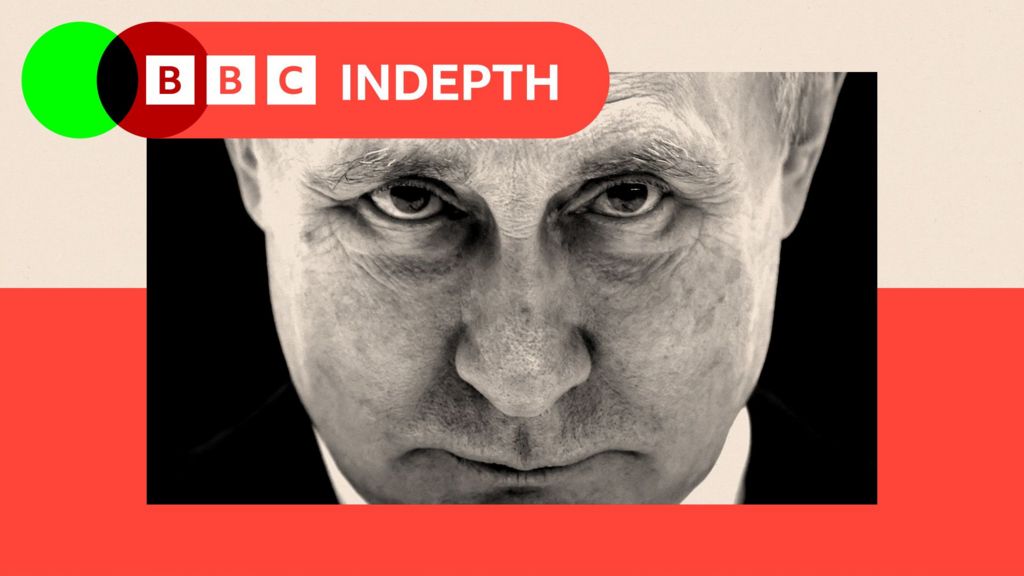
For more than a quarter of a century at the helm of Russian politics, Vladimir Putin has held an unwavering understanding of one core truth of modern governance: visual imagery shapes public perception, and public perception consolidates power. This instinct stretches back decades before his 1999 rise to the presidency, and it has evolved alongside his grip on Russia, transforming from a carefully curated brand to a tool that now underpins an increasingly authoritarian regime.
In the very first BBC interview with Putin in 2001, moments before cameras went live, a member of his entourage rushed in and removed the small water glasses placed on the interview table. When asked why, the aide offered two reasons: no one should be allowed to misinterpret the glasses as holding vodka, and a spilled glass on live television was an unacceptable risk. “Television is a nuclear bomb when it comes to publicity,” the aide explained. Political analyst and author Peter Pomerantsev notes that this small incident reveals a widespread understanding among Russia’s political elite, particularly Putin, that controlled television imagery was the key to unifying and holding power in post-Soviet Russia.
Putin’s journey to the center of Russia’s political stage began far from the limelight. Growing up in Leningrad (now St. Petersburg) as a child of the Soviet television age in the 1960s and 70s, he drew early inspiration from the tough, stoic spy heroes that dominated popular Soviet film and television series. By his own admission, these portrayals of agents fighting enemies of the state convinced him to pursue a career with the KGB, the Soviet Union’s notorious intelligence service. For decades, he operated in the shadows: as a KGB operative, he avoided public attention, and after the collapse of the Soviet Union in 1991, he rebranded himself as a quiet, loyal, and efficient bureaucrat, first in St. Petersburg’s city government, then in Boris Yeltsin’s Moscow presidential administration. Photos from this era consistently show him positioned at the back or edge of group shots, never looking directly at the camera, never claiming center stage. Nina Khrushcheva, great-granddaughter of Soviet leader Nikita Khrushchev, recalls that in 1990s KGB circles, Putin was nicknamed “the moth” — a man who could blend into any background and operate unseen.
When Yeltsin unexpectedly catapulted Putin to the role of acting president in 1999, and he won election months later, Putin and his PR team immediately set to work constructing a public persona that would stand in stark contrast to his unpopular, ailing predecessor. Yeltsin’s public struggles with alcohol had become a source of national embarrassment for Russians, so the first step of image-building was to frame Putin as a disciplined, almost complete teetotaler. At annual meetings of the Valdai Discussion Club, where foreign experts are served fine wines, Putin sticks to a single cup of tea with honey. Even when he does drink in private settings, his minders go to great lengths to keep the information hidden. On one occasion, a local museum custodian who shared vodka-infused Russian pancakes with Putin begged a BBC correspondent not to report the interaction, warning that strict rules meant he could face severe punishment for the disclosure.
Beyond framing himself as sober and disciplined, Putin set out to project an image of youthful, decisive masculinity — a sharp rebuke to the perception of Russia as a weak, declining state after the Soviet collapse. He posed for photos flying a fighter jet, released footage showcasing his competitive judo skills, and beginning in 2007, a series of viral images cemented this brand: bare-chested Putin riding a horse through Siberia, fly fishing in remote mountain rivers, or swimming laps to display his physical strength. Pomerantsev explains that this calculated visual messaging worked for two distinct audiences: for younger, media-savvy Russians, the stunts had a knowing, ironic edge that felt current; for traditionalist voters, they reinforced the narrative that Russia needed a hard, strong leader to return the country to great power status. “Putin was playing a very traditional Soviet leadership role, but he was doing it in the era of reality TV, MTV, and modern celebrity culture,” Pomerantsev notes. Fiona Hill, a leading Russia scholar and former advisor to multiple U.S. presidents, calls Putin a pioneer: “He shaped the image of the first populist president, the first acclaimed strongman of the 21st Century.”
These over-the-top public stunts served multiple purposes beyond projecting strength abroad. Some, from scuba diving to “discover” pre-placed ancient relics in the Black Sea to flying a motorized hang glider alongside endangered Siberian cranes to petting a captive Siberian tiger cub, read as the fulfillment of childhood fantasies for a former Leningrad schoolboy who spent decades operating in the shadows. When he stepped down from the presidency to serve as prime minister between 2008 and 2012, the continued stream of attention-grabbing photos sent a clear signal: he, not sitting president Dmitry Medvedev, remained the ultimate center of power in Russia. Even the obvious effort behind the image hints at underlying insecurity, analysts argue: the relentless focus on physical fitness and strength is as much about reassuring Putin himself as it is about reassuring the Russian public that he remains the undisputed “main man” in the country.
2011 marked a pivotal visual and political turning point for Putin. When he reemerged to run for a new presidential term, his face looked noticeably fuller, puffier, and far less expressive than before — sparking widespread speculation about undisclosed health issues, cosmetic treatments to reverse aging, or both. After his predictable election victory, he appeared at an open-air victory rally with streaks of tears running down his altered face. While the BBC correspondent who observed the scene concluded the tears were genuine, born of relief after widespread anti-Putin protests challenged his bid to return to power, some analysts argue the moment was yet another calculated performance, designed to evoke religious imagery of a weeping icon and frame Putin as Russia’s divinely anointed savior.
Whatever the truth of that moment, it marked a clear shift in Putin’s rule. After 2012, his grip on Russian society tightened dramatically: what was once subtle discouragement of dissent became outright criminalization, political opposition was almost entirely eliminated, the national parliament was reduced to a rubber-stamp body that approved Putin’s every policy, and control over media and public expression became near-total. Nadya Tolokonnikova, a founding member of protest group Pussy Riot who was jailed and labeled a foreign agent for anti-Putin activism, calls this the turning point that created the Putin the world knows today: “Putin got obsessed with placing himself in history as the saviour, not just of Russia, but of the entire world.”
Now aged 73, and more than 25 years after he first took power, Putin’s public image has shifted again, shaped by the Covid-19 pandemic and the 2022 full-scale invasion of Ukraine. He appears far less frequently in public, and every on-camera appearance is heavily scripted and choreographed, with Putin deliberately keeping distance from most people. Hill argues this new approach reflects growing paranoia: “He obviously wants to be careful that people can’t necessarily track him down. It shows someone who’s paranoid about his personal safety – from germs or assassination attempts.”
Today, the war in Ukraine sits at the center of Putin’s public identity. Veteran Russian journalist Mikhail Fishman argues that after returning to the Kremlin in 2012, Putin still lacked a clear defining mission — the war gave him that purpose. But after more than four years of full-scale conflict, the war has become a trap. Ending the war carries huge political risks for Putin, but continuing it imposes growing costs on Russia’s economy and political system. The resulting portrait of Putin today is a far cry from the dynamic, action-oriented sportsman he once worked so hard to project: he is a remote, inflexible leader, trapped in the authoritarian system and cult of personality he spent a quarter-century building.
This analysis is adapted from BBC InDepth, a series offering in-depth reporting and fresh perspective on global current affairs. The documentary *Putin: In Ten Pictures* is available to watch now on BBC iPlayer.