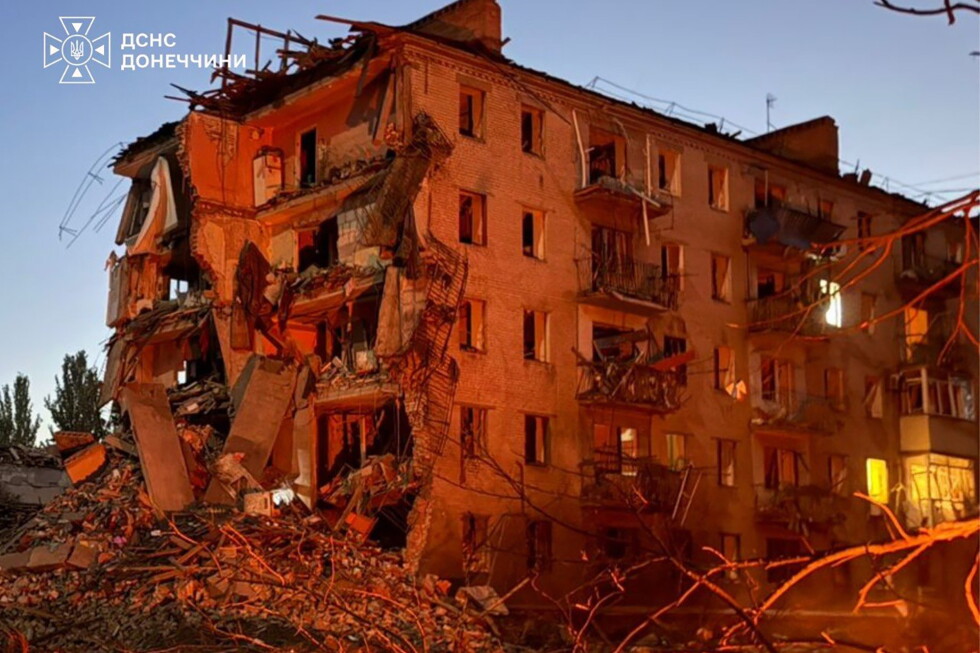
In the latest escalation of the ongoing Russia-Ukraine conflict, a wave of mass Russian drone strikes across Ukrainian territory over the weekend left at least two civilians dead and multiple others injured, while Ukrainian military forces carried out a retaliatory strike on a key drone manufacturing facility inside Russian territory. These tit-for-tat attacks underscore the persistent intensification of long-range strikes on both sides amid the grinding full-scale invasion.
On Sunday morning, regional and local Ukrainian officials confirmed the civilian casualties from overnight airstrikes launched by Russia. In the northern Ukrainian city of Chernihiv, a 16-year-old teenager was killed when Russian drones hit residential areas during what local military administration head Dmytro Bryzhynskyi described as a massive nighttime attack. Bryzhynskyi announced on his Telegram channel that search and rescue teams recovered the teenager’s body while clearing rubble from damaged structures. The strike also left four additional people injured: three women and one man, and ignited destructive fires that gutted multiple residential homes, he added.
Across southern Ukraine, a second civilian fatality was recorded in Kherson after a Russian drone targeted a civilian passenger van traveling through the city center. Oleksandr Prokudin, head of the Kherson regional military administration, confirmed that the driver of the vehicle died from his injuries, while a second male passenger was admitted to a local hospital with severe blast-related injuries.
Ukraine’s Air Force released official figures confirming the staggering scale of the Russian attack, noting that Moscow deployed a total of 236 drones across Ukrainian territory between Saturday night and Sunday morning. Ukrainian air defense systems managed to intercept and destroy 203 of the incoming unmanned aerial vehicles (UAVs), while 32 Russian drones successfully breached defenses and struck targets across 18 separate locations around the country, the service reported.
In a coordinated retaliatory action, Ukraine’s General Staff announced that its own military forces had carried out a targeted strike on a Russian drone production facility in Taganrog, a city in southwestern Russia located roughly 35 miles east of the Russian-occupied eastern Ukrainian border. The targeted site was the Atlant Aero factory, a facility that designs and builds both reconnaissance and combat drones, as well as producing critical components for larger UAVs capable of carrying guided bombs weighing up to 550 pounds, according to Ukrainian military officials. The strike triggered a large fire at the factory site, they added.
Russian authorities have confirmed the strike but have not explicitly acknowledged the target was the drone factory. Taganrog regional governor Yuri Slyusar stated that three people were injured in the overnight attack on commercial infrastructure in the city, and that the strike sparked fires that destroyed local warehouses. Taganrog Mayor Svetlana Kambulova further clarified that the attack damaged multiple local commercial enterprises, a city vocational school, and dozens of civilian vehicles parked in the area.
Russia’s Ministry of Defense also released a statement about its own air defense operations over the weekend, claiming that Russian forces shot down 274 Ukrainian drones overnight, alongside multiple guided aerial bombs and one domestically produced Ukrainian Neptune anti-ship missile. The ministry did not provide details on how many Ukrainian munitions evaded interception to hit their intended targets.
This exchange of large-scale long-range strikes comes as the conflict has entered a months-long stalemate along the front lines, with both sides increasingly turning to drone and missile strikes targeting infrastructure and military assets deep behind enemy lines.
标签: Europe
欧洲
-

Russian attacks kill at least 2 as Ukraine strikes a Russian drone factory
-

Baby food brand HiPP recalls jars in Austria after samples test positive for rat poison
VIENNA, Austria – In a major public health alert issued over the weekend, iconic organic baby food manufacturer HiPP has launched a precautionary recall of all its baby jar products sold at Austrian SPAR supermarket locations following confirmed detection of rat poison in multiple product samples across Central Europe. Authorities in Austria, Slovakia and the Czech Republic first identified the dangerous contamination during routine testing, with the first positive result returned this past Saturday.
Investigations so far point to intentional external tampering, not any production defect in the company’s manufacturing process. In an official statement released Sunday, HiPP stressed that all products leave its production facilities meeting strict quality and safety standards. “This recall is not due to any product or quality defect on our part. The jars left our HiPP facility in perfect condition,” the brand emphasized, noting the incident is tied to an ongoing criminal investigation led by Austrian law enforcement.
The specific products of concern are 190-gram (6.7-ounce) jars of carrot and potato baby food formulated for infants 5 months and older, distributed exclusively through SPAR Group locations in Austria. Burgenland State Police have released key identifying characteristics to help consumers spot potentially tampered products: affected jars are marked with a white sticker bearing a red circle on their bottom base. Additional red flags include damaged or improperly sealed lids, unusual or rancid odors, and the absence of the characteristic popping sound that confirms a jar’s vacuum seal when first opened.
Out of an abundance of caution, HiPP expanded the recall to cover every one of its baby food jars sold across all SPAR-branded outlets in Austria, which includes the core SPAR chain, EUROSPAR, INTERSPAR and Maximarkt locations. The company has pledged full refunds for all returned products, even for customers who do not retain their original purchase receipts. Retail partners in both Slovakia and the Czech Republic have already proactively pulled all HiPP baby jar products from store shelves as a preventive measure.
Austrian law enforcement confirmed that a consumer first flagged a suspicious jar that appeared to have been tampered with, and as of the official announcement, no cases of people consuming the contaminated product or related illness have been reported. The Austrian Agency for Health and Food Safety has shared details on the risks of rat poison exposure, which most commonly contains the anticoagulant bromadiolone that disrupts the body’s ability to clot blood. Ingestion of even small amounts can cause internal and external bleeding, including bleeding gums, frequent nosebleeds, unexplained bruising and blood in fecal matter. Agency officials added that symptoms of poisoning may not appear until two to five days after ingestion, meaning affected individuals may not notice adverse effects immediately.
-

Nathalie Baye, French actor known for her warmth and versatility, dies at 77
Beloved French screen icon Nathalie Baye, whose decades-long career and approachable charisma made her a staple of French cinema, has passed away at the age of 77. The actress died Friday in Paris following a battle with a neurodegenerative disease, according to a family statement shared with French media outlets.
French President Emmanuel Macron joined audiences and industry peers nationwide in mourning Baye’s death, honoring her as a defining figure of modern French film. “We loved Nathalie Baye so much,” Macron shared in a post on X, formerly Twitter. “With her, we loved, dreamed and grew. Through her voice, her smiles, and her modesty, she accompanied the past decades of French cinema, from François Truffaut to Tonie Marshall.”
Born into a family of artists, Baye began her creative training as a dancer before refining her craft at two of France’s most prestigious performing arts institutions: the celebrated Cours Simon drama school and the Paris Conservatoire. She first stepped into the international spotlight in 1973 after landing a lead role in François Truffaut’s critically acclaimed *Day for Night*, and would collaborate with the legendary New Wave director again five years later on *The Green Room*.
Over a career that spanned more than 50 years, Baye appeared in over 80 feature films, earning a reputation as one of France’s most versatile performers capable of seamlessly shifting between big-budget mainstream comedies and intimate auteur-driven projects. She was twice honored with the César Award for Best Actress, France’s highest film honor equivalent to the Academy Award.
Her 1982 breakout role in the historical drama *The Return of Martin Guerre* catapulted her to national fame. A year later, her gritty portrayal of a sharp-tongued sex worker loyal to her down-on-his-luck gangster partner in the crime drama *La Balance* earned her first César win. Baye also became a favorite among new generations of filmmakers, regularly collaborating with emerging directors including Xavier Beauvois. It was for Beauvois’ 2005 crime drama *The Young Lieutenant* that she took home her second Best Actress César.
One of Baye’s most widely seen international roles came in 2002, when she played Leonardo DiCaprio’s on-screen mother in Steven Spielberg’s blockbuster hit *Catch Me If You Can*. Arguably her most celebrated late-career performance came in Tonie Marshall’s 1999 romantic comedy *Venus Beauty Institute*, which follows three employees at a Paris beauty salon navigating love and personal fulfillment. The role earned Baye widespread popular and critical acclaim, while Marshall took home the 2000 César Award for Best Director for the project.
Throughout her career, Baye shared the screen with some of France’s greatest directors, including Maurice Pialat, Claude Sautet and Bertrand Tavernier, leaving an indelible mark on every production she joined.
-

Britain’s chief rabbi says Jews are facing a campaign of violence after spate of arson attacks
LONDON – A foiled arson attack on a northwest London synagogue has thrown a harsh spotlight on growing threats targeting British Jewish communities, with the country’s most senior Jewish leader warning that Jews are now facing an escalating, coordinated campaign of violence and intimidation.
The attempted arson at Kenton United Synagogue, which occurred late Saturday, left only minor damage to the building, and no injuries were reported in the incident. It marks the latest in a string of suspicious fires targeting Jewish-associated sites and an Iranian opposition media outlet across the capital over the past month, all of which are now under the direction of counterterrorism investigators.
In a public statement posted to the social platform X on Sunday, Chief Rabbi Ephraim Mirvis sounded the alarm over the accelerating danger of the current wave of threats. “A sustained campaign of violence and intimidation against the Jewish community of the UK is gathering momentum,” Mirvis wrote. “Thank God, no lives have been lost, but we cannot, and must not, wait for that to change before we understand just how dangerous this moment is for all of our society.”
Prime Minister Keir Starmer responded quickly to the incidents, saying he was appalled by the targeted attacks and issuing a firm pledge that all perpetrators would be held accountable. “Those responsible will be found and brought to justice,” Starmer said.
London’s Metropolitan Police has responded by deploying additional uniformed and plainclothes officers to the city’s northwest, the area where most of the recent attacks have been concentrated. The series of incidents began unfolding weeks ago, with targets including multiple synagogues, ambulances operated by a Jewish charity, and the offices of a Persian-language media outlet that is openly critical of the Iranian government. The arson attempt at the Kenton synagogue came just 24 hours after another incident Friday night, when suspects tried to ignite containers of flammable fluid outside the former offices of a London-based Jewish charity.
To date, no one has been hurt in any of the linked incidents. Law enforcement officials have already arrested and charged several suspects, whose ages range from teenagers to people in their 40s. While investigators have not formally connected all of the cases to a single network, Counter Terrorism Policing London took over lead investigative duties due to striking similarities in the attacks and public online claims of responsibility from a little-known group calling itself Harakat Ashab al-Yamin al-Islamia, or the Islamic Movement of the Companions of the Right.
Israeli officials have characterized the group as a newly formed organization with suspected ties to an Iranian proxy network. The group has also claimed responsibility for similar synagogue attacks in Belgium and the Netherlands in recent weeks. It also released an online video threatening to carry out a drone attack carrying hazardous materials at Israel’s embassy in London. While no attack was ultimately carried out at the embassy, police closed London’s popular Kensington Gardens park Friday to investigate discarded items that included two jars holding unidentified powder. Tests later confirmed the substances found were not harmful.
British authorities have long accused Iran of orchestrating attacks on European soil through criminal proxy networks, targeting both Iranian opposition outlets and Jewish communities across the continent. MI5, the U.K.’s domestic intelligence agency, reported that it disrupted more than 20 potentially lethal Iran-backed plots in the 12 months leading up to October this year.
Still, some independent security analysts have urged caution over the group’s claims, noting that Harakat Ashab al-Yamin al-Islamia is more likely a “flag of convenience” – a name used by disparate actors to claim responsibility for attacks – rather than a structured, centralized terrorist organization.
-

Zelensky condemns US extension of Russian sanctions waiver
As relentless Russian airstrikes and missile barrages continue to pummel Ukrainian cities, leaving a rising trail of death and civilian suffering, a new diplomatic rift has emerged over a U.S. decision to extend a key exemption to Western sanctions on Russian crude oil exports. The U.S. move extends the window for global buyers to purchase Russian oil and petroleum products already loaded onto cargo vessels at sea until May 16, a measure Washington says is designed to head off a catastrophic global energy supply crunch stoked by escalating conflict between the U.S., Israel and Iran.
-

Allies back Starmer as Mandelson and Epstein leave the UK leader fighting for his job
LONDON – As Prime Minister Keir Starmer braces for a make-or-break showdown with restive British lawmakers on Monday, his grip on the highest office in the United Kingdom hangs by a thread, triggered by a explosive botched appointment of a disgraced political ally to the nation’s most critical diplomatic post.
The crisis centers on Starmer’s January 2025 decision to name Peter Mandelson, a veteran politician with longstanding ties to late convicted sex offender Jeffrey Epstein, as Britain’s ambassador to the United States. It has now been revealed that Mandelson failed the mandatory intensive security vetting process required for the role – and Starmer claims he was never notified of the damning vetting recommendation that barred Mandelson from receiving clearance. The Prime Minister says he is “furious” over the withheld information, insisting he would never have moved forward with the appointment had he been informed of the outcome. The Foreign Office, which holds final authority over diplomatic nominations, ultimately approved Mandelson’s appointment despite the vetting panel’s opposition.
Senior figures within Starmer’s own Cabinet have rushed to shore up his position this weekend. Deputy Prime Minister David Lammy defended the Prime Minister, stating, “if Starmer had known, he would never, ever have appointed him ambassador.” Technology Secretary Liz Kendall echoed the defense during a Sunday interview with Sky News, arguing Starmer “is a man of integrity and there is no way he would have proceeded” with the nomination had he been aware of the failed security check.
The fallout has already claimed one high-profile casualty: Olly Robbins, the top civil servant at the Foreign Office, was forced to step down on Thursday. Supporters of Robbins, however, insist he is being made a scapegoat for the political failure, claiming he only followed established protocol in handling the sensitive vetting process. Robbins is set to deliver his own account of the chain of events to the House of Commons Foreign Affairs Committee on Tuesday. Simon McDonald, who served as Foreign Office permanent secretary until 2020, backed that narrative, telling the BBC that Robbins had been “thrown under the bus.” McDonald added that highly classified vetting information “would never be shared” with the prime minister or his political staff, per longstanding security rules.
All major opposition parties have already united in calling for Starmer’s immediate resignation. Kemi Badenoch, leader of the right-of-center Conservative Party, called the prime minister’s position “untenable.” Liberal Democrats leader Ed Davey doubled down on that demand Sunday, saying, “the government is in perpetual crisis, and I don’t think they can get out of that unless Keir Starmer moves aside.”
While Starmer’s Labour Party holds a substantial parliamentary majority, any push to remove him from office will have to come from his own party lawmakers – many of whom are already deeply frustrated by the party’s plummeting approval ratings. Starmer temporarily defused tensions over the appointment back in February, when a small group of Labour MPs first called for his resignation. But political analysts widely expect a formal leadership challenge to launch after local and regional elections conclude on May 7, where polling projects major losses for Labour.
Internal divisions within Labour run deeper than just the Mandelson scandal. Some MPs argue that changing leadership mid-term would be deeply damaging amid ongoing global instability, including the active wars in Ukraine and the Middle East, with a national election not required for another three years. But other party members have grown despairing over Starmer’s string of missteps since he led Labour to a landslide general election victory in July 2024. The Prime Minister has struggled to deliver on campaign pledges to boost economic growth, repair strained public services, and ease the country’s ongoing cost-of-living crisis, and has already been forced to reverse course on multiple key policy positions.
Critics argue the Mandelson appointment lays bare a fundamental failure of judgment on Starmer’s part. Government documents released in March 2025, after Parliament forced transparency, show Starmer’s own own staff warned him that Mandelson’s close friendship with Epstein – who died in prison in 2019 while serving a sentence for sex offenses – created significant “reputational risk” for the government. Despite those warnings, Downing Street moved forward with the nomination, pointing to Mandelson’s experience as a former European Union trade chief and his extensive network of contacts among global political and business elites, which officials framed as a major asset for engaging with U.S. President Donald Trump’s second administration.
Mandelson’s tenure in Washington lasted less than nine months. Starmer fired him in September 2025, after new evidence emerged that Mandelson had lied about the full extent of his connections to Epstein. The release of millions of pages of court documents related to Epstein by the U.S. Department of Justice earlier this year brought fresh damaging revelations, showing Mandelson maintained his relationship with the financier even after Epstein’s 2008 conviction for sexual offenses involving a minor. Emails included in the document dump also suggested Mandelson shared sensitive, potentially market-moving British government information with Epstein in 2009, following the global financial crisis.
British law enforcement launched a criminal investigation into the allegations, and arrested Mandelson on February 23 on suspicion of misconduct in public office. He has since been released from custody without bail conditions as the investigation proceeds. Mandelson has repeatedly denied all wrongdoing, has not been formally charged with any crime, and does not face any allegations of sexual misconduct connected to the Epstein case.
-

Belgium’s Beguinages: Tranquil oases in a world of noise and distraction
Bruges, Belgium’s most iconic tourist hub, hums with the constant energy of rolling suitcase wheels on cobblestones, chugging motorboats cutting through canal waters, and multilingual chatter from visitors that fills every historic street. Tucked away just across a small bridge, beneath an ornate stone arch carved with the Latin word “sauvegarde” — meaning “safe place” — a small group of 24 women have carved out a quiet sanctuary far from the city’s crowds: the Princely Beguinage Ten Wijngaerde, a serene oasis ringed with golden daffodils that dates all the way back to 1245.
For Trees Dewever, this enclosed community has been home for 22 years. In a world defined by chaos and constant stimulation, she says the beguinage wraps its residents in an overwhelming sense of peace that feels essential to modern life. Her neighbor Jo Verplaetsen, who has lived here for the same span of decades, echoes that sentiment: the medieval spirit of shelter that shaped the community remains just as soothing and socially connected today, leaving residents grateful for their home every single day.
The origins of beguinages stretch back to the 12th century, born as a response to widespread societal upheaval. Centuries of medieval conflict had decimated Europe’s male population, leaving a surge of widows and unmarried women without financial or social stability. Rather than committing to the strict, binding rules of traditional convents, many of these women chose the more flexible structure of beguinage life, explains Michel Vanholder, a volunteer at the Grand Beguinage Church of Mechelen. “They didn’t want to go become nuns but nevertheless they wanted to live together without men because there were not enough men to marry,” he notes.
Women who joined these communities were called beguines. Unlike nuns, they were never required to take formal vows of celibacy or poverty, could own personal property, and were free to leave the beguinage at any time if they chose to marry. This middle way between secular life and religious order filled a critical gap for women seeking independence in a male-dominated medieval world, says Brigitte Beernaert, who has called the Bruges beguinage home for more than 20 years. Historically, beguines supported their communities by caring for the sick and impoverished, selling skilled handwork like needlepoint and fine lace, and reinvesting earnings back into shared community resources.
For centuries, beguinages had a fraught relationship with the Vatican: at times embraced as legitimate religious communities, they were also targeted with waves of persecution. One of the most famous beguines, French Christian mystic Marguerite Porete, was burned at the stake as a heretic in 1310 for her unorthodox theological writings. Over the centuries, the beguine movement has captured the imagination of creative thinkers, with iconic novelists including Charlotte Brontë, Ken Follett, and Umberto Eco all featuring beguines and their male equivalent, the beghards, in their work.
Architecturally, beguinages were intentionally designed to prioritize comfort, quiet, and safety for like-minded women. Small private gardens are tucked along quiet alleys or clustered around a central courtyard, where homes face inward to foster community connection, and a chapel or church almost always sits at the heart of the site. Today, 13 historic beguinages across Flanders, Belgium’s Dutch-speaking northern region, are protected as UNESCO World Heritage Sites, recognizing their unique cultural and historical significance.
For visitors like German tourist Biata Weissbaeker, who explored the Bruges site with her husband, these all-women spaces remain just as vital today as they were 800 years ago. “Women need a place like this: a safe place that gives them the possibility to go inside themselves,” she says.
While the last traditional beguine in Belgium, Marcella Pattijn, passed away in 2013 at 92 years old, the core mission of the beguinage community has endured through eight centuries. “Once you are in here, you are safe — that was of course literal in the Middle Ages, once you lived here, the law couldn’t take you away,” Beernaert explains. “Today it’s more like a safe place for women alone.”
The Bruges beguinage still restricts residency to women exclusively, even as the city of Bruges now owns and maintains the grounds, with residents renting their homes from the municipal government. Across Belgium, beguinage communities host regular public events to nurture connection among residents through shared activities like community gardening, and open their doors to the public through open house events to share their history. Recently, residents of the Bruges beguinage planted raspberry bushes along the canal wall and keep beehives to produce their own honey. For Beernaert, the timeless peace of the site feels more important than ever amid global uncertainty. “The world is terrible for the moment, and this gives us the impression that it’s still safe here,” she says. “This gives Bruges already a little bit of a small paradise, if you want. And living inside that paradise feels unbelievable.”
-

Bulgarians head to the polls to elect a parliament for the eighth time in 5 years
SOFIA, Bulgaria — Balkan EU and NATO member Bulgaria is heading into its eighth national parliamentary election in just five years on Sunday, a vote that comes after years of crippling political gridlock that has left the country starved of stable, effective governance. This snap election was triggered last December, when a conservative-led administration stepped down in the wake of mass nationwide demonstrations that drew hundreds of thousands of protesters, overwhelmingly young Bulgarians, to capital and city streets across the country. Demonstrators’ core demand was the creation of a truly independent judiciary capable of rooting out the deep, systemic corruption that has defined the nation’s political landscape for decades.
Since 2021, the country of 6.5 million people has been trapped in a cycle of fragmented legislative bodies that have only produced fragile, short-lived governments. No administration formed in that window has managed to hold power for more than 12 months, with every government falling either to mass public protests or unaccountable backroom power deals within parliament. This constant rotation of ruling coalitions has eroded public faith in democratic institutions, spurred widespread voter apathy, and driven a steady decline in election turnout across successive votes.
Sunday’s ballot carries outsized geopolitical weight, coming just days after Hungarian voters rejected the long-ruling authoritarian administration of Viktor Orbán, a prominent far-right leader who has maintained close personal and policy ties to Russian President Vladimir Putin. The clear front-runner in this election is Rumen Radev, a left-leaning, pro-Russian former president who resigned from his largely ceremonial post in January — months before the end of his second five-year term — to launch a campaign for the position of prime minister. The 62-year-old Radev, a former fighter pilot and ex-air force commander, is leading the newly organized center-left Progressive Bulgaria coalition, and stands as Bulgaria’s most popular active politician.
Radev has campaigned on a promise of a national fresh start, positioning himself as a vocal opponent of the country’s deeply entrenched oligarchic networks and their links to top political figures. At campaign stops across the country, he has vowed to “remove the corrupt, oligarchic model of governance from political power.” His support base is split between two broad groups: voters drawn to his anti-corruption platform, and backers who align with his open Eurosceptic and pro-Russia policy stances. While Radev has issued formal public condemnation of Russia’s full-scale invasion of Ukraine, he has repeatedly opposed sending military aid to Kyiv and has advocated for reopening diplomatic negotiations with Moscow to end the ongoing conflict.
Bulgaria’s geopolitical standing has shifted notably in recent months: the country joined the EU’s eurozone on January 1 of this year, shortly after gaining full membership in the EU’s border-free Schengen Area, even as its domestic political system remains mired in chaos. The current race was triggered by the 2021 resignation of three-time conservative prime minister Boyko Borissov, who stepped down after mass protests driven by public anger over corruption and systemic injustice. The closest rival to Radev’s coalition is Borissov’s center-right GERB party.
Opinion polling indicates Radev’s coalition is on track to capture more than 30% of the national vote, putting it roughly 10 percentage points ahead of GERB. Most published polls carry a margin of error between 3% and 3.5%. Polling stations opened across the country at 7 a.m. local time and are scheduled to close at 8 p.m., with initial exit polls set to be released immediately after voting ends. Preliminary full election results are expected to be published on Monday.
-

French peacekeeper killed in southern Lebanon
A deadly deliberate attack on a United Nations peacekeeping patrol in southern Lebanon has claimed the life of one French service member and left three other peacekeepers injured, two critically, according to senior UN and French officials. The incident, which unfolded on a routine mission near the village of Ghanduriyah, has deepened concerns over the safety of UN personnel in the region just days after a fragile 10-day ceasefire between Israel and Hezbollah took effect.
The fatal shooting occurred when the patrol, deployed with the United Nations Interim Force in Lebanon (UNIFIL), was working to clear explosive ordnance along a key road and reopen access to a UN position that had been cut off by weeks of cross-border fighting between Israel and the Iran-aligned militant group Hezbollah. French Armed Forces Minister Catherine Vautrin confirmed the unit was ambushed at close range by an armed faction. The fallen French peacekeeper was struck immediately by a direct small-arms round; fellow troops pulled him to safety but were unable to resuscitate him, Vautrin added.
French President Emmanuel Macron publicly placed blame for the attack squarely on Hezbollah, saying “Everything suggests that responsibility for this attack lies with Hezbollah.” He called on Lebanese national authorities to immediately arrest those responsible and fulfill their security commitments alongside UNIFIL personnel. A spokesperson for UN Secretary-General António Guterres echoed the condemnation, noting that an initial UNIFIL assessment attributed the gunfire to non-state actors, which the mission presumes to be Hezbollah. The spokesperson stressed the urgent need for all factions to honor the recently agreed cessation of hostilities and maintain full compliance with the ceasefire terms.
Hezbollah has forcefully rejected all accusations of involvement, calling the claims rushed and baseless. In an official statement released Saturday, the group urged stakeholders to exercise caution before assigning blame, calling for a full, transparent investigation by the Lebanese Armed Forces to uncover the full circumstances of the incident. The militant group also called for continued close coordination between UNIFIL, the Lebanese army, and local communities during this period of heightened volatility.
Lebanese national leaders have moved quickly to condemn the attack. Lebanese President Joseph Aoun spoke by phone with President Macron, pledging that all perpetrators would be brought to justice. Prime Minister Nawaf Salam has formally ordered a full official investigation into the ambush. The Lebanese Armed Forces said the shooting followed earlier exchanges of fire with unidentified armed individuals, adding that it is maintaining close operational coordination with UNIFL during what it describes as an extremely sensitive security phase in southern Lebanon.
This attack is the latest in a string of deadly incidents targeting UN peacekeepers in the region. In late March, three Indonesian UNIFIL personnel were killed in two separate incidents: one in a vehicle-borne explosion and another in a projectile strike a day prior. Since UNIFIL was first established by the UN Security Council in 1978, following Israel’s initial invasion of southern Lebanon, more than 330 peacekeepers have lost their lives during the mission.
UNIFIL has reiterated that under binding international law, all armed and political actors are legally obligated to guarantee the safety and security of UN personnel deployed in the region. The mission emphasized that deliberate targeted attacks on peacekeepers constitute grave violations of international humanitarian law, and can be formally prosecuted as war crimes.
The current attack comes against a backdrop of sharply escalating tensions along the Lebanon-Israel Blue Line, where cross-border clashes between Hezbollah and Israel reignited on March 2, drastically raising the security risks for peacekeepers deployed to the area. The 10-day ceasefire brokered by the United States went into effect on April 16, with Washington calling on Hezbollah to strictly abide by the agreement’s terms.
Originally mandated to oversee Israeli withdrawal from southern Lebanon, restore regional stability, and support the Lebanese government in reasserting sovereign control over its southern territory, UNIFIL’s mandate was expanded following the 2006 Israel-Hezbollah war. UN Security Council Resolution 1701 expanded the mission’s responsibilities to include monitoring ceasefire compliance along the Blue Line, the de facto border between Israel and Lebanon, in partnership with the Lebanese Armed Forces.
-

‘Croatia, but cheaper’: The quirky holiday spots on trend for 2026
In an era where the thrill of discovering a lesser-known travel spot has become one of the most sought-after holiday experiences, shifting travel trends among British holidaymakers are throwing a spotlight on underrated European gems that balance affordability, authenticity, and adventure. New data from the Association of British Travel Agents (ABTA) reveals that 2024 has seen a growing preference for genuine, off-the-beaten-path trips over crowded, one-size-fits-all all-inclusive resorts, with 40% of Britons planning to visit a country they have never explored before this year. This shift comes against a backdrop of global uncertainty: ongoing conflict in the Middle East has pushed many travelers to seek safer European alternatives, while concerns over potential jet fuel shortages and the ongoing cost-of-living crisis have put longer-haul trips out of reach for many. For those hunting for a cost-effective, unique summer getaway, a handful of lesser-known European destinations are quickly climbing must-visit lists.