标签: Asia

亚洲

  • Connecting neighbors with energy and education

    Connecting neighbors with energy and education

    As the China-Laos 500-kilovolt interconnection project nears full commercial operation, it is delivering far more than cross-border energy connectivity — it is building enduring people-to-people bonds between the two neighboring nations through targeted skills training and community investment.

    Few embody this dual impact as clearly as Fenta Sisoulath, a technical staff member at Electricite du Laos Transmission Company (EDL-T). Stationed at the Namor 3 Substation in northern Laos, Fenta now fills a newly created role: lead mentor to 21 recently hired Lao technicians, guiding his local colleagues through the complex mechanics and operational protocols of the advanced cross-border energy system.

    For Fenta, this full-circle professional journey began with a life-changing opportunity: a regional scholarship funded by China Southern Power Grid (CSG), designed to support young students from Lancang-Mekong Cooperation countries pursuing energy-related higher education. Seven years ago, he became one of the first Lao students admitted to the program, heading to Kunming, the capital of China’s Yunnan Province, to study electrical engineering.

    The early days of his studies presented steep challenges. Arriving with limited proficiency in Mandarin Chinese, Fenta struggled to navigate dense, technical coursework packed with specialized engineering terminology. There were points when he questioned whether he could complete the program, he recalled, never imagining he would one day work in the national power sector. Today, he stands as a critical bridge between the two countries, passing on hard-won technical expertise while strengthening cultural connections between China and Laos.

    From the earliest construction phases of the interconnection project, both project partners prioritized localized employment and inclusive professional development. To date, the initiative has hired more than 500 Lao workers across all phases of development and operation, from on-site construction teams to central control room staff, placing local employees side-by-side with Chinese engineers at every step of the cross-border infrastructure project.

    As bilateral energy cooperation has deepened, Laos’ domestic power sector workforce has expanded significantly, with growing numbers of Lao professionals stepping into key technical and senior managerial roles. By 2025, the share of local employees at EDL-T had climbed to 85 percent, marking major progress in building long-term local capacity for the Lao energy industry.

    Beyond the original scholarship program that supported Fenta and dozens of other students, CSG has rolled out a full suite of capacity-building initiatives, including specialized professional courses and on-the-job practical training. As bilateral cooperation continues to grow, CSG has announced plans to further expand its regional training system. In 2026 alone, the company expects to host 27 international training programs across 28 separate sessions, expecting to reach nearly 590 trainees from ASEAN member states — with Lao participants making up a large proportion of attendees.

    The project’s commitment to local development extends far beyond energy infrastructure and workforce training, addressing unmet needs in local community services. Xie Min, deputy general manager of EDL-T, noted that inclusive community investment, particularly in education, has been a core pillar of the bilateral partnership from the start.

    During construction surveys, project teams discovered that multiple rural primary schools in remote northern Lao border regions lacked basic teaching facilities. In response, EDL-T funded construction of a new primary school campus in Namor Tai village, located near the Namor 3 Substation along the China-Laos border. Spanning 3,185 square meters, the new campus opened to students in December 2025, providing dramatically improved learning environments for local children.

    “Our core goal from the start has been to cultivate homegrown talent for Laos’ national development and its growing power sector,” Xie explained. “What matters most is that this expertise will contribute to long-term progress for Lao society.”

    As the 2026 first semester approaches, the new school stands ready to welcome its young students — representing a lasting investment in Laos’ future, one that will outlive the infrastructure project itself and deepen the connection between the two neighboring nations for generations.

  • UN voices hope for US-Iran talks resumption

    UN voices hope for US-Iran talks resumption

    Diplomatic efforts to de-escalate tensions between the United States and Iran are at a critical juncture this week, as the United Nations has publicly pushed for both sides to extend their existing temporary ceasefire and restart stalled dialogue.

  • Xizang’s coffee blends with traditional flavors attract global attention

    Xizang’s coffee blends with traditional flavors attract global attention

    A groundbreaking culinary movement emerging from Southwest China’s Xizang Autonomous Region is turning heads across the global coffee landscape: small-batch coffee brands weaving centuries-old Tibetan flavor traditions into unique roasts are building growing international followings, opening new doors for cultural exchange on the world stage.

    At the forefront of this movement is Nindo Coffee, an independent Xizang-based brand that recently captured widespread acclaim at the 2025 Paris Coffee Festival, held from April 11 to 13. The appearance marked the brand’s second major European showcase, following a successful debut at a London coffee exhibition in 2024. For Tsomo, Nindo Coffee’s founder, this global momentum is the product of eight years of deliberate, sustained experimentation, not a sudden break into international markets.

    Unlike many novelty fusion products that tack exotic regional elements onto existing coffee recipes, Nindo Coffee’s signature blends are rooted in a deep reimagining of Xizang’s culinary identity. Drawing on beloved local flavor profiles such as creamy salty milk tea and the hearty, textured ingredients of high-altitude Tibetan diets, the roasts redefine what specialty coffee can taste like, rather than just adding a cultural gimmick. To complement the unique flavor experience at the Paris festival, the brand brought immersive Tibetan visual culture to its booth, displaying traditional incense cloths and Tibetan opera masks to give attendees a full sensory introduction to the region behind the beans.

    The immersive offering resonated far more than casual novelty: attendees returned to the booth repeatedly, sharing their new favorite find with other guests and sparking genuine organic enthusiasm among coffee lovers. Industry experts echoed that praise, with support from the International Culture Association of the Xizang Autonomous Region helping amplify the brand’s presence on the global stage. Angie Molina, 2025 World Brewers Cup France champion, described the brand’s viral salted milk tea dirty blend as one-of-a-kind, noting it struck a perfectly balanced profile of sweet, rich depth that left a lasting impression.

    Looking ahead, Nindo Coffee has ambitious plans to embed Xizang more deeply in the global professional coffee community. The brand aims to launch the first Xizang Autonomous Region coffee festival, creating a space for domestic and international coffee roasters to collaborate and exchange ideas. It is also set to host the Lhasa regional qualifying round of the 2026 China Brewers Cup, the official selection pathway for the World Brewers Cup, bringing top-tier global coffee competition infrastructure to the region.

    Nindo Coffee’s success is part of a larger booming coffee culture across Xizang, where neighborhood street-side cafes have quickly become central hubs for social connection, remote work, and leisure. Local industry leaders note that fusion coffee creations that blend global coffee culture with Tibetan heritage — from tsampa-infused roasts to rich butter coffee — have already become beloved local staples, earning widespread recognition as distinctive cultural emblems of Xizang. For local coffee enthusiasts like Lhasa resident Tashi Dundrup, the international acclaim for Nindo Coffee marks a major milestone: it not only shares Tibetan coffee culture with the world but also creates pathways for global industry professionals to visit Xizang, build connections, and help the region’s unique coffee identity carve out a permanent place on the global coffee map.

  • Zhengzhou restaurant serves up flavors of home

    Zhengzhou restaurant serves up flavors of home

    Tucked away in a quiet corner of a cultural and creative park in Zhengzhou, the capital of China’s central Henan Province, Daodao Guilai restaurant offers far more than authentic Taiwanese cuisine. For visitors and regulars alike, it is a warm harbor of homely comfort, and a quiet, powerful bond that brings together people from both sides of the Taiwan Strait.

    Founded in 2024 by 46-year-old Lan Wen-chuan, a native of Yilan County, Taiwan, the restaurant carries layers of personal and cross-generational meaning. Lan’s maternal roots stretch back to Luohe, Henan, where her grandparents left decades ago to build a new life and run a family restaurant in Taiwan. It was not until more than 20 years ago, when Lan moved to Zhengzhou for a work posting, that she fully grasped the depth of this family connection.

    “For my family, this wasn’t leaving home—it was coming home,” Lan explained. After years of building an online business and putting down roots in Henan, Lan decided to open the restaurant when friends, both Taiwanese and local Zhengzhou residents, told her the city was missing a spot serving real, traditional Taiwanese flavors. Drawing on decades of her family’s restaurant expertise, she set out to craft a space that feels like a home away from home for anyone who misses Taiwan.

    Every detail of the restaurant’s decor is curated to evoke Taiwanese cultural memory: vintage radios, retro promotional posters, and hand-painted murals line the walls, each small element adding to the warm, familiar atmosphere. “I wanted every detail to tell a story of the shared memories we hold across the Strait,” Lan said.

    The menu centers on beloved Taiwanese street food and home-style dishes: Taipei-style braised pork rice, crispy oyster omelette, chewy beef noodles, aromatic three-cup chicken, and crunchy shrimp crackers. To perfect her oyster omelette recipe, Lan traveled back to Taiwan to train with more than a dozen seasoned night market vendors, refining her technique to match the authentic flavors she grew up with. For Lan, one of the greatest joys of running the restaurant is hearing small, satisfying moments: “One of my happiest moments is hearing a parent say their picky child finished a whole bowl of braised pork rice,” she shared.

    Beyond serving food, the restaurant has grown into a beloved community hub for young Taiwanese people living and working in Henan. Lan makes a point of supporting new arrivals as they adapt to life on the Chinese mainland, helping with everything from applying for residence permits and enrolling in medical insurance to sharing practical career advice. She actively encourages Taiwanese people to come experience the mainland for themselves, instead of forming opinions based on secondhand reports.

    “Don’t understand the world only through what you hear. Come and see it with your own eyes,” she said. Lan notes that many young Taiwanese visitors are caught off guard by how advanced daily life is on the mainland, from the ultra-convenience of mobile delivery apps to the rapid pace of development. “What they see here is completely different from what they heard back home,” she added.

    Xu Chu-qiao, a 24-year-old new graduate from Kaohsiung who got a job at the restaurant after finishing her degree at Zhengzhou University, echoes this view. “For me, coming to the Chinese mainland to study and work is also a process of broadening my horizons,” Xu said. “It’s best if you come and see for yourself — that’s the only way to truly experience and understand.”

    Displayed prominently on one of the restaurant’s main walls is a plaque that reads: “People on both sides of the Strait are one family.” For Hsi Yun-lung, a diner who grew up in New Taipei, that sentiment feels tangible every time he visits. “The familiar decor and flavors remind me of home,” he said. “It feels like being back in my hometown. Being able to eat these dishes in Zhengzhou is truly special.”

    For Lan, food has always been the most natural, approachable bridge between people. “Many dishes from Taiwan originated on the mainland and then developed their own unique local character, much like simplified and traditional Chinese characters,” she explained. “Different in form, but the same at heart.”

  • South Korean fighter jets collided due to pilots snapping pictures, report finds

    South Korean fighter jets collided due to pilots snapping pictures, report finds

    A years-old investigation into a 2021 mid-air collision between two South Korean F-15K fighter jets has finally concluded, revealing a surprising root cause: two pilots were distracted by taking personal photos and shooting video of the flight. The Board of Audit and Inspection of Seoul, which launched the probe following an appeal from the involved pilot, released its full findings in a public report this Wednesday, laying out the full sequence of events that led to hundreds of thousands of dollars in damage.

    The collision unfolded during a routine training mission over South Korea’s central city of Daegu, as the two jets prepared to return to their base. The pilot flying the wingman aircraft, who was completing his final flight with his unit before a career transition, had planned to capture commemorative photos of the experience. He had even openly stated his intention to do so during the pre-flight briefing, and the audit board confirmed that informal in-flight photography for personal milestones was a widely accepted, unregulated practice among South Korean Air Force pilots at the time of the incident.

    Pulling out his personal mobile phone to snap photos mid-flight, the wingman pilot abruptly executed an ascent and roll maneuver to position his jet for a better shot. This sudden movement brought his aircraft far too close to the lead jet. In a frantic attempt to avoid an immediate full impact, the lead pilot ordered a rapid descent, but the two aircraft still collided. The lead jet suffered severe damage to its left wing, while the wingman jet’s tail stabilizer was heavily damaged. Miraculously, neither pilot was injured in the incident, but repair costs totalled 880 million South Korean won, equal to roughly $596,000 or £440,500.

    After the collision, the South Korean Air Force suspended the wingman pilot, who later left the service to take a pilot position with a commercial airline. The air force initially ordered the pilot to pay the full 880 million won in repair costs as a fine. The pilot contested this steep penalty, triggering the independent audit investigation to review the case.

    In his appeal, the wingman pilot admitted his sudden maneuver had directly caused the collision, but argued that the lead aircraft crew shared blame: he claimed the lead pilot had tacitly approved of the photo shoot, since the lead crew was aware the activity was taking place and had even decided to film his jet for the video. The audit board ultimately sided partially with the appellant, ruling that the pilot would only be required to pay 10 percent of the original fine – 88 million won.

    The board outlined two key reasons for reducing the penalty. First, it ruled that the South Korean Air Force carried partial institutional responsibility for the incident, due to its failure to implement clear rules and enforcement around personal device and camera use by pilots during active flight missions. Second, the board noted the pilot had an unblemished service record prior to the incident, and his quick action to safely land his damaged jet after the collision prevented far more severe damage and potential loss of life. The publicly released report did not include any information on potential disciplinary action against the other pilots involved in the incident.

  • Funding focus moving away from journal fees

    Funding focus moving away from journal fees

    For years, Chinese researchers have watched a growing share of their precious public research funding flow not into lab experiments, equipment or fieldwork, but into the pocket of international academic publishers in the form of soaring article processing charges (APCs) for open-access publications. Now, the country is rolling out a sweeping set of reforms to its scientific research evaluation and funding systems, designed to redirect that money back to actual experimental work and boost the overall quality of Chinese scientific output.

    The shift comes as the global academic publishing industry has undergone a major structural transformation over the past two decades. Traditionally, publishing operated under a subscription model, where institutions and readers paid to access published research, and authors bore no cost to submit or publish their work. The move to open access was intended to tear down paywalls, making cutting-edge scientific research freely available to scholars, clinicians and the public worldwide to speed up knowledge dissemination. But under the dominant open-access model today, the costs of publishing are shifted entirely to authors, and APCs have climbed steadily year after year, putting an unsustainable strain on research budgets.

    Data from the National Science Library of the Chinese Academy of Sciences (CAS) underscores the scale of the financial drain. In 2024 alone, the average APC for a single article published in an international open-access journal exceeded $3,000. Chinese scholars contributed nearly one-third of all open-access articles published globally that year, totaling 313,500 papers, and collectively spent more than $909 million on APCs — a 20% year-over-year jump in total spending.

    Many researchers argue that this situation amounts to Chinese public research funding effectively subsidizing large international publishing groups, and the systemic impact goes far beyond drained budgets. High APCs entrench existing academic hierarchies, they say, widening gaps in academic discourse power along financial lines: well-funded labs can afford to publish dozens of papers a year, while early-career researchers and teams working at smaller institutions are locked out of high-profile publishing opportunities simply because they cannot cover the fees. Even for established teams, the rising costs eat directly into resources for core research.

    A graduate student at CAS’s Nanjing Institute of Astronomical Optics and Technology told China Central Television that when APCs eat up a large chunk of a research project’s total budget, there is no way to avoid cuts to the experimental work that is the core of scientific progress.

    Prominent CAS academician Yan Ning has been one of the most vocal critics of the current system. Late last year, she took to Chinese social platform Weibo to point out that while the open-access model was founded on good intentions, APCs have grown to excessive levels. Her lab has stopped paying publication fees for journals that charge exorbitant APCs, she said, instead sharing new work as freely available preprints and only publishing in formal journals if fee waivers are granted.

    “It feels like researchers are being exploited, making us suffer. Why should the funding we apply for be taken by middlemen?” Yan told CCTV, noting that most major publishing groups are publicly traded companies driven first by commercial profit. She called for efforts to restore a healthy, equitable publishing ecosystem that serves the global academic community, rather than shareholder interests.

    To break the current deadlock, China is pursuing two interconnected tracks of reform: curbing unreasonable spending on international journal fees, and building up a robust, high-quality ecosystem of domestic open-access academic journals that serve researchers worldwide. One notable new entry is *Vita*, a new open-access journal focused on life sciences and biomedicine, which will launch its print edition in June 2026. The journal’s main content is freely accessible to researchers globally, and the first paper published online in *Vita* comes from Yan Ning’s own research team.

    In a landmark policy shift that drew global academic attention, CAS stopped covering APCs for 30 major international open-access journals — including high-profile titles such as *Nature Communications*, *Cell Reports* and *Science Advances* — using academic funds and central government allocations starting in March 2026, according to the journal *Science*. The policy also prohibits reimbursement for APCs for any articles published in journals suspected of academic misconduct, with the dual goals of strengthening oversight of academic publishing and bringing charges down to reasonable levels.

    Additional national policies have been introduced to encourage researchers to prioritize high-quality work over publication in high-fee international journals, and to support the growth of domestic academic publishing. Revised guidelines for national science and technology awards, issued by the Ministry of Science and Technology, call for a gradual increase in the weight given to major research publications published in domestic Chinese journals. The National Natural Science Foundation of China has introduced a new requirement for all projects funded starting in 2025: at least 20% of a project’s representative research papers must be published in domestic journals to meet funding requirements.

    At the institutional level, many leading Chinese universities are revising their faculty evaluation and recruitment criteria to move away from an overreliance on publication metrics like impact factor and total paper count, creating a more flexible, supportive environment for long-term original research. Tsinghua University now asks faculty to submit up to five works that best represent their actual academic standing — which can include papers, monographs or patents — rather than rewarding quantity or impact factor rankings. Fudan University has launched a special pilot zone for basic research, providing long-term support for original work for up to 10 years with minimal disruptive interim evaluations.

    Zhao Dongyuan, a CAS academician and dean of Fudan University’s Xianghui Academy, emphasized the transformative impact of these new evaluation models in an interview with CCTV. “Over a 10-year period, instead of formal high-stakes evaluations, we organize regular salons and academic activities where researchers present their ongoing work. These presentations allow us to observe the progress of their research firsthand,” Zhao explained. “By fostering such a supportive research environment, we enable them to pursue ambitious work and achieve significant breakthroughs that would not be possible under a pressure-driven, metric-heavy evaluation system.”

  • Barbecue, spicy noodles on new job training menu

    Barbecue, spicy noodles on new job training menu

    Against the backdrop of evolving labor market needs and growing demand for industry-aligned professional skills, China’s expansive vocational education network is undergoing a sweeping transformation, adding unexpected niche majors from outdoor barbecuing and spicy snail noodle making to professional training for delivery riders. This shift is part of a broader overhaul of the world’s largest vocational training system, designed to bridge the gap between worker capabilities and evolving requirements from local industries and regional economies.

    Xu Shuai, a 25-year-old restaurant marketing professional based in Changsha, Hunan Province, represents the growing cohort of workers turning to these specialized programs to advance their careers. After two years of working in customer acquisition and restaurant marketing, Xu hit a professional ceiling: without direct expertise in core product development and operations, sustained career growth felt out of reach. To address this skills gap, he plans to enroll in Yueyang Barbecue College later this year. What attracts him is not just learning how to perfect grilled dishes, but the program’s comprehensive training covering every layer of the barbecue business, from supply chain management and cost control to brand building and customer experience optimization.

    Qiao Binbin, secretary-general of the Yueyang Barbecue Association, one of the college’s founding operators, emphasized that the institution’s mission goes far beyond basic cooking instruction. “This is more than teaching students how to grill,” Qiao explained. “We aim to train students to understand the entire business ecosystem of the local barbecue industry.”

    For Yueyang, the decision to launch a specialized barbecue college is anything but random. Industry data from the association shows that barbecue is a cornerstone of the city’s local economy, supporting more than 2,000 operating outlets and generating annual output exceeding 2 billion yuan ($293.4 million). The college was jointly established in July 2025 by Yueyang Open University, the local barbecue association, and private industry partners, said Jiang Zongfu, vice-president of Yueyang Open University. It was designed to anchor two key local growth drivers — nighttime consumption and urban tourism — while addressing a pressing industry need for greater professional standardization.

    “Many local barbecue practitioners want to expand their businesses beyond Hunan, even overseas,” Jiang noted. “But to do that, they need to transform informal hands-on experience into systematic, standardized knowledge, to move from ordinary informal workers to certified industry professionals.”

    Prospective students at the college span a diverse range of backgrounds: from first-time job seekers and freelance food vendors to employees sponsored by barbecue chains from across China, with most being new entrants to the industry. The program blends academic coursework with hands-on practical training, offering both degree-credited academic programs and short-term skill certification courses. Its curriculum extends far beyond grilling technique to cover all aspects of small business operations, including food safety regulation, cost control, digital marketing, and customer service, with a core focus on preparing graduates for either wage employment or independent entrepreneurship.

    Yueyang Barbecue College is far from an isolated case. Across China, a wave of specialized niche vocational institutions has emerged in recent months, responding to both local industry demand and national policy guidance pushing for more market-aligned vocational education. Examples include a crayfish industry vocational college in Qianjiang, Hubei Province, a Yibin spicy noodle college in Sichuan Province, and a luosifen (spicy snail noodle) college in Liuzhou, Guangxi Zhuang Autonomous Region. Even more specialized programs focused on sectors like bathhouse services and gig work food delivery have also launched in recent months.

    In December 2025, Guangzhou Polytechnic University in Guangdong Province launched China’s first formal “Rider Academy”, officially named the Modern Grassroots Workers Academy. The institution was created to support the growing professionalization of gig delivery workers, offering foundational training in food safety, road safety, and service standards, while also providing pathways for career advancement into logistics management and roles tied to emerging supply chain technologies.

    This growing trend of niche vocational programs reflects a broader shift in China’s vocational education strategy, moving away from one-size-fits-all training to customized programs that directly support local economic strengths and address unmet skill needs in fast-growing emerging sectors.

  • Iran’s decision not to participate in US talks in Pakistan ‘definitive’: Tasnim news agency

    Iran’s decision not to participate in US talks in Pakistan ‘definitive’: Tasnim news agency

    TEHRAN – In a clear statement released on Tuesday, Iran’s semi-official Tasnim news agency has confirmed that Tehran’s decision to skip the second round of direct talks with the United States, scheduled to take place this Wednesday in Pakistan, is final and non-negotiable. According to the agency, Pakistani authorities acting as the mediator for the planned diplomatic meeting have already been formally notified of Iran’s choice to withdraw from the engagement. The report added that the decision was crafted to uphold and fully protect the sovereign rights and national interests of the Iranian people, closing the door on any last-minute speculation that Iran might reverse its stance ahead of the planned meeting. This development comes amid long-running tensions between Tehran and Washington, with Pakistan having stepped in to facilitate diplomatic dialogue between the two adversarial nations in recent months.

  • US, China forge rival fusion chains as Europe weighs role

    US, China forge rival fusion chains as Europe weighs role

    The long-standing strategic competition between China and the United States has expanded beyond high-profile domains like artificial intelligence and space exploration into a new frontier: fusion energy, a game-changing power source widely hailed as a near-limitless, zero-carbon solution to the global climate crisis. Both nations are racing to scale domestic fusion capabilities and lock in resilient supply chains to support future commercial reactor deployment, and both have turned to Europe for its irreplaceable expertise in core fusion technologies ranging from superconducting magnets and high-power lasers to advanced robotics and tokamak design—expertise that is critical to moving fusion from small-scale laboratory research to full-grid commercial operation.

    Tokamaks, the most widely tested magnetic confinement fusion design, are doughnut-shaped chambers that use intense magnetic fields to contain superheated plasma heated to hundreds of millions of degrees Celsius, the core condition required to sustain a fusion reaction. But as Washington and Beijing both court European partnership, the global fusion community remains deeply divided over how Europe should navigate the growing US-China rivalry in this sector. Some experts urge European stakeholders to align exclusively with the United States, arguing that denying China access to advanced fusion technology is critical to preventing Beijing from gaining an edge that could reshape the existing global geopolitical order. Others counter that the extraordinary technical complexity of commercial fusion development demands broad, inclusive international collaboration—including active participation from China.

    One of the most prominent voices calling for open international partnership is Laban Coblentz, chief strategic advisor to the International Thermonuclear Experimental Reactor (ITER), the world’s largest multinational fusion megaproject hosted in southern France. In an interview with Asia Times in London, Coblentz pointed to China’s track record of large-scale nuclear infrastructure delivery to illustrate the benefits of integrating global supply chains: China completed construction of its 1,000-megawatt Hualong-1 third-generation fission reactor in just five years for $5 billion, a timeline and cost that outpaces most comparable projects in the United States and Europe. What many observers miss, he noted, is that 140 French firms are embedded in the Hualong-1 supply chain, a clear example of how cross-border collaboration drives efficient, affordable progress.

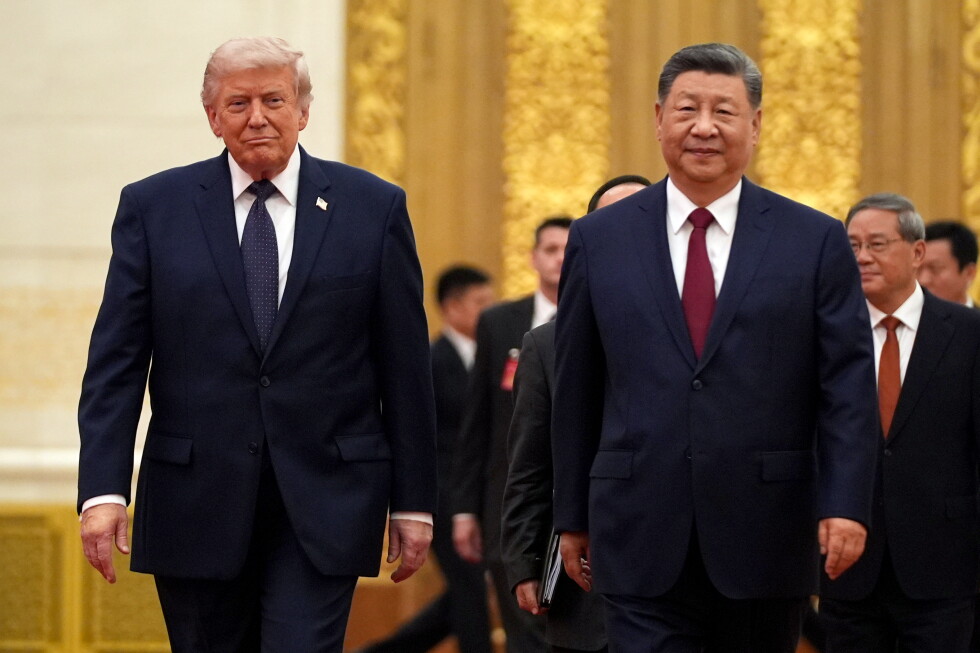
    Coblentz also voiced hope that upcoming talks between US President Donald Trump and Chinese President Xi Jinping, scheduled for mid-May in China, will break down existing trade and technology barriers and shift the relationship from pure competition to complementary collaboration. His remarks referenced ongoing contract negotiation challenges between ITER and American firms, where trade barriers have created unnecessary delays and added costs. During a speech at the Fusion Industry event organized by Economist Impact on April 14, Coblentz shared a surprising anecdote about US Senator Joe Manchin, a prominent critic of Chinese technology policy who has publicly accused Chinese scientists of intellectual property theft from US research labs. After touring the ITER assembly hall in 2022, Manchin told a gathering of 30 US ITER staff that he saw, for the first time in years, a “light at the end of the tunnel” for global energy security, and even a path to long-term world peace. Manchin noted that many historical conflicts have been rooted in competition over energy access, and observed that the ITER site brings together scientists and engineers speaking Mandarin, French, Italian, English, Russian and dozens of other languages—proof that if fusion succeeds, it could fundamentally rewrite the rules of global geopolitics.

    ITER, the foundational global fusion project, traces its origins back to 1986, when Euratom, Japan, the Soviet Union and the United States agreed to co-design a large-scale international fusion test facility. Concept development began in 1988, with the final design approved in 2001, laying the groundwork for one of the most ambitious international scientific collaborations in modern history. Construction launched in 2013 with an initial budget of 6 billion euros ($6.8 billion), but costs have ballooned far beyond initial projections: ITER’s official 2021 estimate put total costs at roughly 22 billion euros, while the US Department of Energy projects total costs could reach $65 billion by 2039, the current target date for full fusion operations. The European Union covers 45.6% of ITER’s total costs, with China, India, Japan, South Korea, Russia and the United States each contributing approximately 9.1%.

    Despite the long history of multinational collaboration on ITER, a growing cohort of US experts are warning that the West risks falling behind China’s rapid fusion expansion, pointing to China’s close diplomatic and trade ties with US adversaries including Russia, Iran and North Korea. Ylli Bajraktari, president and CEO of the Special Competitive Studies Project (SCSP), a non-partisan US think tank, used an address at the same Fusion Fest event to warn that the West is at risk of repeating the same mistakes it made in other emerging clean energy sectors, where China now holds dominant global market share.

    “China didn’t create the original scientific breakthroughs for electric vehicles, solar panels or 5G infrastructure, but they prioritized government subsidies and scaled manufacturing capacity rapidly, and that strategy paid off massively,” Bajraktari argued. “China didn’t scale solar manufacturing just to hit net-zero emissions targets; they sold panels at below production cost to lock in global economic dependence. The same scenario will play out in fusion if the US and EU don’t move quickly and coordinate closely.”

    Bajraktari noted that since the Lawrence Livermore National Ignition Facility achieved the first net energy gain from fusion three years ago, China has invested $6.5 billion in new fusion infrastructure—with independent analysts putting the actual figure as high as $10 to $13 billion, a level of spending that outpaces current US investment. He outlined four major public projects that form the backbone of China’s national fusion strategy: the Chinese Fusion Engineering Testing Reactor (CRAFT) and Burning Plasma Experimental Superconducting Tokamak (BEST) in Hefei, Anhui, an integrated research campus designed to move from component testing to grid-connected net fusion power demonstration by the end of this decade; the Xinghuo fission-fusion hybrid reactor in Nanchang, Jiangxi, which targets 100 megawatts of output by the early 2030s; the Shengguang-IV laser fusion facility in Mianyang, Sichuan, a large inertial confinement fusion facility estimated to be far larger than the US National Ignition Facility; and the long-running Experimental Advanced Superconducting Tokamak (EAST) in Hefei, which has repeatedly set global records for plasma confinement and serves as the anchor of China’s domestic fusion research program.

    Beyond large-scale test facilities, Bajraktari emphasized that China is also investing heavily across the entire fusion supply chain: scaling domestic production of high-temperature superconductors for fusion magnets, tightening export controls on critical raw materials including gallium and germanium, securing long-term access to copper and other key resources through overseas investment, and expanding domestic capacity in precision manufacturing and advanced components. “Control of the fusion supply chain is an existential threat to the West’s long-term energy future,” he said. “We can’t outcompete China by copying their state-driven model. For the West to succeed, we need to collaborate across our allied bloc.” Bajraktari outlined a proposed allied division of labor that leverages each partner’s existing strengths: the United Kingdom leads in magnetic confinement and radiation-resistant robotics, the US in inertial confinement, beryllium supply and venture-backed private innovation, Germany in laser technology, and Japan in high-performance superconductors. “It’s time to stop treating fusion like a distant academic science project,” he said. “It’s no longer a curiosity. We need to take it as seriously as China does—this is critical national infrastructure that we have to build.”

    Global fusion development currently follows two primary technical pathways: magnetic confinement fusion (MCF) and inertial confinement fusion (ICF). MCF is the more mature approach, which includes tokamak and stellarator designs: tokamaks use magnetic fields in a doughnut-shaped chamber to contain and heat plasma, while stellarators use complex twisted coils to achieve more stable long-term plasma confinement. ICF, by contrast, uses high-energy lasers or particle beams to rapidly compress and heat fusion fuel pellets to trigger the reaction, a pathway pursued most prominently at the US National Ignition Facility.

    China’s state-led fusion program pursues a diversified portfolio across both pathways, with active projects in tokamaks, stellarators and inertial confinement systems. Its EAST project, often nicknamed the “artificial sun,” made global headlines in January 2025 when it sustained plasma at 100 million degrees Celsius for 1,066 seconds, a new world record for fusion plasma confinement. The EAST program aligns closely with research at France’s WEST tokamak, which tests tungsten plasma-facing components and steady-state plasma conditions to support ITER development. As a core ITER member, China has not only absorbed European tokamak technology through the project but has also emerged as a key supplier of large-scale critical components: in April 2025, China shipped key oversize components for ITER’s tokamak magnet feeder system to the project site in southern France.

    In contrast to China’s state-driven model, the US Department of Energy supports a market-driven approach that prioritizes funding for private fusion firms. Current US funding supports projects including Commonwealth Fusion Systems’ tokamak development, Type One Energy Group’s stellarator program, and Xcimer Energy’s laser-based inertial confinement fusion work. Jennifer Arrigo, senior adviser for fusion energy sciences at the US Department of Energy, acknowledged that China is a major global fusion player but emphasized that the West’s core advantage lies in dynamic public-private collaboration. “China is one of the big players in this space, but if you look at the innovation ecosystem across the US and Europe, the partnership between private industry and government is just as powerful,” Arrigo said. “It’s critical that we support our domestic industry and lead on inclusive international collaboration with our allies. That’s how we win the fusion race—by keeping it a global endeavor with the US at the center of that effort.”

    In comments to Asia Times, Arrigo added that a core goal of the US Fusion Science and Technology Roadmap, launched in October 2025, is to build out a diversified domestic and allied supply chain. The Department of Energy is currently working with fusion-related private firms, supporting university spinouts and expanding domestic industrial capacity, with the explicit goal of reducing reliance on Chinese parts, components and services and securing alternative supply sources across the US and its allied partners.

    Last month, Duan Xuru, chief scientist for fusion energy at China National Nuclear Corporation, noted that global commercial fusion development is accelerating faster than many forecasts predicted. Following China’s phased, risk-mitigation strategy, the country aims to complete its first full-scale engineering test reactor by around 2035 and a full commercial demonstration reactor by approximately 2045, putting it on track to be one of the first nations to deploy grid-connected commercial fusion power.

  • Taiwan president cancels trip after African countries close airspace

    Taiwan president cancels trip after African countries close airspace

    A landmark development in cross-strait diplomatic tensions has forced Taiwan leader Lai Ching-te to scrap a planned overseas trip to Eswatini, marking the first publicly recorded instance of a Taiwanese leader abandoning a foreign journey after multiple countries revoked required overflight access.

    Lai was scheduled to travel to the southern African nation, Taiwan’s only remaining diplomatic ally on the continent, to participate in celebrations marking 40 years of King Mswati III’s reign. According to senior Taiwanese officials, three island nations in the Indian Ocean — Seychelles, Mauritius and Madagascar — withdrew their previously granted overflight permissions following what Taipei describes as “intense pressure” and economic coercion from Beijing.

    In a public statement posted to the social platform X, Lai pushed back against Beijing’s actions, framing the permit revocations as clear examples of authoritarian coercion that highlight broader threats to global international order. “No amount of threats or coercion will shake Taiwan’s resolve to engage with the world,” Lai wrote.

    For its part, Beijing has rejected accusations of coercion, instead praising the three African countries for upholding the long-standing one-China principle, which forms the foundation of Beijing’s territorial claim to the self-governing island. In official comments, a spokesperson for China’s Taiwan Affairs Office expressed “high appreciation” for the position taken by Seychelles, Mauritius and Madagascar. China’s Ministry of Foreign Affairs went further, reiterating that no official title of “President of the Republic of China” holds any international recognition, in a direct rebuke of Lai’s status. Both Seychelles and Madagascar have publicly confirmed their decision to revoke permits stems from their non-recognition of Taiwan as a sovereign state, aligning with Beijing’s position.

    Eswatini’s government has expressed regret over the canceled visit but emphasized that the disruption will not alter the long-standing bilateral diplomatic ties between the two nations. Currently, only 12 United Nations member states around the world recognize Taiwan diplomatically, most of them small island nations in Latin America and the Pacific.

    Cross-strait relations have remained strained since Lai took office, with Beijing repeatedly labeling Lai a “troublemaker” who threatens cross-strait peace. Beijing maintains that Taiwan is an inalienable part of Chinese territory, a position it has defended for decades, and has not ruled out the use of military force to bring the island under its control. Most of the international community, including the United Nations, recognizes the one-China principle, though many Western nations maintain unofficial economic and cultural ties with Taiwan.

    The cancellation has already drawn criticism from U.S. political leaders. The majority staff of the U.S. House Foreign Affairs Committee issued a statement on X affirming that it “stood with Taiwan against this blatant coercion.” U.S. Senator Ted Cruz also publicly condemned Mauritius’s decision, claiming the country was “determined to ally with the Chinese Communist Party.”