标签: Asia

亚洲

  • Taiwan president cancels trip after African countries close airspace

    Taiwan president cancels trip after African countries close airspace

    A landmark development in cross-strait diplomatic tensions has forced Taiwan leader Lai Ching-te to scrap a planned overseas trip to Eswatini, marking the first publicly recorded instance of a Taiwanese leader abandoning a foreign journey after multiple countries revoked required overflight access.

    Lai was scheduled to travel to the southern African nation, Taiwan’s only remaining diplomatic ally on the continent, to participate in celebrations marking 40 years of King Mswati III’s reign. According to senior Taiwanese officials, three island nations in the Indian Ocean — Seychelles, Mauritius and Madagascar — withdrew their previously granted overflight permissions following what Taipei describes as “intense pressure” and economic coercion from Beijing.

    In a public statement posted to the social platform X, Lai pushed back against Beijing’s actions, framing the permit revocations as clear examples of authoritarian coercion that highlight broader threats to global international order. “No amount of threats or coercion will shake Taiwan’s resolve to engage with the world,” Lai wrote.

    For its part, Beijing has rejected accusations of coercion, instead praising the three African countries for upholding the long-standing one-China principle, which forms the foundation of Beijing’s territorial claim to the self-governing island. In official comments, a spokesperson for China’s Taiwan Affairs Office expressed “high appreciation” for the position taken by Seychelles, Mauritius and Madagascar. China’s Ministry of Foreign Affairs went further, reiterating that no official title of “President of the Republic of China” holds any international recognition, in a direct rebuke of Lai’s status. Both Seychelles and Madagascar have publicly confirmed their decision to revoke permits stems from their non-recognition of Taiwan as a sovereign state, aligning with Beijing’s position.

    Eswatini’s government has expressed regret over the canceled visit but emphasized that the disruption will not alter the long-standing bilateral diplomatic ties between the two nations. Currently, only 12 United Nations member states around the world recognize Taiwan diplomatically, most of them small island nations in Latin America and the Pacific.

    Cross-strait relations have remained strained since Lai took office, with Beijing repeatedly labeling Lai a “troublemaker” who threatens cross-strait peace. Beijing maintains that Taiwan is an inalienable part of Chinese territory, a position it has defended for decades, and has not ruled out the use of military force to bring the island under its control. Most of the international community, including the United Nations, recognizes the one-China principle, though many Western nations maintain unofficial economic and cultural ties with Taiwan.

    The cancellation has already drawn criticism from U.S. political leaders. The majority staff of the U.S. House Foreign Affairs Committee issued a statement on X affirming that it “stood with Taiwan against this blatant coercion.” U.S. Senator Ted Cruz also publicly condemned Mauritius’s decision, claiming the country was “determined to ally with the Chinese Communist Party.”

  • Thirteen killed in second India fireworks blast in three days

    Thirteen killed in second India fireworks blast in three days

    A devastating explosion at an illegal makeshift firecracker assembly site in India’s southern Kerala state has left at least 13 people dead and multiple others critically injured, marking the second fatal industrial disaster in the country’s fireworks sector within seven days.

    The blast struck shortly after 3 p.m. local time on Tuesday in the city of Thrissur, where roughly 40 workers were gathering to assemble fireworks ahead of the upcoming Thrissur Pooram, one of India’s most prominent annual Hindu temple festivals. Local authorities confirmed that five of the injured are in life-threatening condition, and damage from the explosion extended to nearby residential structures, with the shockwave felt as far as several kilometers away — so powerful that many local residents initially misidentified it as an earthquake.

    Witnesses reported chaotic scenes in the immediate aftermath of the blast, with local residents rushing to the site to pull survivors and deceased victims out of the rubble before official emergency teams arrived. The response effort was significantly hampered by the location of the temporary assembly sheds: the structures were built alongside rural paddy fields with narrow, unpaved access roads that slowed the arrival of fire trucks and ambulances. The initial blast also triggered a series of secondary smaller explosions from stored firework materials, forcing rescuers to pause operations while hazards were neutralized.

    Officials confirmed the workers were contracted to produce fireworks for the Thiruvambady Temple, one of the two main temple groups that host the iconic competitive fireworks display that is the centerpiece of the 7-day Thrissur Pooram festival. Kerala’s Revenue Minister K Rajan told reporters that the organizing committee held official permission to produce and store fireworks in designated, regulated areas, but it remains unclear why assembly was taking place at the unauthorized rural makeshift site. Food preparations for roughly 40 workers were found at the site, confirming that a large workforce was present when the explosion occurred, though an exact headcount remained incomplete in the hours after the disaster.

    While the exact cause of the blast has not been confirmed, Thrissur’s municipal chairman PN Surendran told reporters that high mid-afternoon temperatures may have been a contributing factor. “There is still no clarity on how many workers were in the shed or the full extent of injuries,” Surendran said. “It is suspected that extreme heat may have triggered this tragedy.”

    This explosion comes just three days after a separate blast at a firecracker factory in neighboring Tamil Nadu state killed 25 people, bringing the total death toll from fireworks sector accidents in south India this week to 38. Deadly explosions are an endemic, recurring crisis in India’s $1 billion fireworks industry, which supplies pyrotechnics for religious festivals, weddings, and cultural celebrations across the country. The sector is dominated by informal, unregulated small-scale operations that handle highly explosive raw chemicals in cramped, low-cost facilities, where even a tiny stray spark can trigger a catastrophic blast.

    India’s largest fireworks production hub is Sivakasi in Tamil Nadu, which produces more than 90% of the country’s domestic firecracker supply. A 2010 study documented nearly 10,000 fireworks-related accidents in Sivakasi between 2003 and 2010 alone, including almost 400 fatal incidents. Weak regulatory enforcement and surging consumer demand ahead of major festivals like Diwali routinely push safety protocols to the background, with factory owners often cutting corners to meet deadlines and keep costs low.

    Kerala has already seen one of the deadliest fireworks disasters in Indian history: a 2016 explosion at an unauthorized fireworks display at the Puttingal Temple in Kollam killed more than 100 people and injured 400 others. Investigations later found that basic safety rules were completely ignored, with explosives stored in unregulated makeshift sheds, and community competitive pressure overriding existing safety regulations.

    In response to Tuesday’s disaster, Kerala authorities have ordered a full magisterial inquiry to determine the cause of the blast and assign responsibility for any safety violations. Kerala Chief Minister Pinarayi Vijayan has announced that the state government will bring in specialized burn care experts from other regions of India if needed to treat injured victims. Indian Prime Minister Narendra Modi also released a statement offering condolences and announcing official financial assistance: 200,000 Indian rupees (roughly $2,140) for each victim’s family, and 50,000 rupees for each injured survivor.

  • Asian benchmarks are mixed in cautious trading amid uncertainty about US-Iran ceasefire talks

    Asian benchmarks are mixed in cautious trading amid uncertainty about US-Iran ceasefire talks

    Global financial markets traded with caution on Wednesday, as investors held their breath for developments in U.S.-Iran diplomatic efforts following a last-minute extension of a temporary ceasefire that was scheduled to expire.

    The day of trading kicked off in Asian markets, where benchmark indexes delivered a mixed performance amid ongoing uncertainty. Japan’s Nikkei 225 notched a 0.3% uptick to close at 59,530.64, while South Korea’s Kospi followed suit with a 0.4% gain to reach 6,413.62. Mainland China’s Shanghai Composite also edged up 0.3% to end the session at 4,096.59. On the downside, Australia’s S&P/ASX 200 dropped 1.2% to 8,841.00, and Hong Kong’s Hang Seng Index fell 1.3% to settle at 26,140.05.

    Sentiment shifted lower across the Atlantic in U.S. trading after U.S. Vice President JD Vance announced the cancellation of a planned trip to Pakistan, where he was set to lead a U.S. negotiating delegation in talks with Iranian representatives aimed at extending the ceasefire. The S&P 500 wiped out early gains to finish 0.6% lower at 7,064.01, while both the Dow Jones Industrial Average and the Nasdaq Composite also recorded 0.6% drops, closing at 49,149.38 and 24,259.96 respectively. Less than 10 minutes after the U.S. market closed for the day, former President Donald Trump confirmed he would extend the ceasefire to give Iran additional time to draft and submit a formal proposal to end the ongoing conflict.

    Energy markets also saw muted movement after weeks of volatility tied to the conflict. Benchmark U.S. crude slipped 19 cents to trade at $89.48 per barrel during Wednesday’s Asian session, while Brent crude, the global benchmark for oil pricing, lost 12 cents to settle at $98.36 per barrel. These small shifts stand in sharp contrast to the extreme swings that roiled markets in the early days of the conflict, when Brent crude briefly spiked above $119 per barrel and the S&P 500 dropped nearly 10% below its previous all-time high.

    Much of the market’s focus has centered on the Strait of Hormuz, the critical narrow waterway running along Iran’s coast that carries a large share of the world’s daily oil shipments out of the Persian Gulf. Net oil importers such as Japan, which sources nearly all of its crude through global shipping lanes, have already taken proactive steps: the Japanese government has released strategic petroleum reserves and is evaluating alternative shipping routes to mitigate potential supply disruptions.

    Despite the lingering uncertainty, U.S. stocks remain near the record high set just the previous Friday, a signal that investors still hold cautious optimism that Washington and Tehran will avoid a full-scale escalation that would trigger severe economic damage. Tim Waterer, chief market analyst at KCM Trade, noted that Trump’s last-minute extension preserves the current uneasy standoff rather than resolving the underlying conflict. “While the pause has reduced immediate tail risks, the absence of a genuine breakthrough means traders remain inclined to tiptoe rather than trade with real conviction,” Waterer explained.

    In other asset classes, the 10-year U.S. Treasury yield rose to 4.31%, up from 4.26% recorded at the close of Monday’s session, with gains accelerating through the day alongside modest movement in oil prices. In foreign exchange markets, the U.S. dollar edged slightly lower against the Japanese yen, falling to 159.33 yen from 159.38 yen. The euro also slipped marginally to $1.1740, down from $1.1744 in the previous session.

  • Trump extends Iran ceasefire with fate of Pakistan talks left uncertain

    Trump extends Iran ceasefire with fate of Pakistan talks left uncertain

    Hours before a two-week U.S.-Iran ceasefire was scheduled to expire on Tuesday, former U.S. President Donald Trump announced a vague extension of the truce, throwing the future of planned bilateral peace talks into deep uncertainty.

    In an official White House statement, Trump explained his decision to extend the ceasefire came at a formal request from Pakistan’s Chief of Army Staff Asim Munir and Prime Minister Shehbaz Sharif. He argued that Iran’s ruling government is “seriously fractured” and requires additional time to coalesce around a unified negotiating position to present to U.S. mediators. As part of the extension, Trump confirmed he has ordered U.S. military forces to maintain the ongoing naval blockade of Iran, with the truce remaining in place until Iran submits its formal proposal.

    The two-week initial ceasefire has largely held across the region, bringing a much-needed reprieve to both sides. For Iran, which has endured heavy airstrikes from the U.S., Israel, and U.S.-aligned Gulf Arab allies, the truce halted widespread destructive attacks. For oil-rich Gulf states, which faced thousands of incoming Iranian ballistic missile and drone strikes in preceding weeks, the ceasefire similarly ended persistent security threats.

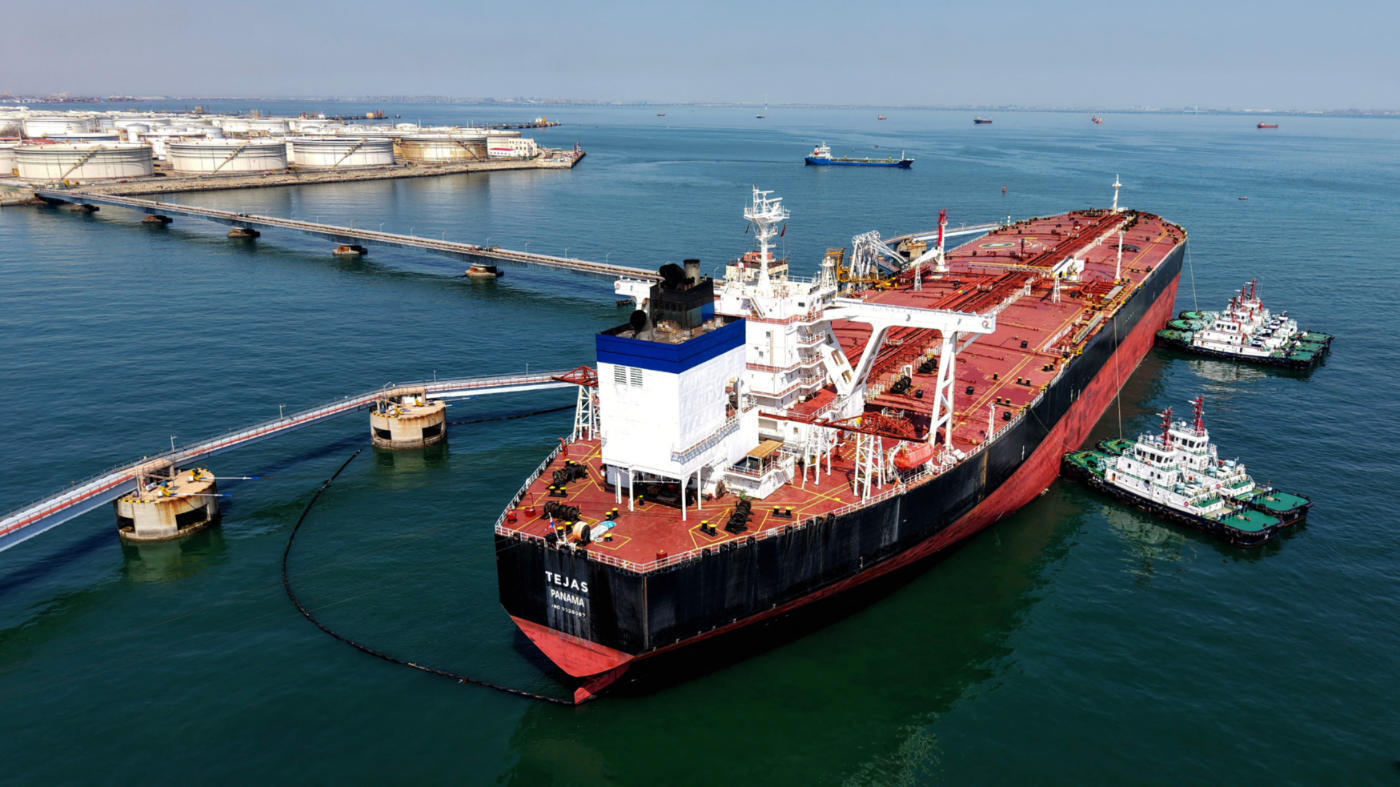
    Instead of continuing offensive strikes, Trump adopted a strategy of naval blockade, framed as a response to Tehran’s seizure of partial control over the Strait of Hormuz and its selective permission for commercial vessels to transit the critical waterway. On Tuesday, the U.S. military carried out its first high-profile action under the blockade: U.S. troops boarded the crude oil tanker *Tifani* in the Indian Ocean via helicopter, seizing the vessel that had already been sanctioned for transporting Iranian crude oil to China. The U.S. Department of War published official footage of the operation to the public.

    Speaking to CNBC on Tuesday, Trump asserted that the blockade was delivering successful results, claiming “We totally control the Strait, just so you understand, for all the fake news out there.” However, his claim directly contradicts reporting from independent maritime intelligence groups, which confirm Iranian commercial vessels continue to transit the Strait of Hormuz and Gulf of Oman – areas where U.S. naval forces are concentrated. Leading maritime publication Lloyd’s List reported that at least 26 vessels have successfully bypassed the U.S. blockade to date, including 11 tankers carrying Iranian oil cargo.

    This conflicting account is just the latest example of inconsistent messaging from the Trump administration on its Iran policy. The collapse of planned talks has further muddied the outlook: just this week, global attention was focused on Vice President JD Vance, who was widely expected to travel to Pakistan for a second round of direct negotiations with Iranian delegates. CNN later reported Tuesday afternoon that Vance remained at the White House alongside Trump, joined by Secretary of State Marco Rubio and Secretary of War Pete Hegseth for emergency consultations.

    Iran has already ruled out participation in the planned talks, blaming excessive U.S. demands for the breakdown. Semi-official Iranian news agency Tasnim reported Tuesday that Tehran had already canceled plans to send a negotiating delegation to Islamabad, arguing that engaging with U.S. mediators would be a waste of time while Washington continues to obstruct any mutually acceptable agreement.

    Tensions have further escalated amid new Iranian threats. The Islamic Revolutionary Guard Corps (IRGC) warned Tuesday that it would shut down all oil production across the Persian Gulf if any new attacks against Iran are launched from Gulf Arab states. “The southern neighbours should know that if their geography and facilities are used in the service of the enemies to attack the Iranian nation, they should bid farewell to oil production in the Middle East,” Fars News Agency quoted IRGC Aerospace Force Commander Majid Mousavi as saying.

    The breakdown of talks has sent a shockwave through the Middle East, reintroducing widespread uncertainty across the region just one week after rising diplomatic optimism. Last week, hopes for a diplomatic breakthrough grew significantly after the Trump administration announced a ceasefire in Lebanon, a core precondition Iran had set for advancing negotiations.

    This report was originally compiled by Middle East Eye, an independent outlet specializing in coverage of the Middle East and North Africa region.

  • Trump extends US ceasefire with Iran

    Trump extends US ceasefire with Iran

    WASHINGTON D.C. – U.S. President Donald Trump announced Tuesday that he will extend the ongoing temporary truce between the United States and Iran, just one day before the original two-week ceasefire was scheduled to expire Wednesday evening.

    In a public post shared to his social media platform Truth Social, Trump outlined the key factors that led to his decision to extend the pause in offensive actions. He cited two core drivers: the well-documented, widely anticipated deep internal political fracture within Iran’s governing institutions, and a formal request from top Pakistani leaders to hold off on any planned military strikes against Iran.

    “Upon the request of Field Marshal Asim Munir, and Prime Minister Shehbaz Sharif, of Pakistan, we have been asked to hold our Attack on the Country of Iran until such time as their leaders and representatives can come up with a unified proposal,” Trump wrote in the post.

    The U.S. president confirmed the ceasefire will remain in place indefinitely for the time being, staying active until Iranian representatives submit their unified proposal and bilateral discussions reach a conclusion, regardless of the final outcome of those talks.

    While offensive military operations will remain on hold, Trump emphasized that the U.S. military will maintain its current blockade of Iran and will stay fully postured to respond to any emerging threats. He noted U.S. forces remain “ready and able” to carry out any necessary actions if the negotiated process fails to deliver an acceptable outcome.

    The extension marks a temporary de-escalation of tensions between the two nations, which had spiked in recent weeks ahead of the original truce taking effect, and leaves the window open for diplomatic efforts to resolve ongoing disputes through negotiation rather than military conflict.

  • Japan records 5th straight fiscal year of trade deficits as Trump’s tariffs hit auto exports

    Japan records 5th straight fiscal year of trade deficits as Trump’s tariffs hit auto exports

    TOKYO – Japan has extended its streak of annual trade deficits to five consecutive fiscal years, according to official data released Wednesday by the Japanese government. The nation recorded a 1.7 trillion yen ($10.7 billion) deficit in the 12-month period ending March 2025, marking the fifth straight shortfall despite modest growth in exports across the full year.

    Finance Ministry figures show that overall Japanese exports climbed 4% year-over-year in the full fiscal year, while import volumes edged up by only 0.5% amid shifting global demand and commodity price stabilization. The biggest drag on annual export performance came from the United States market, where former U.S. President Donald Trump’s legacy of elevated tariffs on Japanese and other Asian imports has hit the country’s key manufacturing sectors particularly hard. Total Japanese exports to the U.S. dropped 6.6% over the full fiscal year, with auto shipments — one of Japan’s flagship export categories — plummeting 16% amid the ongoing tariff regime.

    To mitigate the impact of U.S. trade policy shifts, most of Japan’s largest automotive manufacturers, including industry leader Toyota Motor Corp., have shifted the bulk of their production to North American and other regional facilities to build vehicles close to their end markets. Even with this strategic relocation, a number of Japanese automakers still ship a large share of their specialty and high-volume models directly from Japan to the U.S., leaving them exposed to ongoing tariff costs.

    Encouragingly, latest monthly data points to an emerging turnaround for Japan’s export sector. In March alone, the country’s trade surplus jumped 26% from the same month a year earlier, with overall exports surging nearly 11.7% year-over-year and imports rising by 10.9%. The strong March performance signals that Japanese exporters are gradually bouncing back from the macroeconomic shocks that dampened trade over the previous year.

    Beyond trade policy headwinds, Japan also faces growing energy security risks tied to ongoing conflict in the Middle East. As a nation that imports nearly 100% of its oil and natural gas to power its economy, Japan is deeply vulnerable to any disruptions to Middle Eastern energy shipments, particularly amid the Iran conflict that has threatened traffic through the Strait of Hormuz — the strategic chokepoint that carries the bulk of Asia’s energy supplies, which is effectively closed to commercial traffic due to the fighting.

    Energy disruptions would carry ripple effects beyond just power generation for Japan: reduced oil supplies would cut production of naphtha-derived products, a core input for manufacturing medical supplies and a wide range of plastic goods critical to both industrial and consumer sectors. To ease public anxiety over potential shortages, the Japanese government has highlighted that the country holds 254 days of strategic oil reserves, a system established after the 1970s global oil crisis to prepare for exactly such supply emergencies. Authorities have already begun releasing portions of these reserves to keep global and domestic markets stable, and are also accelerating work to develop alternative oil shipping routes that bypass the Strait of Hormuz.

  • World’s biggest condom maker to raise prices due to Iran war

    World’s biggest condom maker to raise prices due to Iran war

    The ongoing conflict between Iran and the US-Israel coalition is rippling far beyond global energy markets, now threatening to push up consumer prices for a critical everyday product: condoms. Goh Miah Kiat, chief executive officer of Malaysia-based Karex — the world’s largest condom manufacturer — has announced that the company could raise retail prices by as much as 30%, with even steeper increases possible if hostilities continue to disrupt key raw material supplies.

    Karex is an industry powerhouse, churning out more than five billion condoms annually to supply major global brands including Durex and Trojan, as well as public health systems such as the UK’s National Health Service. In recent interviews with Reuters and Bloomberg, Goh explained that production costs have skyrocketed since the outbreak of the conflict, driven by widespread disruptions to oil and petrochemical supplies that the company depends on.

    The crisis centers on the Strait of Hormuz, one of the world’s most vital maritime chokepoints. After Iran responded to US and Israeli airstrikes by threatening to target commercial shipping passing through the waterway, the strait has effectively been closed to regular traffic. Approximately 20% of the world’s crude oil, liquefied natural gas, and key petrochemical products normally move through this route, so the closure has sent shockwaves through global supply chains.

    For Karex, this disruption hits directly at its core production inputs. The manufacturer relies on petroleum-derived materials for its products: ammonia, a petrochemical byproduct used to preserve latex, and silicone-based lubricants, both of which have seen sharp price increases and supply shortages since the strait closure.

    Compounding the issue, demand for condoms has already jumped by roughly 30% globally this year. Elevated freight costs and widespread shipping delays have further tightened supplies, creating a perfect storm of constrained production and rising consumer need. Goh noted that this demand surge follows a clear trend during periods of economic and geopolitical uncertainty: when people face unclear job prospects and future instability, they are far more likely to prioritize avoiding unplanned pregnancies. “In bad times, the need to use condoms is even more because you’re uncertain with your future, whether you’d still have a job next year,” he told Bloomberg. “If you have a baby right now, you’ll have one more mouth to feed.”

    The impending price increase at Karex highlights a little-discussed downstream impact of the Iran conflict: while much of the global focus has been on rising energy prices, the disruption to petrochemical supply chains is pushing up costs for a huge range of consumer goods that few people connect to oil markets.

    As of Wednesday, the outlook for de-escalation remains uncertain. US President Donald Trump has announced he will extend a bilateral ceasefire between the US and Iran while peace negotiations progress, but there has been no clear update on the status of talks or a timeline for a lasting resolution.

  • Domestic workers legally recognised in Indonesia after ’22-year struggle’

    Domestic workers legally recognised in Indonesia after ’22-year struggle’

    After more than two decades of stalled negotiations and persistent grassroots advocacy, Indonesia’s parliament has finally enacted a groundbreaking law that formally recognizes and protects the rights of the nation’s 4.2 million domestic workers, a workforce overwhelmingly made up of women.

    For years, this critical segment of the Indonesian labor force existed in a legal gray area: prior to this new legislation, domestic workers were not officially classified as workers under national labor regulations, leaving them vulnerable to exploitation, abuse, and poverty with no formal recourse. An estimated 90% of all domestic workers in Indonesia are women, many of whom have long faced systemic marginalization in informal work arrangements that lack basic social protections.

    The Domestic Workers Protection Law, which was first introduced to legislative chambers back in 2004, delivers sweeping new guarantees for domestic workers across the country. Under the new framework, workers will be legally entitled to paid rest days, public health insurance coverage, and formal pension benefits. The legislation also bars recruitment and placement agencies from withholding any portion of workers’ wages as placement fees, and imposes an outright ban on child domestic labor, making it illegal to hire any person under the age of 18 for full-time domestic work.

    Emotional reactions greeted the final passage of the bill, with many long-time advocates and domestic workers describing the moment as the fruition of a decades-long fight for dignity. “It feels like a dream,” Ajeng Astuti, a domestic worker, told BBC Indonesian. “This is our 22-year struggle as marginalized women to gain protection.” Jumiyem, a domestic worker based in Yogyakarta, echoed that sentiment, saying “We’ve been longing for this [law], and now we can feel it.”

    The legislation faced repeated setbacks over its 22-year journey to passage: after its initial introduction in 2004, the bill hit one legislative roadblock after another, with parliamentary discussions put on hold for more than a decade before being revived for debate in 2020. Now that the bill has been signed into law, national regulators have one year to develop detailed implementing regulations that will lay out how the new protections will be enforced across the country.

    Before the new law, even as domestic workers played an unseen but foundational role in Indonesian households and the broader national economy, millions remained completely outside the protection of existing labor laws. Most worked in informal arrangements with no written employment contract, many logging 12-hour or longer workdays for substandard wages, and reports have documented children as young as 12 being pushed into full-time domestic work.

    While human and labor rights organizations have widely praised the law as a historic step forward for worker protections, they caution that the work to secure dignity for domestic workers is far from finished. Lita Anggraini, a representative of Jala PRT, one of Indonesia’s leading domestic worker advocacy groups, told AFP that widespread public education campaigns will be critical to inform employers of their new legal obligations under the law.

    Advocacy groups point to ongoing systemic abuse that the new law must address: between 2021 and 2024, Jala PRT documented more than 3,300 reported cases of violence against domestic workers, including instances of severe physical assault and ongoing psychological abuse. The new legal framework marks the first major national effort to curb these abuses and bring millions of marginalized workers under the protection of the law.

  • Who is calling the shots in Iran?

    Who is calling the shots in Iran?

    A sudden diplomatic reversal following recent US-Iran talks in Islamabad has laid bare the dramatic new power dynamic reshaping Iran in the wake of six weeks of coordinated US-Israeli military strikes. On April 17, Iranian foreign minister and lead nuclear negotiator Abbas Araghchi took to the social platform X to announce that the strategically critical Strait of Hormuz was “completely open,” a signal that Tehran was prepared to show flexibility on two sticking points in negotiations: uranium enrichment limits and Iranian support for regional proxy armed groups.

    Within days, however, that public outreach was completely reversed following backlash from Iran’s most powerful institution. Mohammad Bagher Zolghadr, a former Islamic Revolutionary Guards Corps (IRGC) commander newly appointed as secretary of Iran’s Supreme National Security Council, filed a formal complaint criticizing Araghchi for deviating from the negotiating mandate set by the IRGC leadership. The entire Iranian negotiating delegation was recalled to Tehran, state-run media launched scathing attacks on Araghchi, warning that his public statement had handed then-US President Donald Trump a political opening to falsely declare victory in the conflict, and the Iranian government issued a new declaration that the Strait of Hormuz was closed.

    This high-profile public clash is not an isolated misstep, argues King’s College London defense studies associate professor Andreas Krieg in analysis shared via The Conversation. It is the clearest visible indicator of a permanent power shift that has transformed Iran’s political order: the IRGC now holds total control over all state decision-making, while civilian and traditional religious institutions have been reduced to little more than a ceremonial facade.

    The decapitation strikes that opened the US-Israeli military campaign eliminated decades of entrenched Iranian leadership. Supreme Leader Ali Khamenei was killed in the opening day attack, alongside dozens of his most senior colleagues. Where Iran was once described as a sovereign state with an exceptionally powerful militia, Krieg argues the new reality is the opposite: Iran is now a powerful militia with a state, structured entirely around the IRGC as its core governing authority.

    Traditional centers of Iranian power, including the elected civilian government and the senior Shia clergy, have been pushed to the margins as mere front organizations. Even the newly appointed supreme leader, Mojtaba Khamenei, son of the late Ali Khamenei, functions only as a symbolic legitimizing figure. Multiple reports confirm Mojtaba Khamenei sustained severe injuries in the strike that killed his father, and he plays no active role in governing the country.

    The undisputed holder of power in contemporary Iran is IRGC leader Ahmad Vahidi, a founding member of the corps with decades of experience in Iranian security and politics. The IRGC was founded immediately after the 1979 Islamic Revolution, when Ayatollah Ruhollah Khomeini and his allies distrusted the existing conventional military and state bureaucracy to protect the new revolutionary order. Over the subsequent 47 years, the IRGC expanded far beyond its original mandate as guardians of the revolution, evolving into an all-encompassing network that spans every sector of Iranian life: it operates a conventional military force, a domestic intelligence apparatus, a multi-billion dollar transnational economic conglomerate, and a regional expeditionary network that projects Iranian power across the Middle East.

    Its domestic arm, the Basij militia, enables mass social control across Iran’s population, while the elite Quds Force manages the IRGC’s network of proxy armed groups across Lebanon, Iraq, Syria, Yemen and other regional states. Far from dismantling this network, decades of international sanctions against Iran actually strengthened it: sanctions pushed the IRGC to build a sprawling web of front companies for illicit trade and patronage networks that enriched IRGC-aligned elites, creating a parallel state that gradually outgrew the formal civilian government in both power and influence.

    The IRGC’s organizational structure is built around a “mosaic defense doctrine,” a decentralized network design with a centralized core that sets strategic direction, surrounded by semi-autonomous cells that can continue operating even after decapitation strikes that eliminate top leadership. This structure was explicitly designed to allow the IRGC to keep functioning even when facing large-scale military attacks targeting its command structure, a design that has been vindicated by recent events.

    After IRGC chief Mohammad Pakpour was killed on the opening day of the conflict, Vahidi— a former Iranian interior minister and founding IRGC figure— stepped into the top role in an emergency appointment. He has since consolidated full control over Iranian governance as civilian institutions have been hollowed out by war losses. With the new supreme leader incapacitated and the clergy sidelined, Vahidi and his coalition of hardline IRGC commanders and security council allies, including Ali Akbar Ahmadian and Zolghadr, now set all negotiating mandates and red lines for ongoing ceasefire and nuclear talks with the United States.

    The IRGC’s non-negotiable red lines are well-defined: it will not abandon its uranium enrichment program entirely, it will preserve its ballistic missile program and its regional network of proxy groups (known as the “axis of resistance”), it demands full lifting of international sanctions and the unfreezing of billions of dollars in Iranian overseas assets. Only narrow technical details, such as enrichment level limits, sanctions lifting timelines, and the formal language of any final agreement, are open to negotiation.

    The decimation of pragmatic Iranian political figures in Israeli strikes has cleared the last remaining obstacles to IRGC control. Former Supreme National Security Council secretary Ali Larijani, a leading pragmatic voice, was killed by an Israeli strike on March 16, leaving no prominent opposition to the IRGC’s hardline agenda. While the war accelerated the IRGC’s consolidation of power, Krieg notes this shift was decades in the making: the IRGC spent generations entrenching its influence across Iranian institutions, capturing economic assets, and building up its coercive capacity. The war only provided the final opportunity to eliminate competing power centers, most notably the senior clergy, and solidify total control.

    This new power structure has profound implications for ongoing US-Iran negotiations. US negotiators are not bargaining with independent civilian diplomats; every Iranian negotiator operates on a short leash held directly by the IRGC leadership. Any progress in talks cannot be measured by public statements from Iranian diplomats, but only by what the IRGC is actually willing to implement in practice.

    The US-Israeli decapitation strategy failed to break the IRGC’s structure, and the hardline network now finds itself emboldened, as it recognizes the White House is desperate to secure a diplomatic exit from the conflict. Krieg argues that assumptions the IRGC will quickly capitulate to US demands are unfounded wishful thinking.

    Recent events have confirmed that the IRGC now governs Iran as a militia with a state, using the formal civilian and religious institutions of the Islamic Republic as a public outer layer. While there remains space for negotiation to reach a mutually acceptable agreement, the US administration must approach talks with a clear-eyed understanding of the IRGC’s non-negotiable red lines, and the resilience of a hardened network that has repeatedly demonstrated it can absorb severe punishment and maintain control.

  • Japan’s easing of weapons export restrictions opposed

    Japan’s easing of weapons export restrictions opposed

    On Tuesday, two connected moves by the Japanese government sparked sharp condemnation from China and drew criticism from both domestic and international peace advocates, with observers warning that Tokyo’s accelerating remilitarization trajectory demands heightened global vigilance against resurgent Japanese neo-militarism.

    Early this week, Japan’s cabinet officially approved revisions to the country’s Three Principles on Transfer of Defense Equipment and Technology, along with associated implementation guidelines. The policy change clears legal and procedural barriers for the export of lethal weaponry, eliminating the longstanding requirement for prior parliamentary approval before such shipments can move forward.

    Chinese Foreign Ministry spokesman Guo Jiakun emphasized that this latest policy shift, paired with a string of other destabilizing developments in Japan’s military and security sphere, directly contradicts Tokyo’s repeated public claims of commitment to peace and its stated adherence to an exclusively defense-oriented national security policy. He recalled that Japan’s brutal wartime aggression and atrocities committed against China and other Asian nations gave rise to a series of binding international postwar legal frameworks, including the Cairo Declaration, the Potsdam Proclamation, and Japan’s own Instrument of Surrender. These documents explicitly require that Japan be completely disarmed and barred from maintaining industrial capacity that could enable large-scale rearmament. Furthermore, Japan’s own post-war Constitution imposes strict limits on the country’s military strength, its right to engage in belligerency, and its right to wage offensive war. For decades after World War II, Japan maintained tight restrictions on military expansion and arms exports under its exclusively defense-oriented principle, with a 1976 official policy stance committing the peaceful nation to strict caution on all arms exports.

    Guo noted that a growing community of experts and analysts share deep concerns that Japan is actively rebuilding its wartime military infrastructure and positioning itself to become a global exporter of lethal arms, with tangible steps toward accelerated remilitarization already well underway. In recent years alone, Japan has dramatically expanded its annual military budget, deployed intermediate-range offensive missiles, systematically rolled back arms export restrictions, proposed sweeping amendments to its pacifist post-war Constitution, and pushed to abandon its longstanding three non-nuclear principles.

    Lyu Yaodong, a senior researcher at the Chinese Academy of Social Sciences, pointed out that Tokyo’s primary justification for the new arms export rule changes — a claimed need to counter a so-called “China threat” — has no basis in fact. Lyu explained that the actual goals of the policy shift are twofold: to steadily erode the legal constraints imposed by Japan’s pacifist Constitution, and to open up new economic opportunities for Japanese defense contractors amid long-running domestic economic stagnation.

    Atsushi Koketsu, professor emeritus at Yamaguchi University, echoed these concerns, noting that Japan’s national security policy is increasingly being restructured around the misleading framing of “preparing for war in the name of peace”. For decades, the prospect of a remilitarized Japan has been a core source of concern for China and other Asian nations that suffered from Japanese wartime aggression, and that long-feared outcome is now becoming a tangible reality, Koketsu added.

    Even within Japan, opposition to the policy change remains strong. On Tuesday, hundreds of Japanese citizens who oppose constitutional revision gathered outside Prime Minister Sanae Takaichi’s official office, holding protest signs reading “Do not let Japan become a war merchant” and “No to exporting lethal weapons”.

    In a second provocative move that drew harsh Chinese condemnation on the same day, Prime Minister Takaichi sent a ritual offering to Tokyo’s Yasukuni Shrine, the iconic symbolic center of Japanese wartime militarism and aggression that honors 14 convicted Class-A World War II war criminals.

    Guo confirmed that Beijing has formally lodged solemn diplomatic representations with Tokyo over the offering, stating that Japan’s repeated provocative actions tied to the Yasukuni Shrine amount to a deliberate attempt to evade accountability for wartime atrocities, an affront to global justice, a direct provocation to the millions of people victimized by Japanese aggression, and a fundamental challenge to the internationally recognized outcome of World War II. These actions, Guo added, have been consistently condemned and rejected by the international community.

    Guo stressed that Japan now faces a clear choice: it can either allow the specter of pre-war militarism to spread, distort historical fact, and continue whitewashing its aggression-era crimes, or it can offer a deep, sincere reckoning with its wartime history, build a correct public narrative of the past, and earn back the trust of its Asian neighbors and the broader global community. Peace-loving forces across the world cannot allow resurgent neo-militarism to threaten regional peace and stability, Guo said, urging the entire international community to maintain close vigilance against Japan’s growing historical revisionism.