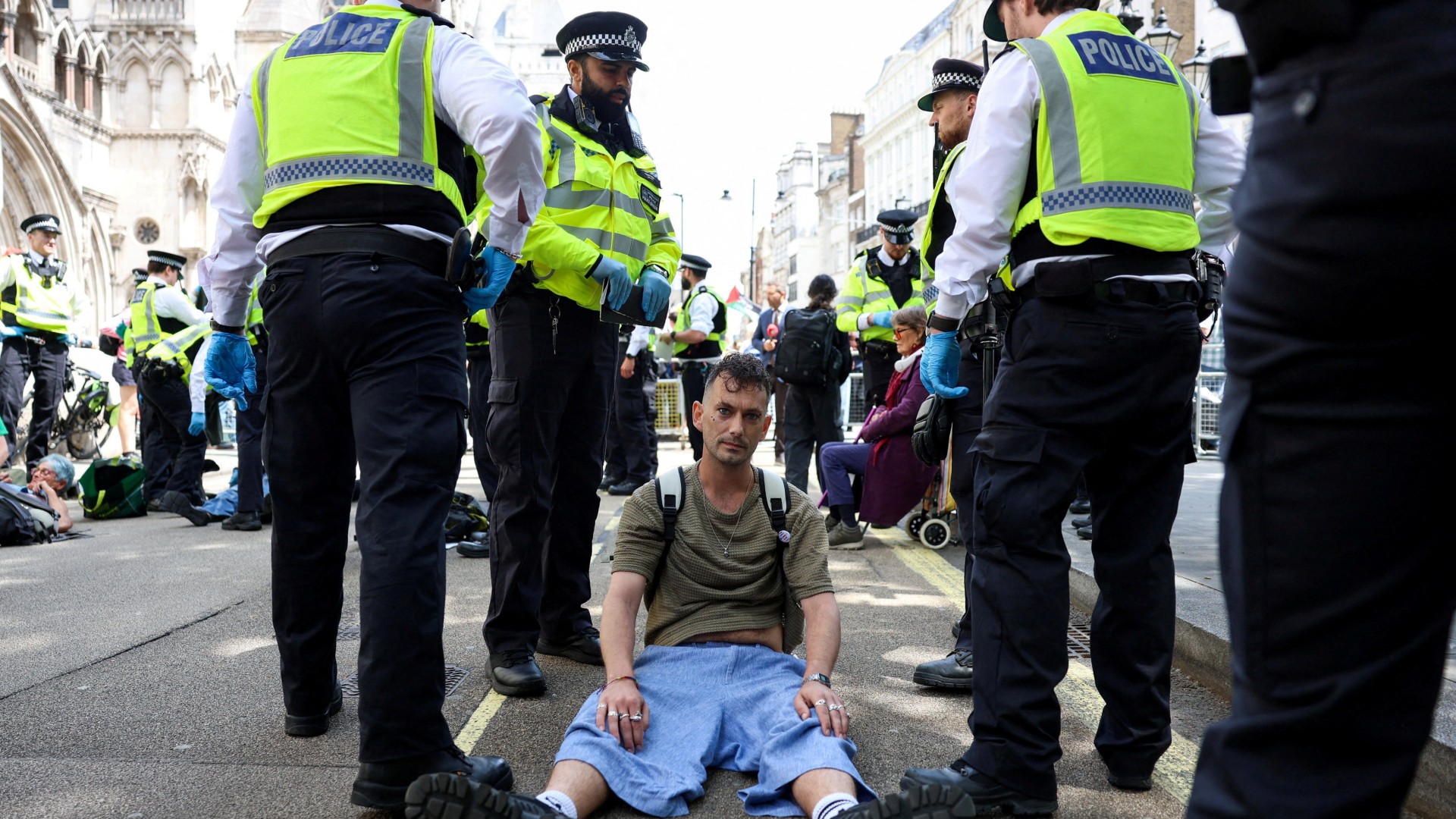
A controversial UK Court of Appeal ruling that upheld the government’s ban on the pro-Palestinian protest group Palestine Action has drawn fierce criticism from legal experts and civil society campaigners, who warn the decision dangerously expands the country’s already broad terrorism definition and undermines long-protected rights to peaceful protest.
The ruling, delivered Monday by a five-judge appellate panel, overturned an earlier February 2025 High Court judgment that had struck down the proscription of Palestine Action as unlawful on three key grounds. The lower court had found that then-Home Secretary Yvette Cooper violated her own government’s proscription policies when she designated the group a terrorist organization, that the ban created an unacceptable chilling effect on freedom of speech and peaceful assembly, and that the measure was fundamentally disproportionate: only three of the 385 direct actions carried out by the group were deemed to meet the UK’s legal threshold for terrorist activity, and existing criminal law was already sufficient to prosecute any illegal activity linked to those actions.
In overturning that decision, the Court of Appeal rejected the finding that Cooper had violated official proscription policy. The appellate judges ruled that policy guidelines did not limit the home secretary’s ability to consider external factors such as the ban’s potential to disrupt the group’s overall operations, arguing Cooper was owed “appropriate latitude” in her national security decision-making, and that her role granted her both institutional authority and democratic accountability to make such a designation. On the question of proportionality, the court held that Cooper had struck a fair balance between individual civil liberties and the UK’s stated national security interests.
Critics argue the ruling grants unprecedented and undue deference to executive branch decision-making, creating a template that concentrates near-unchecked power in the hands of government ministers at the expense of judicial oversight. Former government lawyer Tim Crosland told Middle East Eye that the decision creates a pattern where courts are reluctant to challenge executive assessments of what counts as terrorism, clearing the way for unfettered executive authority that he argued is already misaligned with public interest, captured by corporate lobbying from the fossil fuel and arms industries.
The ruling’s foundation rests in part on the interpretation of the UK’s unusually broad terrorism legislation, which includes “serious damage to property” carried out to influence government or intimidate the public for an ideological cause as a terrorist act. Critically, UK law provides no clear legal standard to define what qualifies as “serious damage”, leaving the determination to executive assessment that can be based on financial cost, potential risk to human life, or ties to national security. While government intelligence confirmed only three Palestine Action actions met the threshold for serious damage, the Court of Appeal took a holistic approach to the group’s activities, concluding the organization as a whole “overtly promotes unlawful violence amounting to terrorism”. The court cited Cooper’s estimate that the three high-profile actions — targeting defence contractor Thales in Glasgow in 2022, Instro Precision in Kent in June 2024, and an Elbit Systems UK facility near Bristol in August 2024 — caused millions of pounds in damage.
That damage calculation has itself been contested. When sentencing activists for the August 2024 Elbit Systems raid, presiding Justice Johnson relied on an insurance report that underpinned a £1 million payout, which defence lawyers have challenged as being full of hearsay and inaccurate, noting it included damage to areas of the factory activists never entered and was prepared after the insurer had already approved the payout.
Leading human rights lawyer Michael Mansfield KC argued that even if the damage claims are accepted, they do not justify a terrorist designation. He told Middle East Eye that the ruling overemphasizes the undefined standard of serious damage, a metric that is inherently subjective. Mansfield also rejected the government’s claim that the group’s actions were intended to influence government policy, noting Palestine Action turned to direct action after conventional advocacy failed to shift UK policy on the Israel-Gaza war, with activists acting out of frustration over ongoing civilian harm in Gaza.
Civil rights organization Liberty warned that the ruling fails to draw any clear line between protected protest activity and terrorism, noting even the appellate court acknowledged it is unusual to designate an organization whose core activity is property-focused direct action as terrorist. The Court of Appeal also justified its overturning of the High Court ruling by arguing the lower court failed to account for an escalation in Palestine Action’s activity in the months leading up to the proscription order in June 2024. The judgment noted that Cooper paused the proscription process in May 2024 to request updated intelligence from Counter Terrorism Policing, which reported 158 additional direct actions, 28 of which caused what was defined as “significant damage” (either costing more than £50,000 in repairs or requiring a large police deployment), including tactics such as lock-ons, occupations, blockades, and vandalism.
The court also cited an action at Brize Norton air base as evidence of escalation, despite acknowledging the action took place on the same day proscription was announced and that there was significant legal debate over whether it qualified as a terrorist act. Even so, judges ruled the action posed a threat to national security, and that this threat justified granting the home secretary a wide margin of appreciation in her decision to ban the group.
Mansfield pushed back on the argument that elected politicians deserve automatic judicial deference, arguing that politicians have lost widespread public trust and that the close ties between UK ministers and the Israeli arms industry raise questions about the true motivation for the ban. “I don’t trust ministers to be telling me the absolute truth,” he said. Clive Dolphin, spokesperson for campaign group Defend our Juries, echoed these concerns, noting that the broad deference granted to the home secretary effectively undermines the entire purpose of judicial review, which exists to check executive overreach. “The slide into authoritarianism is not a single step, it’s not that somebody takes over on day one,” Dolphin said. “This is a really, really dangerous ruling.”