标签: Asia

亚洲

  • King’s College Hospital Dubai brings next-level precision to complex and endometriosis surgery with Da Vinci

    King’s College Hospital Dubai brings next-level precision to complex and endometriosis surgery with Da Vinci

    King’s College Hospital London Dubai has significantly expanded its surgical capabilities by integrating the state-of-the-art Da Vinci Xi robotic system into its complex general and endometriosis procedures. This technological advancement represents a substantial leap forward in minimally invasive surgery, offering eligible patients enhanced precision, reduced recovery times, and improved clinical outcomes.

    The Da Vinci Xi platform revolutionizes surgical procedures through its high-definition binocular 3D vision system that provides surgeons with unprecedented anatomical visualization. The system’s wristed instruments mimic the natural movements of human hands while eliminating tremors, enabling surgeons to perform intricate maneuvers in confined anatomical spaces with exceptional accuracy. This technological sophistication is particularly valuable in complex endometriosis cases where millimeter-level precision and nerve preservation are critical for patient outcomes.

    Dr. Firas Younis, Consultant General and Colorectal Surgeon at King’s College Hospital London Dubai, emphasized the system’s impact on patient care: ‘Patients facing complex surgical interventions often experience significant anxiety. The Da Vinci robotic system provides a platform for extremely precise surgical execution, minimizing tissue disruption and facilitating more comfortable recovery periods. This technology is especially transformative for endometriosis surgery where precision directly correlates with preserved fertility and reduced complication rates.’

    Endometriosis, a chronic condition affecting millions worldwide, can cause debilitating pelvic pain, intimate discomfort, and reproductive challenges. In severe cases, the condition involves multiple pelvic organs requiring highly specialized surgical expertise. The hospital’s adoption of robotic-assisted surgery enables surgeons to address these complex presentations through minimal incisions, resulting in reduced postoperative pain, shorter hospital stays, and accelerated return to normal activities for appropriately selected patients.

    The clinical team at King’s College Hospital London Dubai conducts comprehensive individual assessments to determine patient suitability for robotic-assisted procedures, considering diagnostic findings, case complexity, and overall health status. Patients seeking consultation can arrange appointments through multiple channels including telephone scheduling, online forms, or the dedicated King’s Hub application.

  • Egypt and Saudi Arabia pressure Libya’s Haftar to stop UAE supplies to Sudan’s RSF

    Egypt and Saudi Arabia pressure Libya’s Haftar to stop UAE supplies to Sudan’s RSF

    Egypt and Saudi Arabia have escalated diplomatic pressure on eastern Libyan commander Khalifa Haftar concerning his alleged facilitation of Emirati military support to Sudan’s Rapid Support Forces (RSF). Security sources indicate this assistance could fundamentally reshape Cairo’s relationship with Haftar’s administration.

    This development forms part of a coordinated Egyptian-Saudi initiative to intercept arms, fuel, and combatant flows to the RSF, counter UAE regional influence, and stabilize the volatile border region connecting Egypt, Libya, and Sudan.

    Earlier this month, Saddam Haftar, the commander’s son and deputy leader of the Libyan Arab Armed Forces (LAAF), was urgently summoned to Cairo for meetings with Egyptian Defense Minister Abdel Meguid Saker and senior security officials. While publicly framed as routine military cooperation, intelligence sources confirm the discussions centered on compelling evidence of Haftar’s complicity in weapons transfers.

    According to a high-ranking Egyptian military official, surveillance confirmed weapons shipments originating from Abu Dhabi transiting through Haftar-controlled territories before reaching RSF positions in Sudan. Additionally, monitoring revealed Libyan fuel tankers supplying paramilitary forces in Darfur and documented mercenary movements from South America through Libya to Sudan.

    Despite historical Egyptian support for Haftar’s eastern Libyan administration, his parallel backing by the UAE—the RSF’s primary patron—has created strategic complications. Recent reports indicate supply lines established through Libyan border areas directly enabled RSF military advances, including the capture of el-Fasher where thousands reportedly faced massacre.

    Cairo and Riyadh presented Saddam Haftar with offers of alternative financial and military support to replace Emirati backing. These discussions coincided with a substantial $4 billion Saudi arms agreement with Pakistan, with portions reportedly earmarked for Haftar’s forces and the Sudanese military led by Abdel Fattah al-Burhan.

    Egyptian officials shared intelligence revealing alleged Emirati plans to fragment Haftar’s territory following RSF consolidation in western Sudan. The strategy purportedly involved dividing Libya into multiple zones, potentially diminishing Haftar’s control.

    The geopolitical realignment follows public friction between Saudi Arabia and the UAE, previously close allies. Riyadh has grown increasingly assertive against Emirati regional policies, particularly regarding Yemen where UAE-backed separatists recently faced setbacks against Saudi-supported government forces.

    Egypt demonstrated its resolve through a targeted air strike against a military convoy transiting from Libya to RSF-controlled territory in Sudan. The operation destroyed dozens of vehicles carrying weapons and fuel near the al-Uwaynat border triangle. Subsequent air patrols continue monitoring the region, with authorities warning any further support convoys will face similar consequences.

    Analysts interpret these developments as emerging Egyptian-Saudi coordination to counter expanding Emirati influence across multiple conflict zones, though underlying differences regarding regional leadership persist between Cairo and Riyadh.

  • Hebei’s ‘ancient pressure cooker’ setting internet ablaze

    Hebei’s ‘ancient pressure cooker’ setting internet ablaze

    A remarkable archaeological artifact from China’s Hebei Province has unexpectedly become an internet sensation, drawing worldwide attention to ancient Chinese technological innovation. The Tripod with Bear-shaped Feet, housed at Hebei Museum in Shijiazhuang, has been affectionately dubbed the ‘ancient pressure cooker’ by fascinated netizens who have discovered its ingenious design principles.

    Discovered in 1968 during excavations of a Western Han Dynasty (206 BC-24 AD) prince’s tomb, this bronze culinary vessel stands merely 18.1 centimeters in height but represents extraordinary engineering sophistication. The tripod features three delightfully crafted squatting bears serving as sturdy feet, while its true innovation lies in the sealing mechanism. The lid incorporates an advanced flip-and-twist locking system with animal-shaped latches that creates an exceptionally tight seal when engaged.

    Archaeological experts confirm this sophisticated design enabled the trapping of steam within the vessel, creating higher internal pressure that significantly reduced cooking times—a fundamental principle that modern pressure cookers still utilize today. The precision engineering demonstrates that Han Dynasty craftsmen understood and applied principles of pressure cooking over two millennia before contemporary kitchen technology emerged.

    Cultural heritage specialists have celebrated this discovery as evidence of China’s longstanding tradition of technological innovation and sophisticated metalworking capabilities. The artifact’s viral popularity has sparked renewed interest in ancient Chinese technological achievements, with museums worldwide noting increased public engagement with historical collections that demonstrate early scientific principles.

  • Farms stays to desert camps: How UAE residents spend weekends as temperatures near 0ºC

    Farms stays to desert camps: How UAE residents spend weekends as temperatures near 0ºC

    As the UAE experiences its coldest winter evenings with temperatures approaching zero degrees Celsius in high-altitude regions, residents are transforming their weekend routines to capitalize on the unusual weather phenomenon. The National Centre of Meteorology confirms that this cold spell will persist through coming days, characterized by fluctuating winds that intensify the chill particularly after sunset.

    Emirati families are migrating from urban centers to rural retreats, with farmhouses in Sweihan and Hatta becoming preferred destinations. Abdulrahman Al Shizawi, who plans to spend nights at his family’s Abu Dhabi farmhouse, describes the conditions as “perfect for outdoor gatherings around fire pits with family—the very weather we anticipate throughout the year.”

    The meteorological shift has inspired diverse outdoor activities across demographic groups. While local families favor mountain farm stays, expatriate communities are organizing desert camping expeditions. George Kalathil, an events specialist from Al Quoz, reports that his desert driving group spontaneously arranged an overnight camping trip upon noticing the temperature drop after work hours.

    Adventure enthusiasts are particularly benefiting from the conditions. Multimedia professional Tom Reyes notes that the cool, non-humid atmosphere creates ideal hiking and camping conditions near Jabel Yibir, where morning fog blankets the mountain ranges in spectacular fashion. This weather window has generated widespread social media engagement, with residents sharing photographs of temperature readings and winter attire preparations under captions like ‘its time to take out winter jackets’.

    The collective adaptation to these conditions demonstrates how climate variations can positively influence social behavior and leisure patterns in the region.

  • Major urban renovation restores Xi’an’s ancient moat

    Major urban renovation restores Xi’an’s ancient moat

    The ancient city of Xi’an has achieved a remarkable urban conservation milestone with the successful completion of its comprehensive moat restoration initiative. The recently concluded Phase II renovation project witnessed the historic rehydration of the railway station section, marking the final piece in reconnecting the entire 14.6-kilometer ancient waterway system.

    This engineering triumph represents the first complete restoration of the moat since its initial construction during the late Tang Dynasty (618-907 CE). The recently revitalized 859-meter segment now flows seamlessly between two nationally protected cultural heritage sites: the iconic Xi’an City Wall and the historic Daming Palace ruins.

    Prior to restoration, this critical section suffered from severe silt accumulation averaging 1.2 meters in depth, with some areas exceeding 1.5 meters of sediment. The degraded condition caused annual flooding during rainy seasons, creating problematic mixtures of stormwater, river overflow, and sewage throughout the channel.

    The comprehensive renovation addressed multiple challenges simultaneously—historical preservation, urban infrastructure modernization, and environmental management. By restoring the original hydraulic connectivity, the project has not only revived an important historical landmark but also implemented contemporary water management solutions to prevent future flooding and contamination issues.

    This achievement represents a sophisticated blend of archaeological conservation and urban planning, demonstrating how modern cities can successfully integrate historical preservation with functional infrastructure development. The restored moat now stands as both a testament to ancient Chinese engineering and a model for sustainable urban renewal practices.

  • Exclusive: UK confirms phone call between Cameron and ICC’s Karim Khan

    Exclusive: UK confirms phone call between Cameron and ICC’s Karim Khan

    The British government has officially acknowledged a contentious April 2024 telephone conversation between then-Foreign Secretary David Cameron and International Criminal Court Chief Prosecutor Karim Khan, marking the first formal confirmation of the exchange that allegedly involved threats over the ICC’s Gaza investigation.

    The disclosure emerged through a Freedom of Information request filed by Unredacted, a national security research unit at the University of Westminster. In a January 2026 response letter, the Foreign Office’s Information Rights Unit stated: “The then Foreign Secretary, David Cameron, was the only person present on the call on 23 April 2024 with Karim Khan.”

    This confirmation follows Prosecutor Khan’s recent statement to the ICC alleging that a “senior British official” threatened to withdraw UK funding from the court during the April 23rd conversation. The call occurred during a critical period—one month before Khan sought arrest warrants against Israeli Prime Minister Benjamin Netanyahu and Defense Minister Yoav Gallant, and coincided with intensifying international pressure regarding the Gaza war crimes investigation.

    According to Middle East Eye’s previous reporting, which cited sources including former staff in Khan’s office who had seen meeting minutes, Cameron allegedly characterized the potential warrants as “like dropping a hydrogen bomb.” The former prime minister reportedly argued that while prosecuting Russia for Ukrainian aggression was justified, targeting Israel during its “self-defense” against October 7th attacks was fundamentally different. Cameron purportedly warned that the warrants would have “profound implications” in Britain and within his Conservative Party, threatening defunding and withdrawal from the Rome Statute if proceedings moved forward.

    Professor Sam Raphael, International Relations and Human Rights expert at the University of Westminster, stated: “This raises serious questions about the role of a senior minister in threatening the impartiality of the ICC, especially given the myriad forms of military, intelligence and diplomatic support provided by the UK to Israel at the time.”

    Legal experts consulted by MEE suggest Cameron’s alleged conduct may constitute an attack on judicial independence and potentially violate both the Rome Statute and British law regarding obstruction of justice. Two British MPs have subsequently called for Prime Minister Keir Starmer to initiate an independent investigation into the allegations, noting that any attempted coercion of the ICC could breach Article 70 of the Rome Statute prohibiting interference with justice administration.

    The ICC continues to face significant external pressure, particularly from Israel and the United States, since Khan’s decision to pursue warrants. The Trump administration has imposed financial and visa sanctions against Khan, his deputies, six judges, and Palestinian entities connected to the investigation, while threatening further measures against the court itself.

    ICC judges are currently reviewing an Israeli challenge to the court’s jurisdiction over Palestine and a separate complaint questioning the prosecutor’s impartiality. Khan has been on voluntary leave since May 2025 pending a UN investigation into unrelated sexual misconduct allegations, which he vigorously denies.

  • China launches nationwide employment assistance program

    China launches nationwide employment assistance program

    China has mobilized nine central government departments in a sweeping nationwide initiative to strengthen employment support and increase incomes for vulnerable worker groups during the first quarter of 2026. The coordinated program, operating from January through March, represents a significant governmental effort to address workforce challenges during the winter months.

    The multi-ministry collaboration brings together the Ministry of Human Resources and Social Security, the Ministry of Agriculture and Rural Affairs, and the All-China Federation of Trade Unions, among other key agencies. This interdepartmental approach underscores the comprehensive nature of the employment assistance campaign.

    Implementation strategies include organizing targeted job fairs across diverse locations including residential communities, rural areas, industrial zones, supermarkets, and transportation hubs such as railway stations. The program also emphasizes skills development, actively encouraging participants to obtain professional certifications that enhance their employment prospects.

    Special attention will be directed toward marginalized groups including people with disabilities, urban workers experiencing economic hardship, and graduates facing employment difficulties. These populations will receive customized assistance based on their specific circumstances and needs.

    The initiative builds on recent employment activities across the country, including a major five-province joint employment service event held in Guizhou province on January 16th that attracted numerous job seekers. The program’s implementation will be managed by local authorities who will tailor the employment services to regional needs while maintaining the national framework.

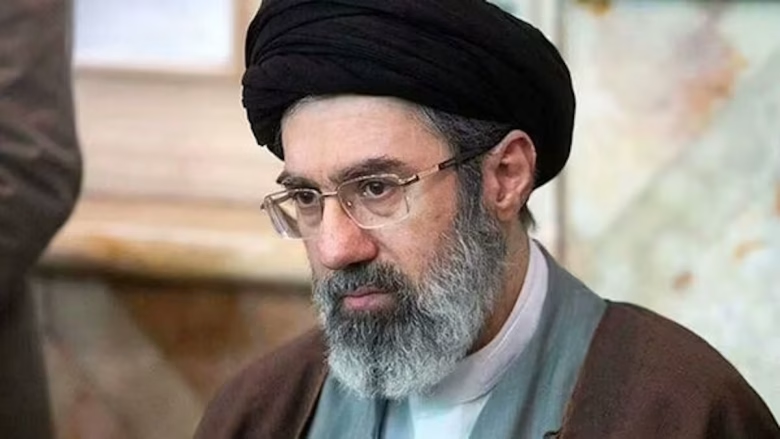
  • Iran says 3,117 people killed during nationwide protests

    Iran says 3,117 people killed during nationwide protests

    Iranian authorities have officially acknowledged 3,117 fatalities resulting from the nationwide anti-government demonstrations that commenced in late December. The protests erupted against a backdrop of severe economic deterioration and the unprecedented devaluation of the national currency.

    According to a declaration from Iran’s Martyrs Foundation, 2,427 of the deceased were classified as ‘martyrs,’ comprising security personnel and innocent civilians caught in the unrest. The remaining casualties were identified as protesters. This official disclosure contrasts sharply with assessments from international human rights organizations, which allege significantly higher casualty figures and accuse security forces of employing excessive, lethal force against demonstrators.

    Amiry-Moghaddam, a co-founder of the Oslo-based Iran Human Rights NGO, provided disturbing accounts in a recent video interview with Middle East Eye, claiming that security personnel executed wounded individuals with headshots. These allegations are reinforced by data from the US-based Human Rights Activists News Agency (Hrana), which documented a death toll of 4,519. Their investigation details 4,251 protesters, 197 security personnel, 35 children, and 38 bystanders among the fatalities, with an additional 9,049 deaths under ongoing scrutiny. Hrana further reported at least 26,314 arrests and 5,811 individuals sustaining serious injuries.

    Iranian leadership has consistently refuted accusations of security force brutality, instead attributing the unrest to foreign interference. Senior military officials, including Armed Forces Chief of Staff Abdolrahim Mousavi, have accused the United States and Israel of deploying ISIS-affiliated mercenaries within Iran to attack both civilians and security forces. This rhetoric was amplified by Islamic Revolutionary Guard Corps Commander General Mohammad Pakpour, who issued a stark warning to Israel and the US against ‘miscalculations,’ asserting that his forces had their ‘finger on the trigger.’

    These developments unfolded alongside heightened international discourse on Iran. Israeli President Isaac Herzog publicly advocated for regime change in Iran during an address at the World Economic Forum in Davos. Concurrently, US President Donald Trump indicated a openness to diplomatic negotiations with Tehran, stating that the initiative originated from Iranian officials and that Washington was prepared to engage.

  • Ryan Coogler, Leonardo DiCaprio, Rose Byrne, Diane Warren react to Oscar nominations

    Ryan Coogler, Leonardo DiCaprio, Rose Byrne, Diane Warren react to Oscar nominations

    Hollywood’s brightest talents shared intimate reflections on their creative processes and emotional connections to their Oscar-nominated work following Thursday’s announcement of the 96th Academy Award nominations.

    Ryan Coogler, whose blues-infused vampire film ‘Sinners’ received a record-breaking 16 nominations, revealed the deeply personal inspiration behind his project. ‘I wrote this script for my uncle who passed away 11 years ago,’ Coogler explained in an emotional interview. The filmmaker, nominated for Best Picture, Director, and Screenplay, described his relentless dedication to the craft: ‘I was writing last night. That’s why I didn’t get too much sleep.’

    Leonardo DiCaprio, nominated for Best Actor in ‘One Battle After Another,’ emphasized the enduring power of cinematic storytelling. ‘At the end of the day it’s about trying to be in films that are memorable,’ DiCaprio stated, highlighting the communal experience of theater-going as fundamental to human connection.

    Across the globe in Australia, Rose Byrne received her Best Actress nomination for ‘If I Had Legs I’d Kick You’ in the middle of the night. Byrne detailed the intensive five-week rehearsal process that shaped her turbulent character, crediting director Mary Bronstein’s performance-driven approach. The nomination announcement triggered a joyous family celebration via FaceTime with her husband Bobby Cannavale in New York.

    Composer Ludwig Göransson, nominated for Best Original Score and Original Song for ‘Sinners,’ described the project as a ‘family affair’ that celebrates the foundational influence of blues music on Western culture. ‘Anything we’re hearing today on the radio wouldn’t exist if it wasn’t for blues,’ Göransson noted, praising Coogler’s ability to showcase this musical heritage.

    Songwriter Diane Warren received her 17th nomination for ‘Dear Me’ from the documentary ‘Diane Warren: Relentless.’ The legendary composer reflected that ‘to be nominated is winning because these are the best of the best in the fields of film, music, that vote for you.’

    Producer Liza Marshall expressed amazement at audiences’ deep emotional connection to ‘Hamnet,’ noting that viewers frequently remain seated through the credits to process the film’s impact. Marshall praised star Jessie Buckley’s ‘primal’ performance that transcends conventional acting.

    Composer Alexandre Desplat described ‘Frankenstein’ as director Guillermo del Toro’s ‘dream project’ and the completion of a thematic triptych about empathy for those who are different. Nicholas Pike expressed excitement about his nomination for the contemporary operatic aria ‘Sweet Dreams Of Joy,’ while Bryce Dessner of The National celebrated his collaboration with musical hero Nick Cave on the grief-themed ‘Train Dreams.’

  • Australian Open: Sinner overpowers Duckworth, Wawrinka wins thriller

    Australian Open: Sinner overpowers Duckworth, Wawrinka wins thriller

    Melbourne witnessed a spectacular display of tennis prowess and veteran resilience on Thursday at the Australian Open, where two distinct narratives unfolded on the courts.

    Reigning champion Jannik Sinner demonstrated why he holds the world number two ranking with a commanding performance against Australian wildcard James Duckworth. The Italian maestro needed merely one hour and forty minutes to secure a decisive 6-1, 6-4, 6-2 victory on Rod Laver Arena. Sinner’s precision and power were on full display as he extended his remarkable winning streak against Australian opponents to 27 consecutive matches. His last defeat to an Australian came against Duckworth himself in Toronto back in 2021, but there was no hint of a repeat upset. Sinner’s clinical performance featured impeccable shot placement and relentless pressure, culminating in a match-ending ace that propels him into a third-round encounter with American Eliot Spizzirri.

    Meanwhile, on Kia Arena, 40-year-old Stan Wawrinka authored one of the most memorable chapters of his storied career. The Swiss veteran, who previously announced this would be his final Australian Open before retiring in 2026, battled Frenchman Arthur Gea in an epic five-set thriller that stretched to four hours and thirty-three minutes. Wawrinka ultimately prevailed 4-6, 6-3, 3-6, 7-5, 7-6(10-3) in a match that tested both physical endurance and mental fortitude.

    The three-time Grand Slam champion, who captured his first major title in Melbourne back in 2014, became the first player aged 40 or older to reach the third round of a Grand Slam since Ken Rosewall accomplished the feat at the 1978 Australian Open. Wawrinka’s victory was particularly impressive considering he received a late wild card entry and faced an opponent nineteen years his junior. Despite visible exhaustion, the veteran tapped into the energy of a supportive crowd to overcome cramps and mounting pressure, particularly during the decisive tiebreak where he demonstrated the champion mentality that has defined his career.