标签: Asia

亚洲

  • Couple caned for kissing on TikTok in Indonesia’s conservative Aceh province

    Couple caned for kissing on TikTok in Indonesia’s conservative Aceh province

    In Indonesia’s only province that enforces a formal version of Islamic Sharia law, a young couple has received public corporal punishment after a viral TikTok livestream of them kissing resulted in conviction for violating local religious morality regulations. The sentence was carried out Thursday on a public stage in Bustanussalatin City Park, Banda Aceh, the provincial capital, where at least 100 onlookers gathered to watch as masked, robed officials administered 21 strokes of a rattan cane to each person.

    The couple — a 22-year-old man and 25-year-old woman — were taken into custody by Sharia authorities in April, roughly two months after their Feb. 27 in-car livestream circulated widely across social media and triggered formal complaints to local officials. Originally, the Sharia court had sentenced each defendant to 25 lashes, but the punishment was reduced by four strokes to account for the four months the pair spent in pre-sentencing detention. As part of the court ruling, the mobile phone and USB drive storing the original livestream footage were seized and ordered destroyed as evidence of the violation. Thursday’s caning was not an isolated event: four additional Aceh residents were also publicly punished the same day for convictions of online gambling and adultery.

    Aceh’s right to enforce Sharia law was granted by Indonesia’s secular national government in 2006, as a key component of a peace agreement designed to end decades of violent separatist conflict in the province. In 2015, regional authorities expanded the scope of the law to apply to non-Muslim residents, who make up roughly 1 percent of Aceh’s total population. Under the regional regulatory framework, morality offenses can carry penalties of up to 100 lashes. The punishment is also routinely applied for violations ranging from gambling and alcohol consumption to immodest clothing for women and failure to attend Friday prayers for men.

    Human rights advocates have strongly condemned the practice, labeling public caning a clear violation of fundamental human rights standards. Usman Hamid, executive director of Amnesty International Indonesia, noted that while the couple’s public kiss may be seen as inappropriate for a platform accessed by audiences of all ages, including children, corporal punishment and imprisonment remain wildly excessive responses. “It is cruel, inhumane and degrading to human dignity,” Hamid explained, pointing out that Indonesia has formally ratified an international convention requiring the elimination of cruel and unusual punishment.

    But the punishment has drawn support from some local Aceh residents who attended the public event. Aini Nadhirah, a 22-year-old Banda Aceh resident who was in the audience, argued that the public punishment serves a necessary educational purpose. “In my opinion, this caning is entirely justified because it serves as a warning to other Aceh residents to be more careful when using social media,” Nadhirah said. “It also raises awareness that such actions are unacceptable, thereby educating the public.”

  • Two metropolises seek common ground through city dialogue

    Two metropolises seek common ground through city dialogue

    On Tuesday, the third iteration of the groundbreaking ‘Our Water Season’ initiative, the Shanghai-New York City Dialogue, opened its doors at Bloomberg’s iconic Manhattan headquarters, gathering cross-sector leaders from two of the world’s most influential global metropolises to advance pragmatic cooperation and people-to-people connection between China and the United States.

    Centered on the overarching theme ‘Rivers of Opportunities’, the forum brought together a diverse cohort of participants: government officials from both nations, top business executives, leaders of global financial institutions, major consumer brand representatives, and prominent cultural figures. Attendees focused their discussions on unlocking untapped collaborative potential across China-US relations, with targeted attention to deepening partnership between the two cities in the financial and consumer sectors.

    Michael Bloomberg, founder of Bloomberg L.P. and Bloomberg Philanthropies, and a former mayor of New York City, opened with remarks highlighting the deep shared characteristics that bind the two waterfront metropolises. Both Shanghai and New York hold global status as leading commercial and cultural hubs, a common identity that forms a strong foundation for exchange, he noted. With Bloomberg L.P. maintaining a thriving presence in Shanghai for more than 30 years, and following his own visit to China in 2025, Bloomberg emphasized that city-to-city engagement has never carried greater weight than it does in today’s fractured geopolitical climate.

    ‘Great cities just don’t compete with each other. They learn from each other. That kind of exchange between cities has never been more important,’ he told attendees. Bloomberg added that with more than half of the global population now residing in urban areas, municipal governments are on the front lines of tackling shared global challenges, from public health infrastructure and education access to affordable housing and climate change adaptation. ‘We borrow ideas from other cities, and we’re glad the other cities borrowed from us,’ he said.

    Tang Zhiwen, Minister at the Chinese Embassy in the United States, framed the ongoing exchange between Shanghai and New York as a powerful model for what constructive China-US cooperation can achieve. Tang noted that the two cities are well-positioned to take the lead in driving collaboration across high-growth emerging sectors, including artificial intelligence, climate action, green shipping, and smart city development, while paving the way for deeper high-level exchanges across the two entire nations.

    Tang also highlighted the ongoing progress of China’s youth exchange initiative, which aims to welcome 50,000 young Americans to China over a five-year period. To date, Shanghai alone has hosted nearly 10,000 young American visitors through the program, building lasting people-to-people ties between the two countries.

    Chen Yiqun, Director-General of the Information Office of Shanghai Municipality, echoed the forum’s water-centered framing, noting that river and coastal waterways have connected both cities to global markets and cultures for centuries, and continue to shape their future trajectories. ‘Water once carried both of our cities into the world. And now, water is asking something new of us: how do we keep our harbors and our waterfronts alive, open and growing for the next generation,’ she said. ‘Our Water exists to give cities like ours a place to compare notes, to learn from each other, and to keep growing together.’

    Chen added that the ‘Our Water’ initiative was specifically created to provide a sustained, open platform for cities to share best practices, exchange insights, and collaborate to solve shared urban challenges. ‘When we talk today about finance, investment, consumption and innovation, we’re not just talking about growth for growth’s sake. We’re talking about what it takes to keep a city open, adaptable and full of opportunity for the people who call it home,’ she said.

    Beyond plenary remarks, the forum featured a high-profile fireside chat titled ‘Seeking Common Ground through Dialogues’, bringing together Tsinghua University international relations professor Da Wei and Bloomberg Economics Chief Economist Tom Orlik to discuss China-US economic ties and opportunities for collaboration amid growing global economic and geopolitical uncertainty. Orlik, who lived and worked in China for multiple years, told China Daily that his time in the country deepened his understanding of China and underscored how critical people-to-people connections are to bridging divides. ‘Connections are really important for understanding,’ he said. ‘Both sides have more work to do to make it easier and more welcoming for those kinds of exchanges to take place.’

    One of the forum’s most anticipated speakers was Yao Ming, NBA Hall of Famer, chairman of the Yao Foundation, and one of the most recognizable cultural bridges between China and the United States. Yao noted that sports have long served as a universal language that connects people across cultural and national boundaries. He highlighted a coincidental milestone for both cities this year: the New York Knicks claimed the 2026 NBA championship, while the Shanghai Sharks, which Yao led to their first CBA title in 2002, won this year’s Chinese Basketball Association championship.

    Reflecting on his decades of cross-border experience, including his years playing in the NBA, Yao said splitting his time between Shanghai and regular travel across the United States transformed his perspective on cross-cultural exchange. ‘I try to learn from other people and make sure that becomes part of me,’ he said. ‘I learned so much from all the people I met and all the cities I visited.’ Yao also noted that Shanghai has grown into a top global destination for major international sporting events, including Formula One, a shift that reflects the city’s enduring openness, dynamic youthful energy, and deep cultural roots.

  • 11-year-old boy driving pickup truck crashes into group of Thai monks, killing 9

    11-year-old boy driving pickup truck crashes into group of Thai monks, killing 9

    BANGKOK – A devastating traffic accident left nine Buddhist monks dead on Thursday, after an 11-year-old boy lost control of a pickup truck and struck the religious procession as they walked along a rural highway in Thailand’s northeast, local government officials confirmed.

    The group of 35 monks had embarked on a multi-day walking pilgrimage from their home province of Mukdahan, located roughly 372 miles northeast of Thailand’s capital Bangkok, bound for neighboring Ubon Ratchathani province. The 161-mile journey had been underway for just 30 minutes when the collision occurred.

    Initial casualty reports from the Mukdahan provincial administration note that five of the monks died instantly at the crash site, while four more succumbed to their injuries after being transported to local medical facilities. Thirteen other injured monks remain hospitalized, with three still listed in critical condition as of the latest updates.

    Surveillance camera footage obtained and shared by the local Ruam Jai Mukdahan Rescue Association captures the moments before the impact: the monks were walking in a single orderly line along the shoulder of the road when the pickup veered off course and plowed into the group. Witness accounts from surviving monks indicate the vehicle began swerving unpredictably before sliding off the roadway and hitting the procession.

    Thai police have taken the 11-year-old boy into custody following the crash. Per protocol, formal questioning will not begin until representatives from Thailand’s state child protection services arrive at the station to oversee the process. Authorities have launched a full investigation to determine the root cause of the tragedy, including whether mechanical failure, driver error, or other factors contributed to the crash.

  • India asks WhatsApp to pause username feature rollout over fraud concerns

    India asks WhatsApp to pause username feature rollout over fraud concerns

    India, WhatsApp’s largest single market with more than 850 million active users, has ordered the Meta-owned messaging platform to pause the rollout of its highly anticipated username-based chat feature, citing growing concerns that the update could fuel a surge in cybercrime and malicious online activity.

    The new function, which was set to roll out gradually to WhatsApp’s 3 billion global users over the coming months, allows users to connect with other accounts without sharing their personal phone numbers, a long-requested privacy upgrade for the platform. Users were already able to reserve their preferred unique usernames ahead of the full launch when Indian regulators stepped in.

    In an official notice dated Wednesday, India’s Ministry of Electronics and Information Technology (MeitY) demanded WhatsApp halt deployment immediately and explain why regulatory action should not be taken against the company under existing Indian cyber law for moving forward with a feature it argues poses unacceptable public risk. The ministry outlined that by allowing bad actors to contact potential victims without revealing their phone numbers, the update could materially increase rates of online fraud, phishing schemes, digital extortion scams, and impersonation attacks. Regulators also warned that the username system could enable bad actors to create lookalike accounts mimicking government officials, financial institutions, public agencies, and private individuals to carry out deception.

    MeitY’s notice, a copy of which has been obtained by the BBC, cites provisions of India’s Information Technology Act and national rules governing intermediary due diligence, identity theft, and impersonation offenses. The regulator has ordered WhatsApp not to proceed with launch until it completes a government consultation that addresses official concerns to the authorities’ satisfaction.

    In response to the order, Meta confirmed that the feature has not yet been activated for general users and that it has built a multi-layered framework of safeguards to prevent misuse. To combat impersonation, the platform has pre-reserved all high-profile usernames associated with public figures, government entities, celebrities, and already verified Meta accounts, ensuring these can only be claimed by their legitimate owners. It has also locked lookalike derivatives of prominent official and public figure usernames to block spoofing attempts.

    WhatsApp also emphasized that users will still require a verified phone number to create an account, even with the new username feature active. Additional protective measures include requiring any user to know an exact username to initiate contact, limiting the number of new users a single account can reach out to, blocking repeated automated attempts to guess usernames, and maintaining automated systems to detect and remove activity matching known patterns of impersonation and abuse. For first-time messages from unknown contacts, the platform will also display contextual information to help recipients assess risk, including whether the account is new, shares a common group with the recipient, is already saved in the user’s contacts, or is based in a foreign country.

    Cybercrime has become an increasingly urgent policy challenge for India, as hundreds of millions of first-time internet users adopt digital platforms and mobile payment services every year, many without formal training on digital safety practices. According to the most recent published federal data, India registered nearly 102,000 cybercrime cases in 2024, representing an 18% increase from the prior year, with online fraud accounting for nearly three-quarters of all reported cases.

    The Indian government’s order has drawn criticism from digital rights advocates, who argue the regulatory move lacks a clear legal foundation. The Internet Freedom Foundation, an Indian digital rights non-profit, stated that the notice overreaches by attempting to grant the government power to approve or reject individual software features, a authority not outlined in the laws MeitY cited. “The power to require prior permission for a feature is not in the [Information Technology] Act, not in the Rules, and cannot be created by a notice,” the organization said in a public statement.

    This latest regulatory action is part of a broader ongoing trend of Indian authorities tightening oversight of global technology platforms operating in the country. Earlier this year in February, New Delhi amended its digital rules to require social media platforms to remove unlawful content within just three hours of receiving a government takedown notice, cutting the previous compliance deadline of 36 hours dramatically. Just last month, Indian authorities temporarily banned the messaging platform Telegram ahead of a retest for the country’s national medical entrance examination, over concerns that its username-based interaction and hidden phone number features made it easier for exam cheaters to coordinate. The government’s position was upheld in court after Telegram unsuccessfully challenged the ban.

    For Meta, the regulatory clash in India carries particular weight: as WhatsApp’s largest market by user count, any changes to product rollout or design in the country will have a major impact on the platform’s global rollout plans and long-term growth strategy.

  • Singapore seizes $42m mansion over Nvidia chip smuggling

    Singapore seizes $42m mansion over Nvidia chip smuggling

    In a landmark enforcement action targeting illegal tech trade circumventing U.S. export controls, Singaporean authorities have seized a high-end luxury residence allegedly purchased with millions in illicit proceeds from a smuggling ring trafficking restricted Nvidia artificial intelligence chips. Announced by police on Wednesday, the seizure marks one of the most high-profile busts in a ongoing cross-border crackdown on unauthorized semiconductor shipments.

    The property, situated just a short walk from Singapore’s iconic Botanic Gardens in one of the land-scarce city-state’s most exclusive residential districts, last sold for 55 million Singapore dollars, equal to approximately $42.5 million U.S. or £32 million. Investigators confirmed that at least 38 million Singapore dollars — around two-thirds of the total purchase price — was traced to criminal earnings from the illegal trade operation. A court order has already been enacted to freeze the asset, blocking any sale or transfer of the property while the investigation proceeds.

    The case centers on Wei Zhaolun, also known as Alan Wei, chief executive of Singapore-based tech firm Aperia Group, which specializes in selling servers and enterprise tech hardware. Wei faces formal money laundering charges for his alleged role in funneling illegal proceeds into the home purchase. In addition to the luxury residence, authorities have seized roughly 1 million Singapore dollars in cash held in linked bank accounts.

    Since the investigation launched in February 2025, a total of four individuals have been charged with fraud and other criminal offenses connected to the scheme. The ring allegedly placed orders for servers equipped with advanced, export-restricted Nvidia chips from global tech suppliers, including Dell, Super Micro Computer and Asus, under false pretenses — claiming the equipment would be used by legitimate local companies. Authorities have not publicly disclosed the final destination of the diverted servers, though the U.S. Department of Justice has previously identified Singapore as a common transit hub for illicit shipments bound for China. The BBC has reached out to Aperia Group, Dell, Super Micro Computer and Asus for comment on the case, with no response available as of yet.

    Notably, the operation also marks the first time Singaporean authorities have pursued charges against corporate entities linked to this type of illicit trade. Alongside the individual defendants, Singapore-based firm Luxuriate Your Life and three subsidiary companies under the Aperia Group umbrella also face criminal charges. Attempts by the BBC to contact Luxuriate Your Life for comment have been unsuccessful.

    If convicted on the multiple fraud charges they face, the four individual defendants could be sentenced to up to 20 years in prison. Singaporean police emphasized their unwavering commitment to rooting out this type of criminal activity, stating that the force maintains a strict zero-tolerance stance toward such offenses. Officials added that aggressive enforcement is critical to protecting Singapore’s reputation as a secure, trusted global business hub.

    The bust comes as part of a years-long joint crackdown between Singapore and the United States on illegal shipments of advanced Nvidia semiconductors. Washington first implemented broad export restrictions on the chips in 2022, citing national security concerns over their potential use by the Chinese military for advanced military technology development. As of 2025, Singaporean authorities confirmed they had identified multiple suspected shipments of restricted servers transiting the country. While the U.S. has since approved limited sales of some Nvidia chip models to China under strict regulatory conditions, enforcement against illegal unauthorized shipments remains a top priority for both nations.

  • Asian stocks mostly decline on a sell-off of chip shares

    Asian stocks mostly decline on a sell-off of chip shares

    A widespread sell-off of semiconductor stocks pulled most major Asian equity markets lower on Thursday, while U.S. futures held steady following mild losses on Wall Street a day earlier. Oil benchmarks also dropped as traders priced in growing hopes for a diplomatic resolution to the Iran conflict that could unlock key global energy supplies.

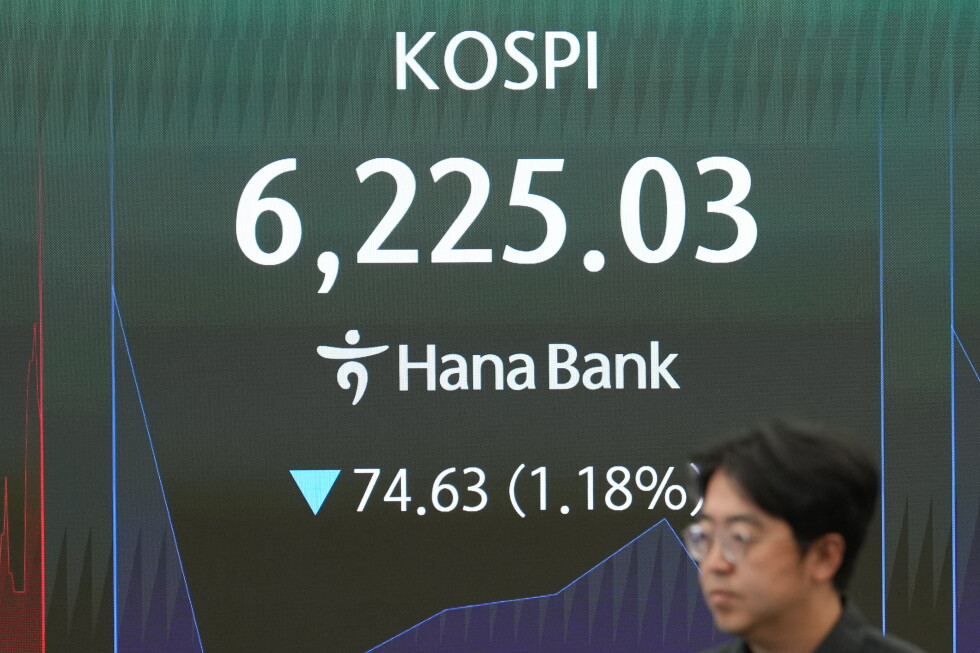
    South Korea’s Kospi index, one of the markets most heavily exposed to global semiconductor production, led the downturn with a sharp 5.1% drop to close at 7,877.45. Top memory chip manufacturer SK Hynix shed 7.7% of its value, while industry giant Samsung Electronics fell 6.4%. In Japan, the Nikkei 225 declined 1.5% to 69,443.16, with leading chip equipment producer Tokyo Electron losing 5.6% of its share value. Taiwan’s Taiex index slipped 1.1% as the world’s largest contract chipmaker TSMC (Taiwan Semiconductor Manufacturing Corp.) dropped 1.8%.

    Outliers in the region included Hong Kong’s Hang Seng Index, which gained 0.8% to reach 23,060.63, lifted by an 8.7% jump in shares of Chinese electric vehicle manufacturer BYD. The surge came after BYD reported a second consecutive month of rising sales. Mainland China’s Shanghai Composite Index bucked the positive trend in Hong Kong, falling 0.9% to 4,075.58. Australia’s S&P/ASX 200 edged 0.1% lower to 8,710.30, while India’s Sensex closed 0.5% higher.

    The chip stock sell-off was triggered by shifting investor sentiment around artificial intelligence, which had driven massive gains for tech and semiconductor stocks across East Asian markets over the first half of the year. Year-to-date, the Kospi has climbed roughly 85% and the Nikkei 225 has gained 34%, fueled by surging demand for AI-enabled chips and components. But growing concerns that massive investments from large U.S. and global tech firms will create a supply glut have started to dampen market enthusiasm.

    The downturn began on Wednesday, when chip stocks fell across U.S. markets. Memory chip producer Micron Technology dropped 10.6%, Intel fell 9%, Advanced Micro Devices (AMD) declined 6.9%, Broadcom lost 2.2%, and sector leader Nvidia slipped 1.3%. On Wednesday, Wall Street’s benchmark S&P 500 fell 0.2% to 7,483.23, the Dow Jones Industrial Average dipped less than 0.1% to 52,305.24, and the technology-focused Nasdaq composite dropped 0.7% to 26,040.03.

    Analysts at Capital Economics note that while AI demand is still growing, it may expand far more slowly than many investors and firms currently project. In a research note published Thursday, economists Megan Fisher and Vicky Redwood pointed out that many stakeholders are underestimating the practical barriers to widespread AI adoption across industries. Even though AI is a transformative technology that will see broad adoption over time, it may not deliver the rapid financial returns needed to justify the massive scale of current investment being poured into the sector, they added.

    In energy markets, crude oil prices fell early Thursday, dipping below levels recorded before the outbreak of the Iran war in late February. The drop came after U.S. and Iranian negotiators held separate talks with Qatari and Pakistani mediators this week, spurring new hopes for a permanent ceasefire deal. A resolution would likely allow for a major increase in global oil supplies by reopening the Strait of Hormuz, the critical global oil chokepoint that has seen limited traffic since the war began. As of Thursday trading, Brent crude, the global benchmark, fell 1% to $70.89 per barrel, down from roughly $72 per barrel before the war started. U.S. benchmark crude also dropped 1% to $67.91 per barrel.

    In currency markets, the U.S. dollar dipped slightly against the Japanese yen to 162.39 yen, down from 162.58 yen a day earlier, after the yen hit a four-decade low against the greenback on Wednesday. The euro edged higher to $1.1387, up from $1.1377 in prior trading.

  • All Blacks select Ruben Love at flyhalf, 2 new caps in Nations Championship lineup to face France

    All Blacks select Ruben Love at flyhalf, 2 new caps in Nations Championship lineup to face France

    CHRISTCHURCH, New Zealand – In his first major selection announcement as the new head coach of New Zealand’s world-famous All Blacks, Dave Rennie has turned to rising star Ruben Love to start at flyhalf for the team’s historic Nations Championship opening match against France, overlooking seasoned veterans Beauden Barrett and Damian McKenzie in a surprising call that underscores his commitment to fresh talent.

    The 25-year-old Love, who has earned five test caps to date, earned his starting spot after delivering standout performances in the recent Super Rugby playoffs that outshone both Barrett and McKenzie. Beyond his strong form, Love brings a distinct playing style to the pitch that sets him apart from his more experienced competitors. Where 145-test veteran Barrett typically opts to pass or kick before engaging the defensive line, and 74-cap McKenzie often moves sideways before testing defenses with a straight run, Love relies on an aggressive, instinctive approach to take on defensive lines directly.

    To keep a cohesive core unit, Rennie has paired Love with two of his fellow Hurricanes teammates in the inside backs: Cam Roigard will start at scrumhalf, while Jordie Barrett takes the inside center position. In another unexpected selection, Damian McKenzie has been moved to fullback, while Beauden Barrett did not earn a spot in the 23-man matchday squad entirely.

    Two uncapped rookies, Hurricanes prop Xavier Numia and leading 2024 Super Rugby try-scorer winger Fehi Fineanganofo, are set to make their All Blacks debuts off the bench in Saturday’s clash. Fineanganofo earned his call-up after a breakout regular season that saw him cross the try line 17 times, more than any other player in the competition.

    Ardie Savea will lead the side as captain from his position at the back of the scrum, with Luke Jacobson starting at open side flanker and Peter Lakai taking the blindside role. Rennie framed his selection as a deliberate balance of proven veteran experience and exciting emerging talent, with a depth-focused bench built to deliver impactful changes through the match.

    “We know we are facing a formidable French side that boasts a strong set piece, a clinical kicking game, and outstanding ability to keep possession alive,” Rennie told reporters. “To match them, we will need to be physical, accurate, and alert for every moment of the game. Over the past nine days, our group has worked hard to build connection and clarity on our game plan, and that foundation will give us the space to play our best rugby and express ourselves on Saturday.”

    Veteran hooker Codie Taylor will notch his 107th test cap in the starting lineup, with dynamic Hurricanes prospect Asafo Aumua waiting to come off the bench. Rennie retained the starting propping combination of Ethan de Groot and Fletcher Newell that featured for the side last year, with Numia and Tyrel Lomax available as impact substitutions. In the second row, Josh Lord and Sam Darry will pair up after former captain Scott Barrett was ruled out of the contest with an injury. Rounding out the starting lineup, Will Jordan will start on the right wing, Caleb Clarke on the left, and Quinn Tupaea will partner Jordie Barrett in the starting midfield.

    Saturday’s fixture at Christchurch marks the opening match of the brand-new 12-team Nations Championship, a landmark competition that pits top Northern Hemisphere and Southern Hemisphere nations against one another in a new global showpiece. The opening round will feature six matches across six nations: alongside the New Zealand-France clash, Japan will host Italy in Tokyo, Australia will face Ireland in Sydney, South Africa will take on England in Johannesburg, Fiji will play Wales in Cardiff, and Argentina will meet Scotland in Cordoba.

    Full All Blacks Matchday 23:
    Starters: Damian McKenzie, Will Jordan, Quinn Tupaea, Jordie Barrett, Caleb Clarke, Ruben Love, Cam Roigard; Ardie Savea (captain), Luke Jacobson, Peter Lakai, Sam Darry, Josh Lord, Fletcher Newell, Codie Taylor, Ethan de Groot.
    Reserves: Asafo Aumua, Xavier Numia, Tyrel Lomax, Patrick Tuipulotu, Wallace Sititi, Cortez Ratima, Billy Proctor, Fehi Fineanganofo.

  • Jock Campbell returns at fullback for the Wallabies against Ireland after 4-year absence

    Jock Campbell returns at fullback for the Wallabies against Ireland after 4-year absence

    Rugby union fans in Sydney are gearing up for a highly anticipated opening clash of the inaugural World Rugby Nations Championship this Saturday, as Australia’s national side the Wallabies have announced a revamped starting lineup headlined by the return of Jock Campbell for his first test cap since 2022. The match at Sydney Football Stadium is already sold out, drawing a capacity crowd to watch the first fixture of the groundbreaking new global tournament.

    Campbell will take the starting fullback position, pairing with 21-year-old rising talent Max Jorgensen and Dylan Pietsch to form the Wallabies’ new-look back three. The halves combination will be made up of Ryan Lonergan and Carter Gordon, while another first-time test starter, Josh Canham of the Queensland Reds, will partner Western Force lock Jeremy Williams in the second row. Star forward Harry Wilson will retain his position as starting number eight and team captain.

    In a notable selection that highlights the team’s depth and experience, head coach Joe Schmidt named 151-test veteran prop James Slipper to the matchday bench. Slipper shocked the rugby world last month when he announced he would come out of international retirement to make a comeback with the Wallabies, adding valuable veteran leadership to the squad for the new tournament.

    Speaking following Thursday’s official squad announcement, Schmidt emphasized the team’s rapid preparation for the stiff test ahead, noting that Ireland enters the match ranked third in the global men’s rugby rankings. “The group has reconnected quickly and we’ve worked hard over the past week to prepare as best we can for what is an exciting challenge against the No. 3 team in world rugby,” Schmidt said.

    This Saturday’s test also carries broader off-field significance for Australian rugby: it will open the final stretch of Schmidt’s tenure as Wallabies head coach, before Les Kiss takes over the top job permanently. Schmidt’s tenure has hit rocky patches in recent months, with the Wallabies finishing winless on their end-of-year tour to the United Kingdom in late 2024. Schmidt will lead the side for two additional Nations Championship matches after the Ireland opener: against France in Brisbane on July 11, and against Italy in Perth on July 18. Kiss will officially step into the head coaching role on July 20, and will make his debut in charge during August’s test series against Japan. He is currently wrapping up his duties with the Queensland Reds Super Rugby side while assisting the Wallabies with current selection processes.

    On the opposing side, Ireland comes into the opener off a strong 2026 Six Nations Championship campaign that saw them finish as runners-up behind France. The Irish notched key wins over Italy and claimed their 15th Triple Crown title with victories over England, Scotland and Wales, before falling 36-14 to tournament champions France in their final Six Nations fixture. Following this weekend’s clash with Australia, Ireland will continue their Nations Championship road trip with matches against Japan and New Zealand.

    The newly launched Nations Championship, a 12-team global competition structured as a North-South showpiece by World Rugby, is designed to crown an undisputed men’s world number one outside of the quadrennial Rugby World Cup. The tournament splits participating teams into two conferences: southern and northern. In the July window, all northern hemisphere teams travel to the southern hemisphere for their away fixtures, while the November window will see southern hemisphere teams travel north for their away matches. After six rounds of round-robin play, the top four teams will advance to a finals series hosted in London in late November, where the tournament’s first champion will be crowned.

    The full announced Wallabies matchday squad for Saturday’s opener is as follows: Starting lineup: Jock Campbell, Max Jorgensen, Joseph-Aukuso Sua’alii, Len Ikitau, Dylan Pietsch, Carter Gordon, Ryan Lonergan; Harry Wilson (captain), Fraser McReight, Rob Valetini, Josh Canham, Jeremy Williams, Allan Ala’alatoa, Josh Nasser, Angus Bell. Reserves: Brandon Paenga-Amosa, James Slipper, Taniela Tupou, Lachlan Shaw, Tom Hooper, Tate McDermott, Ben Donaldson, Tom Wright.

  • RSF committed crimes against humanity in Sudan’s el-Fasher, Amnesty says

    RSF committed crimes against humanity in Sudan’s el-Fasher, Amnesty says

    On Wednesday, global human rights advocacy group Amnesty International published a damning new report confirming that Sudan’s Rapid Support Forces (RSF) has carried out crimes against humanity and systematic ethnic cleansing during its 18-month siege of el-Fasher, the capital of Sudan’s North Darfur state. These findings add to a growing body of evidence collected over the past year documenting widespread atrocities committed by the paramilitary group during the conflict, aligning with prior image and video analysis conducted by Middle East Eye.

    Amnesty Secretary General Agnes Callamard described the report’s grim conclusions as “a stain on the conscience of humanity”, emphasizing that children were not incidental casualties of the violence — they were deliberately targeted on a mass scale. In a formal statement, she detailed that children across the region have been killed, injured, sexually assaulted, abducted, and forcibly conscripted into fighting ranks. The organization’s investigation drew on first-hand testimonies from 247 people, most of whom directly witnessed or survived abuses in North Darfur, a region bordering both Libya and Chad.

    The investigation confirms that non-Arab communities, particularly the Zaghawa ethnic group, were intentionally singled out for attack. Researchers documented pervasive use of ethnic slurs and dehumanizing language, including the term “falangay” which references historical slavery, during RSF offensives. After residents fled their settlements, RSF fighters systematically burned villages to eliminate any possibility of return — a deliberate tactic that Amnesty classified as consistent with the legal definition of ethnic cleansing.

    Nine men who were held in the Mina al-Bari detention center on el-Fasher’s eastern outskirts between mid-2024 and early 2025 shared particularly harrowing accounts of abuse. Held for up to five months in sealed shipping containers, the detainees described lethal conditions with stifling heat and almost no circulating air that left many struggling to breathe. One detainee recalled, “My body was drying out completely, other people as well as myself lost consciousness. [The RSF] thought we had died, so they just threw us out of the container. After a while, they realized we were still alive. They tortured us again and took us back inside the container.”

    The report explicitly names three senior RSF leaders it holds responsible for serious violations of international law. The group’s top commander Al-Fateh Abdullah Idris, better known by his alias Abu Lulu, was identified after video evidence emerged showing him executing captive civilians. Two other senior officers linked to atrocities at the Mina al-Bari facility — Major General Gedo Hamdan Ahmed Mohamed (alias Abu Shouk) and Lieutenant Colonel Abbas Khater Bakhit — are also accused of systematic torture of detainees.

    Amnesty’s report calls for two urgent, concrete actions from the global community: an immediate nationwide ceasefire to end hostilities across Sudan, and the deployment of a dedicated independent international security force to protect vulnerable civilian populations in conflict zones. Callamard pushed back against the international community’s pattern of empty rhetorical condemnation, arguing that meaningful action has been blocked by policy choices from wealthy nations. She specifically cited cuts to humanitarian aid for Sudan implemented after the return of the Trump administration to U.S. power, as well as ongoing attacks on multilateral accountability mechanisms including the United Nations and International Criminal Court (ICC), which have faced escalating threats and U.S. sanctions targeting their officials.

    The ongoing conflict in Sudan, which erupted in April 2023 between the RSF and the official Sudanese Armed Forces (SAF), has already spawned the world’s largest unbroken humanitarian and displacement crisis, according to a recent statement from non-profit advocacy group Refugees International. During the el-Fasher siege that ran from May 2024 to October 2025, widespread famine took hold of the city, forcing starving families to consume ambaz — a peanut oil production byproduct normally reserved for animal feed, the report confirmed.

    The RSF traces its origins to the Janjaweed militias that carried out a well-documented genocide in Darfur more than 20 years ago. The group has long relied on external backing: multiple independent investigations have confirmed that the United Arab Emirates (UAE), which maintains close political and security ties to the RSF, has supplied consistent weapons and logistical support to the paramilitary throughout the current war. Despite official Emirati denials, extensive reporting from Middle East Eye — drawing on satellite imagery, flight and ship tracking data, weapons serial numbers, and on-the-ground sources across the region — has repeatedly verified this ongoing supply of military aid. U.S. policy has indirectly enabled this support: since the war began, successive U.S. administrations have continued to authorize weapons sales to the UAE, which hosts the critical U.S. Al-Dhafra Air Base and has built close ties to the Trump family.

    Earlier in 2025, a bipartisan bill introduced by Maryland Democratic Senator Chris Van Hollen — crafted to cut off unintended U.S. support for the RSF after intelligence sharing from the prior Biden administration — was blocked by Senate Republicans six months after its introduction. The block came immediately after RSF forces seized full control of el-Fasher and overran Sudanese military outposts in the city. More recently, Sudan’s ambassador to the U.S. Mohamed Abdalla Idris has called on the Trump administration to formally designate the RSF as a terrorist organization to enable sweeping sanctions, pointing to the group’s extreme violence. “Boko Haram was designated. Al-Qaeda was designated. IS was designated… why not the Janjaweed? What the Janjaweed are doing is far even worse than what some of those organisations have done,” he argued.

    Amnesty’s new findings build on a UN report released just last month that attributed 87 percent of all verified conflict-related sexual violence in Sudan over the past three years to RSF fighters, their affiliates, and allied Arab militias. That UN report confirmed that rape, gang rape, and sexual slavery have been used systematically as weapons of war by the RSF, warning that ongoing impunity for these crimes risks locking generations of Sudanese into repeated cycles of violence.

    A joint investigation published Monday by Lighthouse Reports, Sudan War Monitor, and Evident added further context on external support for the RSF, confirming that the paramilitary’s fighters are still being trained to use UAE-supplied weapons at five military camps across Libya, run by Khalifa Haftar’s Libyan Arab Armed Forces (LAAF), which continues to partner with the UAE to support the RSF despite regional pressure. RSF defectors and LAAF sources confirmed the camps also provide logistical support including fuel and pickup trucks for the group. On the same day the joint investigation was published, a broad coalition of human rights and legal organizations filed an official request with the ICC calling for an investigation into alleged aiding and abetting of atrocity crimes in Darfur by high-level officials from the UAE and other neighboring Sudanese states.

  • Why did an AI K-pop anti-drug video cause backlash in Hong Kong?

    Why did an AI K-pop anti-drug video cause backlash in Hong Kong?

    A controversial AI-generated anti-drug public service announcement infused with K-pop styling has been pulled from public circulation by Hong Kong’s Correctional Services Department, following swift public criticism that the video’s creative choices inadvertently made illegal drug use look attractive to audiences.

    The short educational video, designed to warn young residents about the dangers of substance abuse, leveraged artificial intelligence to replicate the high-energy, visually vibrant aesthetic that defines global K-pop music videos. Instead of resonating with its target youth demographic as intended, however, the production sparked immediate pushback from commentators and community members who flagged a critical flaw: the AI-generated visual framing of illicit substances carried a glamorous, appealing tone that ran directly counter to the campaign’s core public safety mission.

    In response to the growing backlash, department officials confirmed they had taken the video offline. The incident has sparked new conversations about the unforeseen risks of using generative AI for public service messaging, particularly when creating content targeted at impressionable young audiences. While AI tools offer cost-effective and rapid content creation for government outreach campaigns, this case highlights how unvetted AI outputs can distort core messaging and produce outcomes that undermine the very goal public health and safety officials aim to achieve.