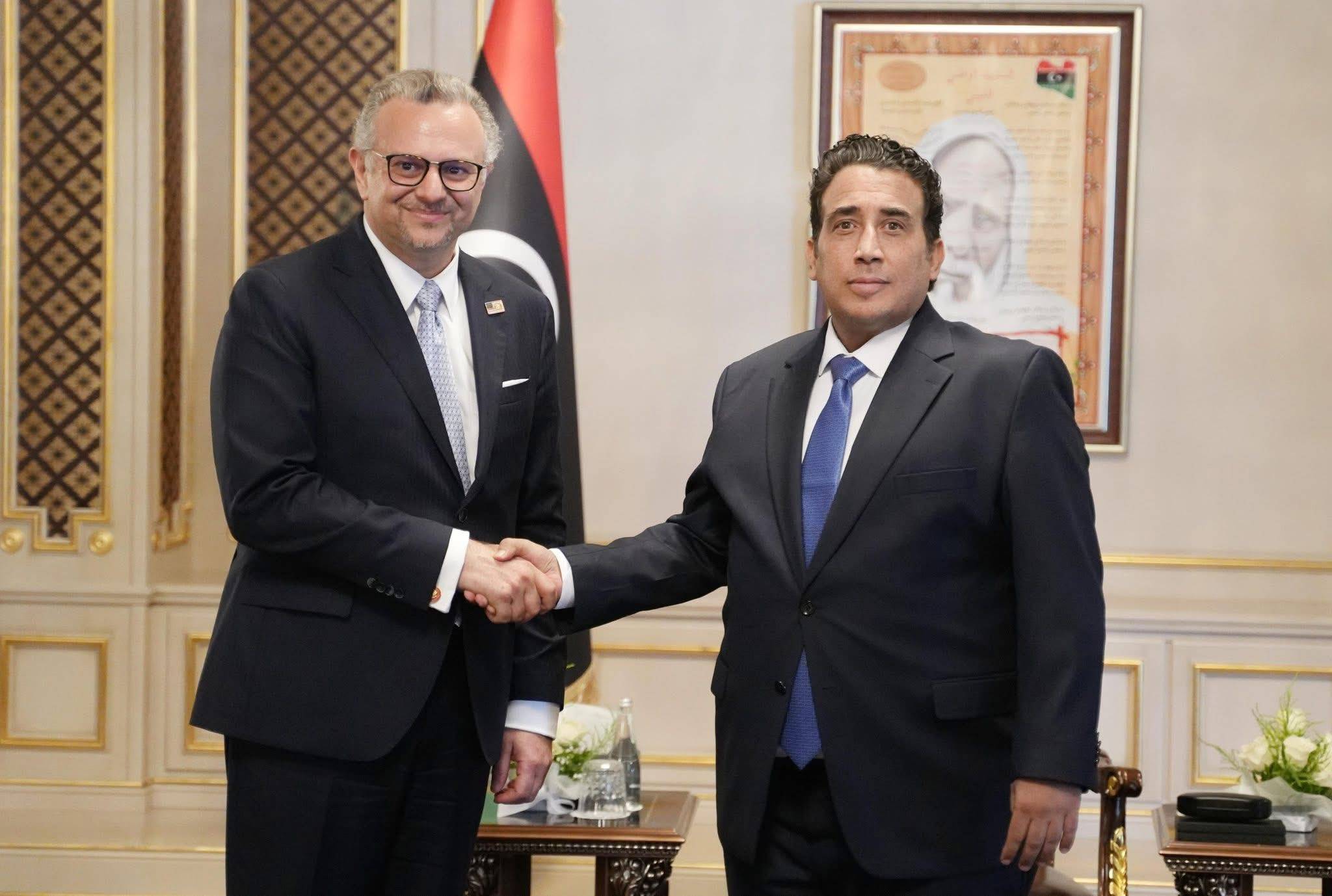
A month after completing what stands as the highest-profile diplomatic tour of Libya by the US’s top regional envoy since he assumed his role, Massad Boulos’ push for Libyan institutional unification remains mired in ambiguity, leaving regional observers and local factions questioning Washington’s core goals in the fractured North African nation.
Boulos, who serves as senior advisor to former President Donald Trump on Arab and Middle Eastern affairs, kicked off his multi-stop tour in early July with widespread expectations that he would unveil a concrete framework to resolve Libya’s decade-long political split. The itinerary kicked off with preliminary closed-door talks with factional representatives in Malta on July 6, followed by back-to-back face-to-face negotiations the next two days: first with Tripoli-based Prime Minister Abdul Hamid Dbeibah, who leads the UN-backed western Libyan government, on July 7, and then with eastern Libyan strongman Field Marshal Khalifa Haftar in Benghazi a day later.
In a notable break from standard diplomatic itineraries, Boulos also carved out time to meet with a range of influential independent players unaffiliated with either of the country’s rival ruling blocs. These included Naji Issa, governor of Libya’s Central Bank, and leading representatives from the Council of Elders of Misrata, the economically powerful western Libyan city that played a key role in defeating Haftar’s 2019–2020 offensive on western Libya.
Despite weeks of follow-up talks after the tour, no clear public roadmap has materialized for what Boulos framed during his visit as national unification efforts, a framework that has become widely known as the “Boulos initiative.”
This diplomatic push is not a new endeavor. As far back as September 2024, Boulos publicly committed that Washington would actively facilitate the reunification of Libya’s governing institutions, which have split along eastern-western lines since the outbreak of the country’s second civil war in 2014. That division came three years after a NATO-backed intervention toppled longtime Libyan ruler Muammar Gaddafi, leaving a power vacuum that has stoked ongoing instability.
Today, the country’s political landscape remains split: Haftar and his allied factions control eastern Libya, while Dbeibah’s UN-supported administration governs the west from Tripoli. The UN Support Mission in Libya has led formal peace negotiations since large-scale fighting ended in 2020, but the country has yet to achieve full institutional unification, with no national elections held to resolve competing claims to power.
After nearly 12 months of regular negotiations and meetings with Libyan officials from all sides, Boulos’ only confirmed major breakthrough has been the brokering of a unified national budget for both rival governments, agreed in April 2025. No additional concrete progress has been recorded in the months since. As of July 19, Aguilah Saleh, speaker of the Tobruk-based House of Representatives aligned with Haftar, confirmed that the legislative body had not received any official draft proposal for the Boulos initiative as of yet.
Slow progress on the initiative has been fueled in large part by mounting criticism from multiple major Libyan factions, whose opposition coalesced after a June 2025 Financial Times report cited anonymous sources familiar with the matter claiming that Washington was pushing a power-sharing deal that would install Saddam Haftar, Khalifa Haftar’s son and widely anticipated successor to the 82-year-old field marshal, as head of Libya’s highest executive body, the Presidential Council. The role is currently held by Mohamed Menfi, a relatively neutral political figure.
When Boulos arrived in Misrata on July 7 to begin his tour of western Libya, dozens of protesters gathered at the city’s airport to demonstrate against his visit and denounce what they called a “suspicious deal” to advance the Haftar family’s political power. Misrata, Libya’s commercial heartland, and its business and military leadership have a long history of fierce opposition to the Haftars; the city’s militias led the resistance that repelled Haftar’s 2019–2020 offensive to seize control of western Libya.
“The criminal Haftar is responsible for everything happening today, this is reason enough to reject a solution [involving his family],” Younes al-Salabi, spokesman for the Misrata Military Council, one of Libya’s largest armed factions, told Middle East Eye in an interview.
Misrata is not the only bloc opposing the initiative. In southern Libya’s desert region, rebel leader Mohamed Wardago, whose armed movement has waged an insurgency against Haftar’s forces since January 2025, echoed the opposition. “Nobody can accept that Haftar and his sons should hold key sovereign positions within the Libyan state,” Wardago said, confirming that his group had also seen reports of the US plan to install Saddam Haftar as Presidential Council head.
Jalel Harchaoui, a leading North Africa-based political analyst, confirmed that placing Saddam Haftar in the top executive role is the core component of the proposed deal. While the constitutional framework that defines the Presidential Council head’s powers remains vague, Harchaoui noted that Saddam Haftar already commands his own military units, so his appointment would expand the office’s influence and fundamentally reshape its role in Libyan politics.
The proposed deal does not only elevate the Haftar family: multiple reports, including the June Financial Times investigation, indicate the framework would allow Dbeibah to remain in his post as prime minister in Tripoli. Though Washington has long-standing ties to Khalifa Haftar, who holds US citizenship, the State Department has also maintained regular direct diplomatic contacts with Dbeibah; Boulos described a July 26 phone call between the two sides as “productive.”
Dbeibah, who was appointed to his post by the UN-backed Libyan Political Dialogue Forum in 2021 rather than elected through a popular vote, has faced growing public backlash in recent months. Since May 2025, repeated street protests have called for his resignation. Tensions flared again at the end of July, when protests sparked by widespread power cuts in western Libya shifted focus to Dbeibah, with demonstrators attempting to storm his Tripoli office. In recent days, protesters have closed five ministry offices and the national anti-corruption authority to protest collapsing public services, the ongoing electricity crisis, and plummeting living standards across the country.
Against this backdrop, a US-brokered deal that allows Dbeibah to retain power is deeply controversial among the Libyan public, even as it offers the embattled prime minister a critical political lifeline. “Dbeibah would gain recognition across the country and would, for the first time, be able to travel to Benghazi,” Harchaoui explained. “Both Saddam and Dbeibah would acquire national legitimacy, with the possibility of remaining in power without elections for at least a year, probably longer.”
While holding national elections remains an official priority for the United Nations, with the UN Security Council reaffirming its call for polls last month, elections have barely been mentioned as a core goal of Boulos’ initiative and do not appear to be part of his proposed framework. Misrata’s leadership says it supports a resolution centered on “the organisation of a constitutional referendum and elections,” while July protesters in Tripoli repeatedly called for “the fall of all political institutions, without exception,” to be replaced through a free electoral process.
In recent weeks, Boulos, a fluent Arabic speaker, has given a series of interviews to Arab regional media to defend and promote Washington’s efforts in Libya. In a July 27 interview with Saudi outlet Asharq Al-Awsat, Boulos argued that “unity is the basis for legitimacy and democratic elections,” meaning his framework prioritizes reaching a unification deal first before holding any national polls.
Analysts say this sequencing aligns with the White House’s core priorities in Libya: securing stable, pro-US partners rather than advancing rapid democratic transition. Since January 2025, when Libya announced its first oil licensing round in nearly 20 years, the US has actively encouraged American energy firms to invest in Libya’s oil sector, which holds the largest proven oil reserves on the African continent. A second core US priority is expanding security cooperation with Libya’s fragmented military, particularly Haftar’s Libyan National Army (LNA), to counter Russian influence in the region.
Russia has provided direct military support to the LNA since the second Libyan civil war, with Russian paramilitary groups deploying thousands of fighters to back Haftar’s forces. In exchange, Moscow has gained access to key airfields and ports in eastern and southern Libya, which the LNA controls, allowing Russia to expand its military operations across the African continent.
Harchaoui noted that “The Pentagon believes that unifying the military commands would make it harder for Russia to maintain its presence” in Libya. So far, one of the only tangible US successes in this area has been the Flintlock 2026 joint military exercise held in April 2025, which marked the first time LNA units and Tripoli-based armed forces trained together on Libyan soil.
During his July tour, Boulos also prioritized meetings with top Libyan security officials, meeting not just the Haftar family in Benghazi but also Interior Minister Emad Trabelsi and Deputy Defence Minister Abdul Salam al-Zoubi in Tripoli, both of whom command powerful western Libyan armed groups. Still, even after months of high-level diplomacy, Boulos has failed to outline clear specifics for his initiative, including how military reunification would be implemented.
A recent UN Panel of Experts on Libya report has also added to skepticism, reiterating longstanding allegations of widespread human rights abuses and systemic corruption involving armed groups and factions aligned with both the Haftar and Dbeibah families. Khalifa Haftar in particular has been accused of war crimes by global watchdog groups including Human Rights Watch, and a US court has previously ruled that he is legally liable for torture and extrajudicial executions carried out by his forces.
Ultimately, the lack of clarity surrounding Boulos’ plan has fueled growing skepticism across Libya, even as a broad majority of Libyans from all factions support the ultimate goal of unifying the country’s fractured institutions.