Three years into Sudan’s brutal civil conflict, more than 8,000 people remain unaccounted for, leaving their relatives trapped in a torturous limbo of not knowing whether their loved ones are alive or dead. The International Committee of the Red Cross (ICRC) confirms these missing persons numbers, a devastating byproduct of a war that has ripped apart countless households across the nation. People have disappeared while fleeing violence, fallen victim to unrecorded combat deaths, or been secretly detained, leaving their families in perpetual psychological agony.
For Azaher Abdallah, that agony has stretched for more than a year. Her husband, 38-year-old Fahmy al-Fateh — a farmer and merchant who joined Sudan’s national army when the war broke out — left their home before sunrise in January last year. He called her on his way out, saying he would stop at the market before returning home after completing his assignment for the day. Al-Fateh was last seen riding a motorcycle away from a Khartoum military base, and he never came back. Today, the couple’s 3-year-old son runs screaming after every passing motorcycle, convinced his father has finally come home.
“He was the most precious thing in my life,” Abdallah said through sobs, hiding her face in her hands. “I would feel more at peace if I knew anything. It is better than this endless uncertainty, never knowing if he is alive or dead.” Abdallah has searched every hospital morgue across Khartoum, pleaded with army officials for information, and still keeps scrolling through old photos of her husband in uniform, refusing to abandon hope. “That is what my heart tells me — he will come home one day,” she said.
Psychological experts warn that this ambiguous loss inflicts long-term, profound harm on surviving family members. “Families of missing persons experience additional layers of vulnerabilities due to hostilities, displacement and the unresolvable grief of ambiguous loss,” explained Nathalie Nyamukeba, a psychologist working with the ICRC. The organization has managed to resolve just over 1,000 missing person cases to date, but has declined to share how many of those cases ended with confirmation of life or death.
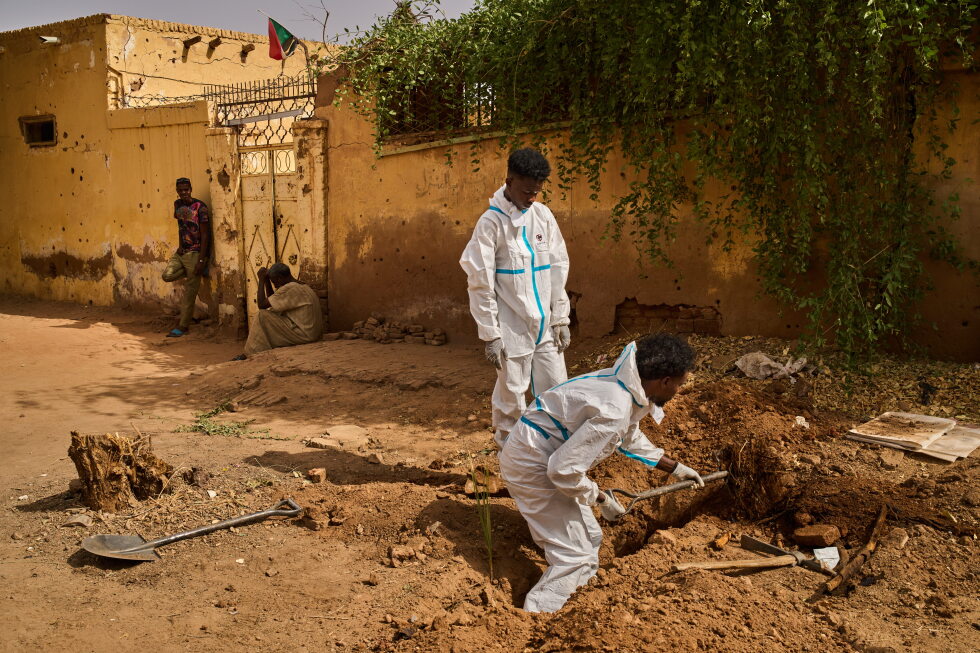
Across Khartoum state, authorities believe many missing people now lie in unmarked graves scattered across the capital. When the army retook full control of Khartoum from the Rapid Support Forces (RSF) paramilitary group last year, tens of thousands of hastily buried bodies were discovered across the city. During the height of combat, it was too dangerous to transport bodies to formal cemeteries, so residents buried their dead wherever they could: in neighborhood soccer fields, along road sides, beside abandoned gas stations, and even in front of family homes. During a recent reporting trip through Khartoum, Associated Press journalists encountered overflowing formal cemeteries and unmarked dirt mounds scattered across public spaces, many with no identifying information at all.
For Sulafa Mustafa, the search for her 18-year-old son Suleiman Abdalsid has stretched across two years. The shy teen left home to visit a friend on the outskirts of Khartoum and never returned. Even when artillery shelling echoed through city neighborhoods, Mustafa walked door to door, showed Suleiman’s photo to strangers, visited every hospital and prison, and even rented a public address microphone to call out his name through the streets. Like Abdallah, she has not given up. “I haven’t lost faith in finding you,” she said.
Locating and identifying missing people remains an enormous challenge amid the ongoing conflict. Most forensic DNA testing laboratories in Khartoum have been destroyed in fighting, and few specialist forensic personnel remain in the country. So far, Khartoum state authorities have relocated nearly 30,000 of the roughly 50,000 hastily buried bodies scattered across the capital to formal burial sites. Roughly 10% of these remains remain unidentified, according to Hisham Zienalabdien, director general of Khartoum’s forensic medicine department. His team is currently storing DNA samples from all unidentified bodies, in the hope that future technology and access will allow them to match remains to grieving relatives.
Even for families who have recovered their loved ones’ remains, the trauma of the conflict leaves permanent scars. Abubakar Alswai waited more than a year to move his 73-year-old brother Mohamed’s remains from a hasty grave in front of their family home to a formal public cemetery. Mohamed was killed by RSF fighters, who waited three weeks before allowing neighbors to bury his bullet-ridden, decomposing body. Under majority-Islamic Sudanese tradition, funerals are held as soon as possible, ideally within 24 hours of death. As gravediggers exhumed Mohamed’s remains to move him, Alswai wiped tears from his cheeks. At least now, he said, his brother will receive the dignified burial he deserves, and his family can find a small measure of peace. “What happened has left a permanent mark on my heart,” he said.