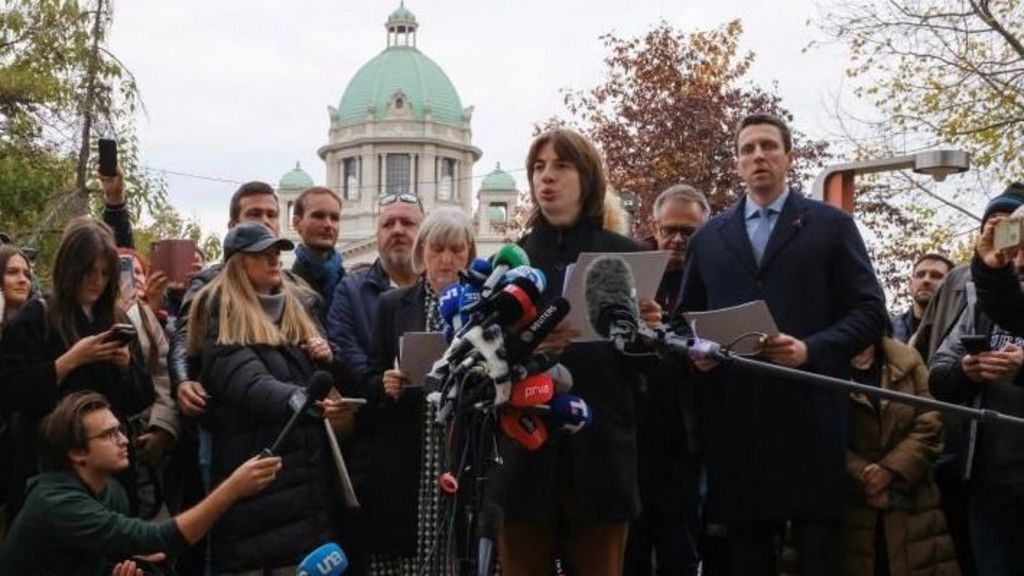
Beneath the foliage of Pioneers’ Park, the green public space directly across from Serbia’s national parliament building, the newly elected representatives of the landslide Student List movement gathered for their first official press conference just days after voters ousted the long-ruling party of former president Aleksandar Vučić from power. The historic political upset, which marks one of the most sweeping overnight reboots of a European national political system in recent memory, has handed governing authority to a cohort of first-time office holders drawn from a cross-section of Serbian society: intellectuals, university professors, professional artists, competitive athletes, and no fewer than 12 practicing medical doctors and surgeons. During the outdoor press briefing, the newly sworn-in MPs issued an immediate, explicit demand for the top leadership of Serbia’s law enforcement, intelligence, and judicial branches to step down. The group called for the dismissal of all police personnel found to have committed unlawful acts during Vučić’s decade-plus tenure, specifically naming the heads of the national police force, the BIA domestic security agency, and the elite anti-terrorism unit as required to vacate their posts. The Student List leadership has openly voiced deep concern that critical documentary evidence of systemic official wrongdoing could be deliberately destroyed over the coming weeks, as the formal handover of state institutional power is scheduled to unfold gradually rather than instantaneously. The very park where the press conference was held bore stark physical traces of the old regime’s last days: as recently as days before the election, the site was a sprawling tent encampment occupied by loyalist supporters of Vučić stationed outside his office. Within hours of Vučić publicly conceding electoral defeat on Sunday night, the entire encampment was torn down, and hundreds of civilian volunteers arrived at dawn the following Monday to begin clearing debris and restoring the public green space. “This is just the first wave of spring cleaning, the new ones are coming now — we are very excited but fully prepared to put in the work,” 25-year-old volunteer Marija Milovanović told reporters as she scrubbed grime off a weathered park bench. The entire Student List movement first coalesced in late 2024, after a catastrophic structural collapse of a railway station canopy in Novi Sad, Serbia’s second-largest city, killed 16 people, triggering widespread public outrage over long-alleged systemic corruption that had been ignored for years. The movement’s founding core demand was to hold every responsible party for the deadly disaster fully accountable in a court of law, and to root out the pervasive graft that officials said had contributed to the structural failure. The group’s 1200-page, meticulously detailed governing manifesto, formally titled the Student Plan, lays out ambitious pledges to halt state asset plunder, recover embezzled public funds back to the national treasury, and direct new public investment directly into underfunded education programs and domestic economic development. The first wave of administrative changes aligned with this agenda has already begun: Manja Grčić, the long-serving Vučić loyalist director of state broadcaster RTS, has already stepped down, and new MP Mirjana Nikolić stated publicly that Serbian citizens hold an inherent right to unbiassed, truthful news coverage after years of the public media outlet operating exclusively to serve the ruling party’s political interests. The movement has also announced plans to replace Vladimir Lučić, the politically appointed head of state-owned telecommunications giant Telekom Srbija. The outgoing acting president Ana Brnabić, a longstanding Vučić ally, has pushed back sharply against the incoming administration’s early actions, accusing the Student List of pursuing “revolutionary justice rather than the rule of law” and claiming the new government intends to forcibly shut down all media outlets that hold opposing political views. Dejan Šoškić, the widely respected former central bank governor who is one of the highest-profile newly elected MPs on the Student List ticket, has emphasized that urgent, time-bound reform is non-negotiable, with core institutional changes required to be fully implemented within the first six months of the new government’s term. “In the first six months, I would like to see the media scene fully liberated, make steady progress in the fight against systemic corruption, ensure every state institution operates strictly in line with existing legal statutes, and pass a formal lustration law,” Šoškić explained. The proposed lustration policy would bar any members of the former Vučić government or ruling party apparatus who are found to have violated Serbian citizens’ fundamental rights from holding any public office for a defined period. Strahinja Subotić, a policy analyst at the Belgrade-based European Policy Centre, has cautioned that this sweeping institutional reset will be an extraordinarily complex process, as every core pillar of state authority in Serbia has been fully controlled by Vučić and his Serbian Progressive Party for more than a decade. Subotić added that the new administration will ultimately need to build collaborative bridges with institutional segments that functioned effectively even under the previous ruling party to avoid full systemic collapse. All 141 successful Student List parliamentary candidates were selected through a lengthy, rigorous, confidential nomination process run by university student groups across Serbia, who tasked the diverse cohort with delivering on the full scope of the movement’s systemic national rebuilding agenda. Radomir Saičić, a University of Belgrade professor of organic chemistry and another prominent newly elected MP, confirmed that while practical implementation mechanisms for the manifesto will be refined on an ongoing basis, the full 1200-page student-drafted plan will serve as the non-negotiable governing roadmap. “Parliament will make formal decisions, but since this entire historic change was led by the sustained efforts of Serbia’s students, we will place enormous value on their input and maintain close, continuous collaboration with them,” Saičić pledged. The incoming governing cohort faces an unprecedented set of structural challenges: nearly every MP is a first-time public office holder, the movement has no designated formal single leader, and it must navigate Serbia’s longstanding delicate balancing act on the global diplomatic stage. Serbia holds official European Union candidate status but has maintained longstanding close economic and political ties with Russia, and has refused to impose Western sanctions on Moscow following its 2022 full-scale invasion of Ukraine. The EU released an official statement quickly welcoming the Student List’s electoral victory, and pledged full support for the new government’s planned rule of law, media freedom, and anti-corruption reforms. Notably, however, EU integration occupies only a very minor position in the movement’s election manifesto, which describes the bloc solely as Serbia’s “most important economic partner.” Šoškić confirmed that the new government has no immediate plans to alter the country’s longstanding neutral foreign policy stance, noting that Serbia endured crippling UN sanctions during the Yugoslav wars of the 1990s, and the new leadership is well aware that punitive trade measures overwhelmingly harm ordinary civilian citizens rather than altering state leadership decisions. The incoming administration’s immediate priority will be fully focused on domestic institutional reform, and it faces a tight political timeline: Serbia’s next presidential election is scheduled for December, and Vučić — who is legally barred from running for a third consecutive presidential term — has already vowed that his defeated Serbian Progressive Party will regroup and mount a fierce political comeback far sooner than their opponents anticipate.