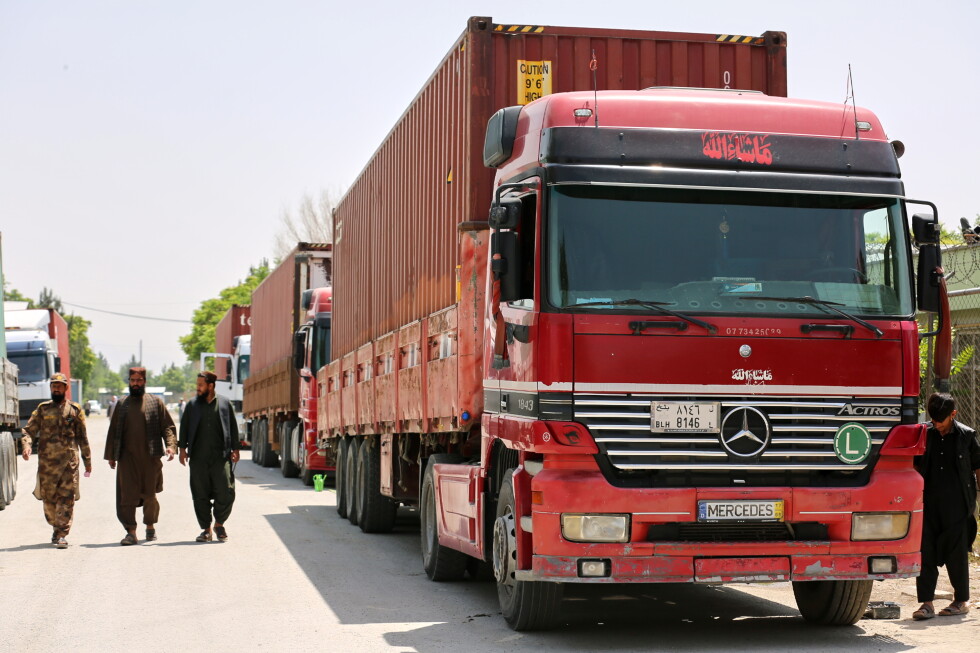
Landlocked Afghanistan, a country already grappling with decades of instability and widespread food insecurity, now faces a cascading logistical catastrophe after two of its primary trade routes were simultaneously knocked offline by overlapping regional conflicts. What began as a border dispute with neighboring Pakistan that closed key crossing points late last year quickly pushed Afghan traders and aid organizations to shift their supply chains to a second alternative: routing goods through Iran’s major Indian Ocean port of Bandar Abbas, located on the strategic Strait of Hormuz. That workaround, however, became unsustainable almost immediately after the outbreak of war in the region left hundreds of commercial vessels stranded in the strait and thousands of crew members trapped aboard, cutting off this critical alternate corridor even as thousands of Afghanistan-bound containers remained stuck at Pakistan’s Karachi shipping hub. For already vulnerable Afghans and strained local businesses, the loss of both major trade arteries has been nothing short of devastating.
The United Nations World Food Programme (WFP), which runs life-saving nutrition interventions across Afghanistan serving acutely malnourished women and children, has borne the brunt of the disrupted supply chains. Most of the organization’s critical nutritional supplements and fortified high-energy biscuits for school-aged children were sourced from Pakistan, but after the Pakistan border closure in October, WFP was forced to reroute incoming supplies via sea through Dubai and Iran. Today, that second route is effectively inaccessible amid heightened tensions: Tehran controls access to the Strait of Hormuz, while U.S. blockades have shut down operations at Iranian ports. By mid-April, WFP’s stockpiles of life-sustaining nutritional supplements had been completely exhausted, leaving health clinics with no aid to distribute to at-risk patients.
“At a time when malnutrition is already at near-record levels, weakened and desperate mothers and children are being turned away from health clinics, as we have no food to give them,” stated John Aylieff, WFP’s country director for Afghanistan. The crisis comes on top of a pre-existing funding shortfall that has stretched the organization’s operations thin: WFP has only received 8% of its required annual funding for its Afghanistan operations this year. “On top of a funding crisis, conflict in the Middle East and the closure of the border with Pakistan are choking WFP’s operations — blocking supply routes, driving up costs and straining markets at the worst possible time,” Aylieff added in emailed comments.
With both southern and southwestern trade routes closed, WFP has been forced to redirect all incoming shipments overland through Central Asia, a far longer and more costly route that lies thousands of kilometers from major ocean ports. Aylieff confirmed that overall transportation costs have tripled, while the per-unit cost of nutritional supplements for vulnerable mothers and children has jumped by 35%. One ongoing shipment of fortified high-energy biscuits, originally bound for Afghanistan from the United Arab Emirates, illustrates the scale of the logistical nightmare: what was supposed to be a short journey through Dubai, Iran and into Afghanistan has turned into a three-month-long circuitous trip across Saudi Arabia, Jordan, Syria, Turkey, Georgia, Azerbaijan, across the Caspian Sea, and finally into Afghanistan via Turkmenistan. The shipment is still in transit after three months.
Private Afghan businesses are facing similarly catastrophic pressures, with many small and medium enterprises on the brink of collapse. Lutfullah Akbari, who operates a small construction equipment import company in Kabul, said his incoming shipment of Chinese-manufactured equipment is stuck on a stranded vessel unable to transit the Strait of Hormuz, while logistics costs have surged past what his business can absorb. “I have nothing else to use to continue my business here,” Akbari said, noting that he is considering abandoning his cargo entirely if the strait does not reopen soon. “The Iran-U.S. war has had a huge impact on my business. Other traders have rerouted shipments through Central Asia, but it is longer and more expensive. The logistics company now wants more than the value of our goods and the capital we had invested in them. We can’t afford it. Even if I bring them here, I’ll have to sell them all at a loss. I can’t afford to lose twice.”
Logistics industry leaders confirm that cost increases have upended nearly every segment of Afghanistan’s import and export market. Gul Meer Amini, logistics director at Kabul-based freight firm Etifaq Bamyan International Transport and Trade Forwarding, which handles both commercial and humanitarian cargo, said container rental rates have more than doubled since the outbreak of war in the Strait of Hormuz. Pre-conflict rates hovered between $3,000 and $3,600 per container; today, rates top $7,000, with some shipments reaching over $11,000. “The impact is reaching all traders,” Amini said.
For smaller retail traders, the price hikes are even more staggering. Mohammad Murtaza Ishaqzai, a Kabul-based electronics retailer, said pre-war delivery costs for Chinese goods shipped through Iran ran between $1,100 and $1,500 per shipment. Today, that same shipment costs more than $15,000 — a tenfold increase. “We can’t export and we can’t import,” Ishaqzai said, appealing to the Taliban-led Afghan government to resolve its ongoing border dispute with Pakistan to reopen the original southern trade route. “If the situation continues, our business will be finished.”
Afghan government officials have sought to downplay broader inflationary impacts, noting that the country has shifted the majority of its trade volume to alternate routes through Central Asia to mitigate damage. Abdul Salam Jawad, spokesperson for Afghanistan’s Commerce and Trade Ministry, said overall national price increases have been held to roughly 3% thanks to continued imports from Central Asia, Russia and China. “The problem we faced was the restrictions on our imported goods and containers coming from other countries via Iran,” Jawad explained. “We are waiting for a solution to be found in the Strait of Hormuz so that we can export normally.”
Khan Jan Alokozai, senior adviser to Afghanistan’s Chamber of Commerce and Investment, confirmed that more than 60% of the country’s total trade now flows through Central Asia, softening the overall blow of the two closed routes. Key supplies including food and petroleum products are currently arriving via Central Asia and Russia, while a growing share of trade is routed through Turkey before moving by rail through either Iran or Azerbaijan into Afghanistan, Alokozai said. Even with these adjustments, however, the humanitarian and economic damage from the collapsed southern routes continues to mount for the country’s most vulnerable populations and struggling small businesses.
(Reporting by Becatoros in Athens, Greece)