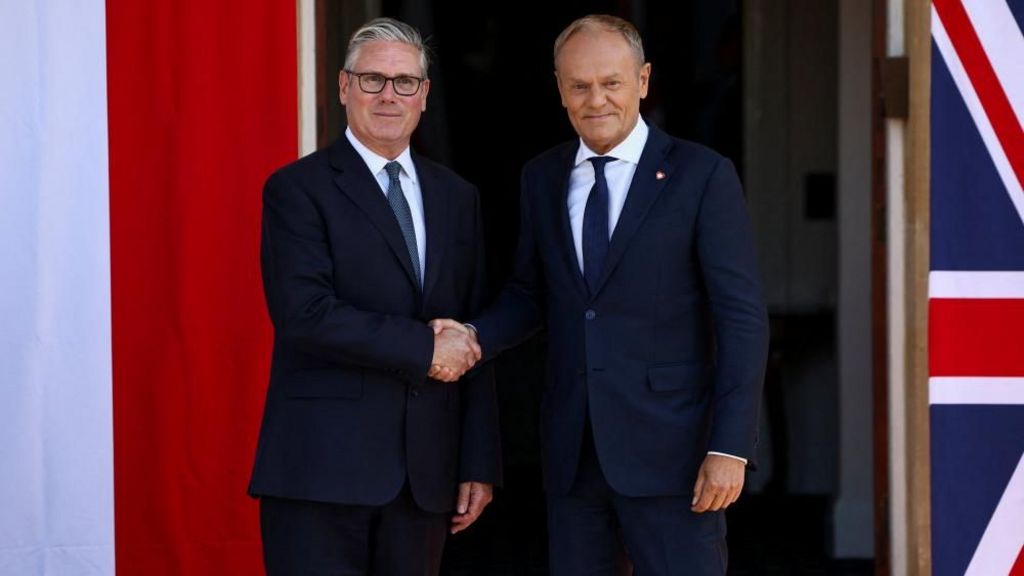
In a high-profile diplomatic gathering held at RAF Northolt in West London on Wednesday, British Prime Minister Keir Starmer and his Polish counterpart Donald Tusk formalized a landmark new bilateral defence and security partnership, capping the event with a solemn visit to the adjacent Battle of Britain Bunker, where the leaders laid a commemorative wreath to honor fallen World War II service members.
Speaking after the signing ceremony, Starmer emphasized that Russian aggression stands as the most pressing shared threat facing both nations, with impacts extending far beyond the war in Ukraine to destabilize all European states. He framed the new accord as a transformative step that would deliver a “generational uplift” to the longstanding security relationship between the UK and Poland.
The official text of the treaty explicitly names Russia as the most significant long-term threat to collective Euro-Atlantic security, and formalizes both nations’ commitment to countering Moscow’s malign influence across the region. It also reaffirms the UK and Poland’s unwavering, ironclad commitment to the collective defence principles of NATO, and addresses a range of additional shared security priorities. These include supporting domestic defence industry jobs, enhancing coordinated response capabilities for cyber attacks, strengthening cross-border security, coordinating crackdowns on transnational organized crime networks, and joint action to curb irregular migrant smuggling. Under a new dedicated joint action plan, the two countries will expand intelligence sharing, deploy emerging technologies to enhance border monitoring, and target the social media infrastructure that smuggling gangs use to recruit and coordinate operations.
Tusk emphasized through an interpreter that the treaty is rooted in the shared core values of the two nations: respect for the rule of law and fundamental human rights. He pushed back against growing narratives that frame these principles as outdated, noting that these values remain non-negotiable foundations for the sovereignty and security of both Poland and the UK.
Despite the official optimism surrounding the agreement, independent defence analysts have raised pointed questions about the tangible impact of the new treaty and its added value compared to previous bilateral accords. Ed Arnold, a defence adviser at The D Group and senior associate fellow at the Royal United Services Institute (RUSI), a leading UK defence think tank, told the BBC that the new agreement delivers little meaningful new content on core defence and security cooperation. Arnold pointed out that the UK and Poland already signed major bilateral security agreements in 2018 and 2023, leaving him unclear what unique role the new treaty will fill.
He added that the bulk of the new text focuses heavily on migration and related border security issues, rather than advancing core defence cooperation. Arnold warned that lumping multiple disparate policy areas into a single treaty carries inherent risks: if the two countries experience disagreements over one policy domain, such as migration management, those tensions could spill over and damage critical defence and security collaboration. He also questioned whether the UK currently has sufficient institutional and resource capacity to deliver on all the treaty commitments it has made across its growing portfolio of bilateral international agreements, concluding that the accord falls far short of the transformative, generational change that Starmer has claimed it delivers.