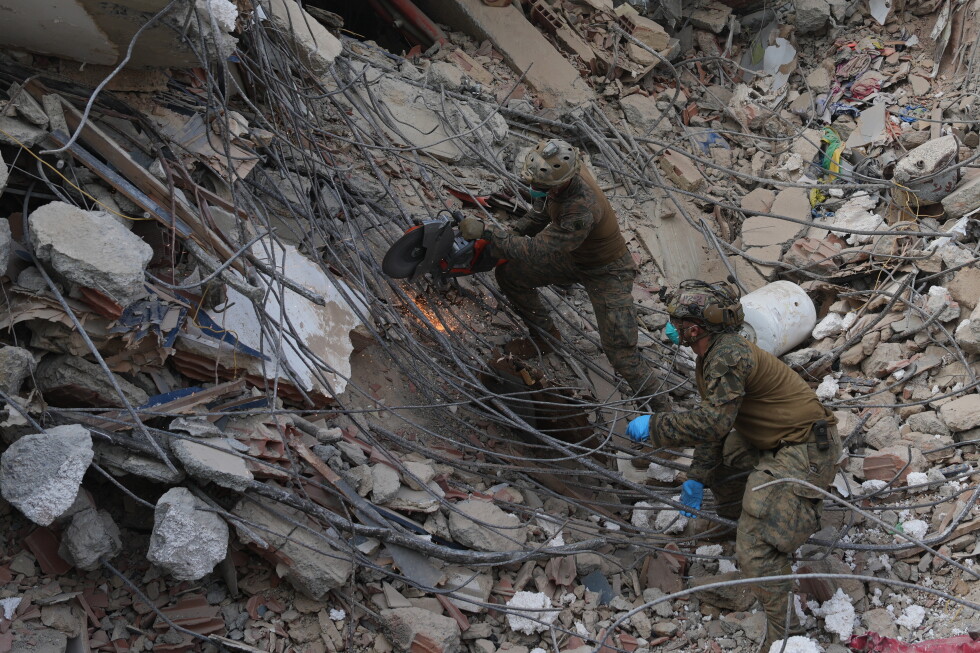
Six days after powerful back-to-back earthquakes tore through Venezuela’s northern coastal state of La Guaira, Angelica Mundrain still waits for heavy machinery to recover the bodies of her son, niece, and nephew trapped beneath the concrete and twisted steel rubble of her former 11-story beachfront apartment. She is far from alone in her wait, and in her frustration: hundreds of survivors across the disaster zone are asking the same unanswerable question: Where is the government?
On June 24, two major earthquakes measuring 7.2 and 7.5 magnitude struck the region, reducing residential towers, corner shops, pharmacies, hotels, and grocery stores to piles of debris. The disaster has laid bare a decades-long erosion of basic state capacity under the socialist party that has ruled Venezuela for 27 years, now led by acting President Delcy Rodriguez who took office after former President Nicolas Maduro was removed by U.S. forces in January and extradited to New York on drug trafficking charges.
In the critical 72-hour window after the quakes — the period widely recognized as the most vital for successful rescue operations — the only visible on-the-ground presence from the Venezuelan government was security personnel, including police, intelligence agents, and armed forces, who were assigned solely to direct traffic at intersections. Ambulances carrying injured survivors were stuck in multi-kilometer traffic jams, local hospitals operated with critical shortages of supplies and too few medical staff, and official emergency responders arrived with little to no heavy rescue equipment.
Most search and recovery efforts have been led by civilian survivors themselves, with limited support from foreign rescue teams that brought specialized gear including thermal imaging cameras, acoustic life detectors, and trained search canines. Multiple residents told stories of uniformed Venezuelan personnel standing idly by as civilians and foreign workers dug through rubble, with some state officials even stopping to take selfies at disaster sites rather than assisting in efforts.
The slow response is also deeply unequal, with access to rescue resources heavily skewed toward wealthy and politically connected families. A telescopic crane, the exact same type of heavy equipment Mundrain needs to retrieve her family members, was deployed for hours at a separate collapsed building where a senior military captain and major general were trapped, arranged by relatives who could afford to rent the machine. Mundrain, by contrast, has no such connections or funds to secure the equipment.
“If someone in power lived in this building, they’d have a fully running operation just like they do at those other residences,” Mundrain said, gesturing to the flattened remains of her apartment building. “We’ve been abandoned. We feel helpless. All we’ve seen is a lack of organization, a lack of empathy, a lack of everything.”
Public anger over the botched response has already boiled over into open conflict. At the site of one collapsed public housing complex, residents blocked a road to stop a government-owned excavator from leaving the site, even pulling the operator out of the vehicle’s cab to force it to stay and continue recovery work.
Venezuelan government figures put the official death toll from the quakes at 1,943, with more than 10,500 injured and thousands more still reported missing. As of Tuesday, rescue teams were still pulling a small number of survivors from debris, giving anguished families a sliver of hope even as the chance of finding more people alive drops sharply with each passing day.
Daniel Castillo, a local electrician, managed to pull his mother and 10-year-old son alive from the second floor of a collapsed public housing building just hours after the quakes hit, but he had to wait a full 24 hours before he could reach his brother’s body trapped deeper in the rubble. Waiting in line Tuesday for free hygiene supplies distributed by the Venezuelan military, Castillo criticized the stark contrast between clean, untouched uniformed personnel and the dust-caked civilians and foreign rescuers who have done the dangerous work of digging through rubble for days.
“You look at the National Guardsmen standing around, their uniforms are completely spotless, not a speck of dirt on them,” Castillo said. “The government did nothing.”
Experts say the failed response is not an isolated failure, but a symptom of long-running structural collapse of the Venezuelan public sector. David Smilde, a Tulane University professor who has researched Venezuelan politics and society for 30 years, noted the disaster makes clear that the January 2023 capture of Maduro by U.S. forces was not a one-off example of state incapacity.
“This isn’t just a case where the Venezuelan state couldn’t defend its own sitting president,” Smilde explained. “It also can’t carry out the most basic function of digging trapped people out of rubble after a disaster, which should be a major warning sign for the current government under Rodriguez.”
Smilde traced the problem to two long-standing issues: widespread flight of skilled workers from the public sector driven by poverty-level wages, and rampant “ghost employee” corruption that puts thousands of names on government payrolls who do not actually show up to work. In a functional government, emergency protocols with clear assigned roles for disaster response are developed and updated years in advance of any event, he said.
“It’s like trying to field a baseball team with only three players on the field,” Smilde said. “No one knows who is supposed to pitch, who is supposed to catch, who is supposed to play the outfield. That is exactly how this government’s disaster response is structured.”