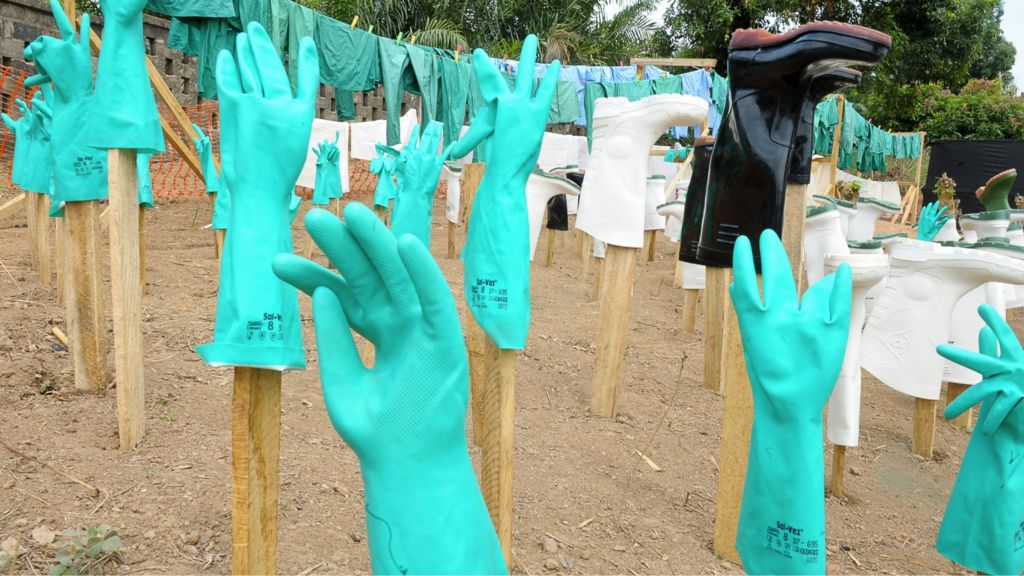
More than a decade after West Africa suffered the deadliest Ebola epidemic in recorded history, a new outbreak in the eastern Democratic Republic of the Congo has stirred traumatic memories for survivors of the earlier crisis, while forcing global health experts to confront gaps in preparedness for rare, untreatable strains of the virus.
Patrick Faley, a Liberian Ebola survivor who lost his four-year-old son to the disease during the 2013–2016 West African outbreak that killed over 11,000 people across Guinea, Liberia and Sierra Leone, says images of medics scrambling to contain the DR Congo outbreak have brought back haunting recollections of loss and chaos. “I saw the burial team taking eight of them,” Faley recalled. “I made new friends although they ended up dying. I was the only person that was left there.”
Faley was recruited as a community health volunteer by Liberia’s Ministry of Health at the height of the West African epidemic, tasked with traveling between rural villages to educate locals on how Ebola spreads through direct contact with bodily fluids, discourage unsafe traditional practices like handshakes and ritual washing of deceased bodies, and dispel dangerous misinformation about the virus. His own infection came after he set aside safety guidance to comfort grieving community members at a colleague’s Ebola funeral: “You have to shake hands; you have to hug people. Forgetting to know that we have a crisis, an emergency crisis in our country.”
Three days after the funeral, Faley fell ill, transforming from a frontline outreach worker to a patient in an overcrowded Monrovia treatment ward, where he watched dozens of patients die waiting for care. He survived the infection, but his wife and young son later contracted the virus. While his wife recovered, four-year-old Momo did not survive.
Today, the lessons learned from Faley’s experience and the broader West African outbreak are shaping the public health response to the new DR Congo outbreak, where the World Health Organization (WHO) has confirmed over 170 deaths so far. One key change adopted from past outbreaks is an immediate ban on traditional funerals for suspected Ebola cases to cut transmission chains — but the policy has already sparked community unrest. Last Thursday, a crowd angry over authorities’ refusal to release a body for burial set fire to part of a hospital near the outbreak epicenter in Bunia.
Dr. Patrick Otim, the WHO’s Africa area manager, emphasized that integrating past lessons into the current response is non-negotiable, and that community buy-in is as critical as medical infrastructure. “One of the biggest lessons from the West Africa outbreak and previous Ebola outbreaks in DRC is that speed matters,” Otim explained. “Early delays in detecting cases, isolating patients and engaging communities can allow transmission chains to expand very quickly.” He added that outbreaks cannot be controlled by medical intervention alone: “Community trust is essential. Safe and dignified burials, local leadership engagement and clear communication are just as important as laboratories and treatment centers.”
This outbreak marks the 17th Ebola event recorded in DR Congo since the virus was first identified in 1976, but it carries unique challenges: it is only the third global outbreak of the rare Bundibugyo Ebola strain, a variant that circulates far less often than the common Zaire strain. Unlike the 2013–2016 West African outbreak, which was eventually curbed with the first approved Ebola vaccine Ervebo, no approved vaccine or specific treatment exists for Bundibugyo.
Professor Thomas Geisbert, a leading Ebola researcher at the University of Texas Medical Branch and co-inventor of Ervebo, explained that the genetic makeup of Bundibugyo differs from Zaire by roughly 30%, rendering existing stockpiled vaccines ineffective. “Just because a vaccine works against one particular type of a virus doesn’t mean it’s going to work against another one,” he said. Ervebo remains the only Ebola vaccine currently available in the global emergency stockpile.
Developing new vaccines is an expensive, time-consuming process that has long been overlooked by profit-driven pharmaceutical companies, Geisbert noted. He and other researchers have already made progress on a Bundibugyo vaccine built on Ervebo’s existing framework, with preclinical trials in non-human primates showing 83% protection. However, the candidate has not yet moved to human testing. Geisbert estimates that moving a vaccine from laboratory development to full-scale deployment can cost more than $1 billion, a price tag that has so far discouraged private sector investment. Teams at the University of Oxford have also announced they are developing a candidate that could be ready for human trials within two to three months, and the WHO says a fully tested, deployable vaccine could take up to nine months to deliver.
Kenyan biochemistry professor Wallace Bulimo of the University of Nairobi said the current outbreak exposes a long-standing failure to prioritize research on less common Ebola strains, which were first identified as a distinct variant in 2007. “Why is it that we have not actually done a lot of work on this virus? And yet we knew it was there,” Bulimo said. “It was first discovered in 2007, so we should have actually never ignored it.”
Faley, who has experienced first-hand the fallout of mismanaged community outreach, warns response teams against openly telling locals that the current outbreak has no cure. Doing so, he argues, will discourage sick people from seeking treatment and fuel stigma, as communities believe seeking care is a death sentence. He also cautions against the common pitfalls of a sudden influx of international aid: large numbers of foreign responders can stoke fear and distrust in local communities, which played a role in slowing the West African response early on. Currently, tons of aid have been shipped to the outbreak epicenter in Ituri province, and multiple international medical and UN agencies are preparing to deploy support teams.
Unlike the early days of the West African outbreak, DR Congo has built up one of the world’s most experienced workforces for Ebola response over the past decade, having managed 16 prior outbreaks. Otim stressed that the Congolese government is leading the current response, and the country has built robust expertise in everything from case detection to outbreak coordination. The biggest challenges do not stem from a lack of experience, he said — instead, they come from the region’s difficult operating environment: long-standing insecurity from armed groups, widespread population displacement, crumbling infrastructure, and constant cross-population movement all make containment far more complex.
Experts warn the outbreak may already be larger than official counts show, as confirmation of the first case took three weeks: the initial patient, a nurse, developed symptoms on April 24, but the outbreak was not confirmed until mid-May. While the situation remains serious, there are small points of cautious optimism: the historical case fatality rate for Bundibugyo is roughly 30%, lower than many other Ebola strains. Still, Geisbert noted that Bundibugyo has a longer incubation period than other variants, which means infected people can unknowingly spread the virus in communities for longer before developing symptoms.
On a more encouraging note, the WHO plans to prioritize experimental use of the antiviral drug Obladesivir, which was developed during the COVID-19 pandemic, under strict clinical protocols. Researchers hope the drug may prevent infection in people who have been exposed to confirmed Ebola cases.
For his part, Faley says he stands ready to support affected communities in DR Congo, drawing on his own experience as a survivor to help people navigate the trauma of the outbreak. “Our arms are open as Liberians,” he said. “Our arms are open in order to help our colleagues who will be surviving, to give them a proper perspective, what it means to survive Ebola. I will always be here to advocate for survival.”