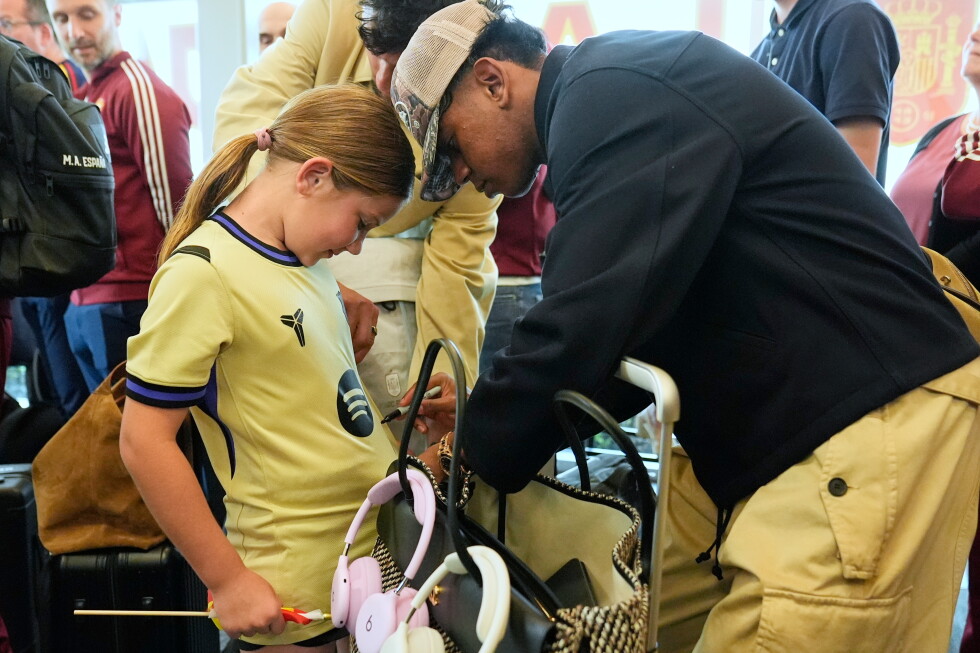
Nestled in the shadow of Tennessee’s iconic Signal and Lookout Mountains, 8-year-old Beckham McClure balanced precariously on a wooden fence for more than three hours on a warm summer day. Clutching a crumpled handwritten note addressed to Spanish soccer stars Pedri and Lamine Yamal, the young fan waited patiently for the Spain national men’s team to step out of their team bus and onto Chattanooga soil. The note read simply: “I love you and I look up to you. Thanks for coming to my city. I hope you win the World Cup.” When the world-famous athletes finally jogged onto the training pitch, Beckham’s eyes went wide with disbelief. “Dad,” he whispered, “they’re real.”
For Beckham’s father Jaxon McClure, a Marine Corps veteran and lifelong local soccer coach who named his son after the legendary David Beckham, that moment of childhood wonder encapsulated everything this World Cup experience has meant for small Southern American communities. This summer marks 32 years since the United States first hosted the FIFA World Cup, and for the 2026 iteration co-hosted by the U.S., Mexico and Canada, dozens of small to mid-sized cities across the South have stepped into the global spotlight as official base camps for competing nations, where teams can settle in, train, and prepare between matches.
Tournament favorites Spain set up their training headquarters at Baylor School, a private boarding academy nestled along the Tennessee River in Chattanooga; the Iraq national team has taken up residence at a remote mountain resort town in West Virginia that counts fewer than 3,000 full-time residents; and four-time World Cup champions Germany have made their home in Winston-Salem, North Carolina, where historic cobblestone streets and repurposed tobacco warehouses now stand side-by-side with German national flags and roaming television crews.
Across these communities, classic Southern hospitality is on full display for visiting teams. In Chattanooga, the 144-foot underground waterfall tucked beneath Lookout Mountain is lit up in Spain’s signature red, and the downtown Embassy Suites where the squad is staying is draped in the red-and-yellow Spanish flag, la Rojigualda. Giant welcome banners emblazoned with “Bienvenidos a Chattanooga” and portraits of star players greeted the team the moment they touched down at Chattanooga Airport. Local resident Skip Schwartz, who now serves on Baylor’s board of trustees, notes that Spanish jerseys are everywhere you turn. “You don’t know if they’re traveling fans from Spain hoping to get a glimpse, or locals who have jumped on the La Roja bandwagon,” Schwartz said.
Demand to watch the world’s best players train up close has been overwhelming: roughly 25,000 local fans entered a public lottery for just 1,000 available spots to watch Spain’s open practice at Baylor. In Winston-Salem, all tickets to see Germany train at Wake Forest University sold out in just four minutes.
Local businesses have also leaned into the excitement. Savannah Lahey, who manages Small Batch Beer Co., a popular soccer-focused bar in downtown Winston-Salem, extended opening hours to host public watch parties and created a special German-inspired menu for the tournament, featuring schnitzel sandwiches and sauerbraten ahead of Germany’s opening match. “It’s just fun to see everyone start to care about something they didn’t care about before,” Lahey said. “It makes our visiting friends feel at home, even when they’re thousands of miles away.”
At West Virginia’s historic Greenbrier Resort, a luxury property that has hosted U.S. presidents and foreign leaders for more than a century, Iraqi and American flags fly side-by-side as the Iraq national team settles into their training camp.
Spain’s decision to choose Chattanooga over larger American hubs like Chicago and Los Angeles comes down to the quality of Baylor School’s world-class soccer facilities. Under FIFA rules, higher-ranked national teams get first pick of approved base camps across North America, and the Spanish federation selected Baylor after FIFA inspectors gave top marks to the academy’s grass pitches, drainage, irrigation systems, and on-site operations. To keep the natural grass pitches in perfect condition for the Spanish team, Baylor’s own high school soccer team moved their entire spring training schedule to artificial turf, a sacrifice the senior class accepted without hesitation, said Sam Green, the school’s operations and systems director.
Tucked behind a dense line of trees, two pristine grass pitches form the core of Spain’s daily routine. The training ground is just minutes from both the airport and the team’s downtown hotel, and Atlanta, where Spain will play two of their group-stage matches, is an easy drive away. After their first official training session, players headed straight to the school’s campus pool to relax and cool off ahead of their next workout.
For Schwartz, the local trustee who played soccer at Baylor back in the late 1980s and early 1990s, when he and his teammates helped lay the Bermuda sod for the school’s first dedicated soccer field, the moment feels almost surreal. That original field has since been replaced by an indoor tennis center that now serves as Spain’s on-site media center, and the school has grown to boast three full soccer pitches and one of the top youth soccer programs in the region. “If somebody had told me then that 40 years later Spain would be using this campus as the foundation for a World Cup, I wouldn’t even have tried to fathom it,” he said.
Local excitement has turned even casual fans into diehard La Roja supporters. At Spain’s open practice, hundreds of fans chanted “Vamos, España!” after nearly every touch of the ball, and even fans with other rooting interests have found themselves swept up in the energy. Seventeen-year-old Baylor midfielder Heath Techasiriwan, a Filipino American lifelong Lionel Messi fan who supported Argentina in the 2022 World Cup, said there’s no question who he’s backing this tournament. “Without a doubt, I’m cheering for Spain,” he said. “I can’t see players like Pedri, Gavi and Lamine Yamal literally right in front of me and not cheer for them.”
Before the open practice, Baylor students snuck into the team locker room to snap photos of stalls freshly labeled with Spain’s biggest stars, joking and debating which player had ended up with “their” locker. Sixteen-year-old goalkeeper Mathew Ramirez, who commutes an hour each way from Calhoun, Georgia to train with Baylor, grew up watching Barcelona with his Guatemalan immigrant father. After the practice, 18-year-old star Lamine Yamal signed his custom Barcelona jersey. Ramirez told the young prodigy in Spanish: “Watching you play gives me happiness.” Ramirez says he plans to watch all of Spain’s matches this tournament surrounded by family and friends, eating traditional carne asada together.
For young Beckham McClure, the day ended with signatures, selfies, and a new Spain jersey that his father says he insisted on sleeping in that night. After meeting his heroes, Beckham kept repeating the same thought: “Wait, Dad. They’re real. Lamine Yamal is a real person. I just thought they were like superheroes. They’re only on TV.”
For Jaxon McClure, who grew up playing pickup soccer in Chattanooga neighborhoods using trash cans as goalposts and now coaches roughly 850 local children, moments like these prove how far the city’s soccer culture has come. Today, Chattanooga is home to both professional men’s and women’s soccer teams. “They could have gone anywhere in this country,” McClure said of Spain. “And they chose us.”