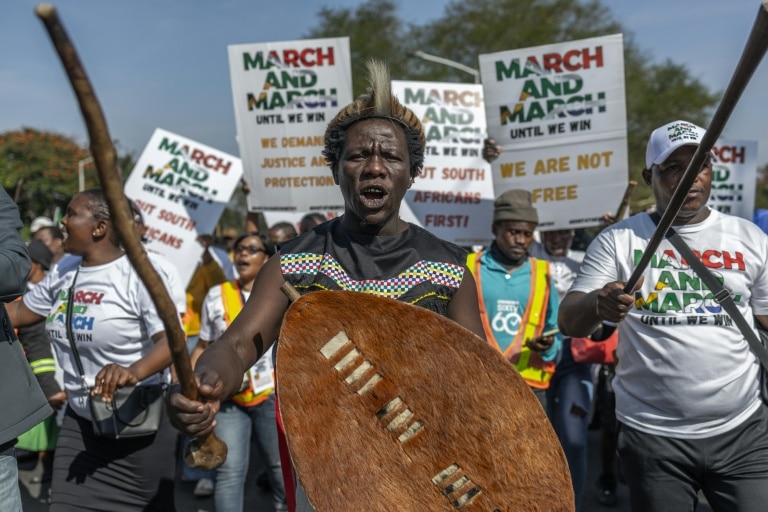
Against a backdrop of escalating anti-foreign-national violence and growing domestic political pressure, South African President Cyril Ramaphosa has issued a urgent call for coordinated collective action among African nations to manage cross-border migration, warning that the continent cannot tackle the unfolding crisis through isolated national efforts alone.
Ramaphosa delivered his appeal during an official session of the Pan-African Parliament, the legislative arm of the African Union, on Monday. His address comes after weeks of widespread xenophobic protests across South Africa, where fringe activist groups have scapegoated undocumented African migrants for the country’s persistent crime rates, high unemployment, and overstretched public infrastructure and services.
The current wave of unrest traces its origins to demonstrations that began in 2024, centered on disputes over undocumented migrants’ access to public healthcare. Tensions surged sharply this year when extremist xenophobic groups issued a deadline demanding all undocumented foreign nationals leave South Africa by June 30. To date, the violence has claimed at least four confirmed migrant lives, though several foreign governments have stated the actual death toll is significantly higher. According to an Agence France-Presse count compiled from data provided by repatriating governments, more than 160,000 foreign nationals have left South Africa over the past two months, marking one of the largest coordinated migrant exoduses the country has seen in recent history.
“Unmanaged cross-border movement poses a tangible risk to regional security and social cohesion, and no single country can confront this challenge on its own,” Ramaphosa told lawmakers. “As African states, we must first recognize and address the root conditions that force people to leave their home countries in search of safety and opportunity. These include ongoing conflict, political instability, failed governance systems, widespread poverty, and deep social division.”
Ramaphosa explicitly condemned the ongoing attacks, describing the violence as “sad and abhorrent.” “We in South Africa deeply regret and mourn every life lost to this hatred,” he said. “Our government has taken a firm, unwavering stand against xenophobia, Afrophobia, and hatred directed at people from other African nations.”
This latest outbreak of anti-migrant violence has drawn sharp condemnation from across the continent. Ghana, which has been one of the most vocal critics of the attacks, has pushed the African Union to convene a formal debate on the crisis. Two Ghanaian citizens have also submitted a petition to the International Criminal Court calling for a formal investigation into repeated xenophobic attacks in South Africa, a move that South African officials have dismissed as “opportunistic.”
As Africa’s most industrialized and wealthiest economy, South Africa has long been a magnet for economic migrants and asylum seekers from poorer and conflict-affected nations across the continent. But the country has grappled with recurring cycles of xenophobic violence for nearly 20 years. The deadliest outbreak on record occurred in 2008, when anti-immigrant riots left 62 people dead and displaced thousands more. Subsequent waves of violence followed in 2015 and 2016, and 2019 attacks left at least 12 people dead, most of whom were South African citizens caught up in the unrest.
What sets the 2024 crisis apart from previous outbreaks is the unprecedented coordinated response: for the first time, multiple African governments have organized simultaneous voluntary repatriation programs to move thousands of their citizens out of South Africa amid ongoing threats.