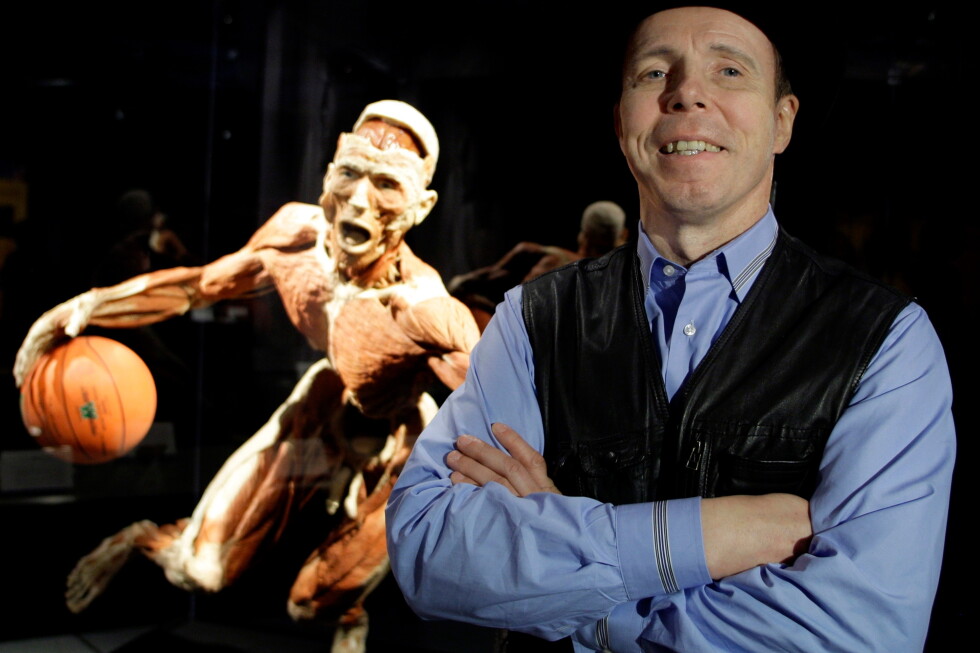
Legendary German anatomist Gunther von Hagens, the polarizing innovator whose traveling ‘Body Worlds’ exhibits of plastinated human bodies sparked global fascination, fierce ethical debate and shifted public understanding of human anatomy, has passed away at the age of 81. His family and the Institute for Plastination, the research organization he founded, confirmed that von Hagens died on Friday, with no additional details about his death provided in the official statement released Monday. The anatomist had publicly disclosed a Parkinson’s disease diagnosis in 2010, having lived with the condition for more than a decade.
At the core of von Hagens’ decades-long career was his revolutionary development of the plastination technique, a preservation method he began refining in the 1970s. The process replaces natural bodily fluids with curable liquid plastic that hardens over time, stopping tissue decomposition while preserving the full structure of organs and cells. This breakthrough allowed von Hagens to create lifelike, durable displays of human bodies that brought internal anatomy out of medical school laboratories and into public view.
The first ‘Body Worlds’ exhibition launched in Japan in 1995, marking the start of a global cultural phenomenon. Two years later, the show opened in von Hagens’ native Germany, overcoming fierce opposition from religious leaders who tried to block the exhibit on the grounds that it disrespected the human dignity of the deceased. Defending his work, von Hagens emphasized that his goal was not to shock, but to educate the public: by seeing real human anatomy up close, everyday people could better understand how their own bodies function. “I touch here a taboo, which is our body, and nothing is so near as our body is to us,” he once said of his work, arguing that his exhibits forced necessary conversations about long-held cultural taboos surrounding death and the human form.
All bodies displayed in ‘Body Worlds’ are donated by individuals who explicitly agreed to give their bodies for public education and plastination. Even so, von Hagens faced persistent criticism from religious leaders and medical ethicists who accused him of crossing into sensationalism. Controversial displays — including a plastinated corpse posed riding a horse, and a pregnant donor preserving her eight-month fetus — drew particular condemnation. When the exhibit opened in Berlin in 2001, the Reverend Ernst Pulsfort of Berlin’s Catholic Academy argued von Hagens “plays with the corpses like a child plays with dolls,” claiming the show catered only to public curiosity for shock rather than genuine education.
Von Hagens doubled down on his unapologetic approach in 2002, when he conducted Britain’s first public autopsy in 170 years during a ‘Body Worlds’ run in London. Wearing his signature black fedora, the anatomist performed the procedure before a sold-out crowd of hundreds, ignoring official government warnings that the act violated public health rules. He called the event a “huge success,” while the head of ethics for the British Medical Association, Dr. Michael Wilkes, condemned it as “degrading and disrespectful.”
After making its United States debut in Los Angeles in 2004, ‘Body Worlds’ went on to tour dozens of major cities across the country, drawing millions of visitors. In 2006, von Hagens opened the Plastinarium, his purpose-built facility for plastination work, in the eastern German town of Guben.
Born Gunther Liebchen on January 10, 1945, in what is now western Poland, von Hagens’ early life was shaped by Cold War division. He began medical school in Jena, East Germany, but grew disillusioned with the communist regime and attempted to escape to West Germany. The attempt failed, and he was imprisoned before West Germany purchased his release in 1970, a common practice for political detainees during that era. He resumed his medical studies at the University of Luebeck, and later joined the pathology and anatomy institute at Heidelberg University in the 1970s, where he began his pioneering work on preservation. He adopted the surname von Hagens from his first wife Cornelia, a former classmate, and went on to have three children with her. His second wife, Angelina Whalley, currently leads the Institute for Plastination in Heidelberg and curates the ‘Body Worlds’ exhibitions.
In accordance with his long-stated wishes, von Hagens’ own body will undergo plastination following his death, the Monday statement confirmed, adding that his family will honor and carry out this request.