Against a backdrop of crippling overcrowding, rampant violence, and some of the world’s highest rates of repeat offending, South Africa’s correctional system is testing an unconventional solution to rehabilitation: turning prison spaces into public art galleries that showcase work made by incarcerated people.
The initiative, launched by South Africa’s Department of Correctional Services in partnership with justice advocacy group Just Detention International-South Africa, has opened nine dedicated prison arts and crafts galleries across the country since 2023. The flagship site at Leeuwkop Correctional Facility, located in Johannesburg, currently features work from 34 participating inmates, opening a rare window into the personal stories, cultural roots, and transformative journeys of people living behind bars in a nation grappling with a persistent national crime crisis.
South Africa’s recidivism rates are among the highest on the planet, with estimates stretching as high as 95% depending on how repeat offending is measured. Correctional officials widely agree that high rates of reoffending are a primary driver of the severe overcrowding that plagues the country’s prison system. Overcrowding, compounded by systemic underfunding, administrative mismanagement, and widespread gang activity, has created a culture of endemic violence within South African correctional facilities.
It is against this urgent context that department officials developed the arts program, designed to address multiple systemic flaws at once: helping inmates process pre-incarceration trauma, build marketable creative skills, earn independent income, and lay the groundwork for stable, law-abiding lives after release.
“For them to also see that this can be a way of living, it helps because now they are able to manage their own finances, albeit at a small scale,” explained Makgothi Thobakgale, national commissioner of the Department of Correctional Services. “As they leave here to serve parole and finish their sentences, this is the most effective way of making it a point that they don’t do crime again.”
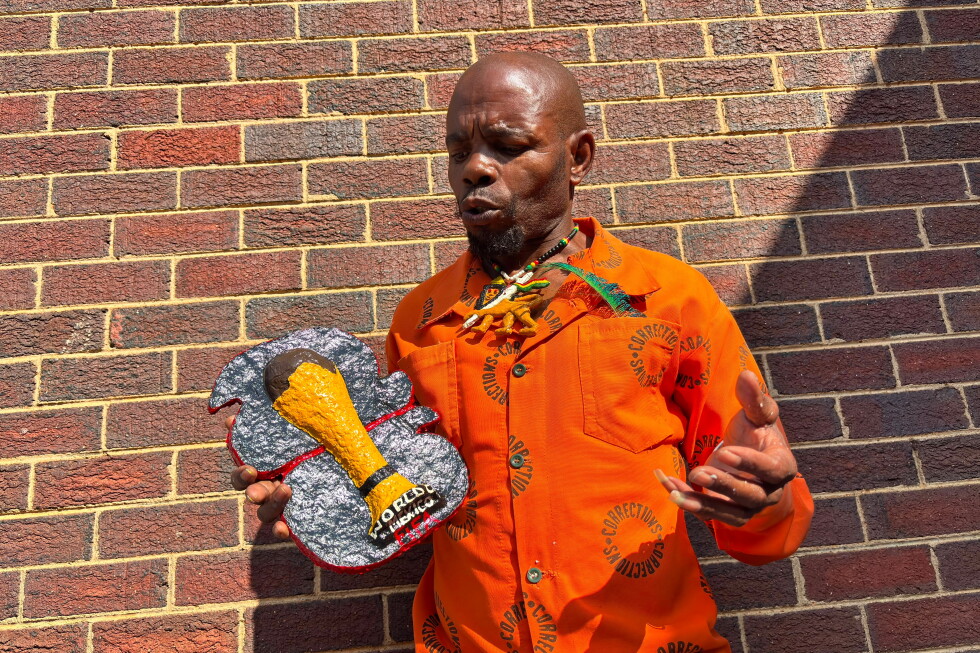
For 51-year-old Freddy Mongkoai, who is serving a 12-year murder sentence for his role in a vigilante justice killing, the program has already reshaped his daily experience of incarceration. He joined the art initiative last October and has since experimented with painting and papier-mâché sculpture, including a detailed replica of the FIFA World Cup trophy that demonstrates his growing technical skill.
“I get a peaceful and healed mindset when I do my art,” Mongkoai told the Associated Press. “It encourages me to be strong and present. I can focus, so it gives me peace of mind.”
One of Mongkoai’s most beloved pieces is a striking grayscale portrait of a woman balancing firewood on her head and a child on her back, a work inspired by childhood folklore he learned growing up in Limpopo province. “The elders would tell us that there is a woman carrying firewood on her head and a baby on her back, while being followed by a dog, on the moon,” he said. “That is my favorite because it reminds me of my childhood.”
The Leeuwkop exhibition reflects a wide range of themes and experience levels, from Mongkoai’s culturally rooted portraiture to a simple pencil drawing bearing the urgent message “STOP GBV” that spotlights South Africa’s ongoing crisis of gender-based violence. Themes of home, family, and personal memory appear repeatedly across the show, program organizers note.
Unlike formal clinical art therapy led by licensed practitioners, the initiative is framed as a voluntary, therapeutic creative outlet that prioritizes emotional processing over technical artistic skill. Unathi Mahlati, a senior program officer at Just Detention International-South Africa, which has partnered on the project since 2024, explained that the vast majority of incarcerated people in South Africa enter facilities with unprocessed trauma, and few services exist to help them work through those experiences.
“A lot of them have experienced a lot of trauma before coming into the facilities, but there’s not a lot of services for them to process and metabolize that trauma,” Mahlati said. “We emphasize that it’s not about skill. It’s a creative expression to process trauma. Correctional facilities have an environment that is very rigid and very dogmatic. So we give people a chance to just be.”
All art created through the program is available for purchase by the visiting public, with prices ranging from roughly 50 rand ($3) for small, simple pieces to more than 2,000 rand ($120) for large, complex works. Proceeds are split between restocking program art supplies and providing small stipends to participating artists — giving incarcerated people a rare opportunity to earn independent income beyond traditional prison work like farm labor and furniture manufacturing. Selected works are also displayed at major public events across South Africa, including the Comrades Marathon Expo and Makhanda’s National Arts Festival, giving artists access to much larger audiences.
For Mongkoai, the program has fostered a bold new vision for his life after release: he plans to open his own art gallery, turning the practice that healed him in prison into a lifelong career.