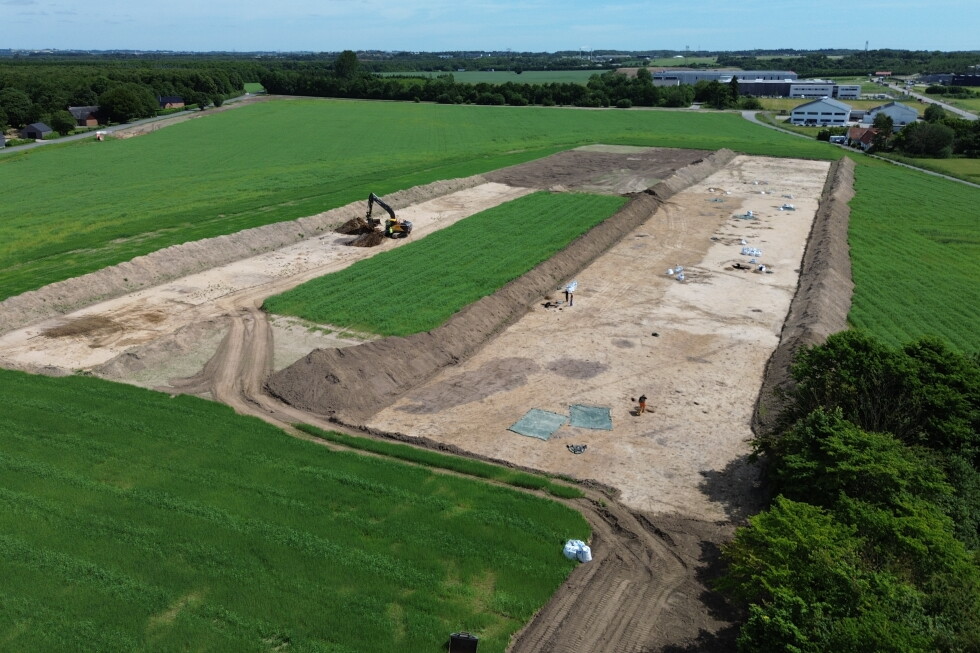
Archaeologists from Denmark’s Moesgaard Museum have uncovered an unprecedented large-scale Viking Age industrial site near the city of Aarhus, a discovery that upends long-held outdated stereotypes about Viking societal complexity. Dating back between 600 and 950 CE, spanning the late Iron Age and early Viking Age, the 100,000-square-meter settlement is located in Søften, just 10 kilometers north of Aarhus on the Jutland peninsula.
After a 10-month excavation led by senior archaeologist Liv Stidsing Reher-Langberg, the team confirmed the site’s clear specialization in large-scale textile manufacturing — a feature that sets it apart from all other known Viking-era settlements recorded to date. The dig uncovered over 30 semi-submerged pit houses, structures that served as both workshops and worker accommodations during the Viking period, alongside a dedicated zone for processing raw flax. Artifacts recovered from the site include spindle whorls, loom weights, silver trade coins, decorative glass beads, and domestic pottery, all of which confirm the site’s core function as a centralized production hub.
The layout of the settlement, which separates production areas from craft zones and includes a single distinct residential structure, indicates that the entire operation was overseen and controlled by a powerful authority figure who held centralized control over local resources and output. The discovery did not come as a complete surprise: amateur detectorists had been recovering silver coins from the area for 30 years, and a trial dig conducted 18 months prior, ahead of planned construction for a new highway and industrial park, confirmed the presence of significant ancient remains.
“When we opened the initial test trenches, we quickly realized the site extended far beyond our initial estimates, with pit houses and production features stretching across the entire area,” Reher-Langberg explained of the moment the team grasped the scale of their find.
Moesgaard Museum historian Kasper Andersen noted that the Søften site fills a critical gap in research into the economic, political and social structures of early Viking-era Jutland. At the time, Aarhus — then called Aros — was already a major hub for royal power and international trade, and just four kilometers from Søften, archaeologists uncovered a noble Viking settlement in Lisbjerg just last year. Andersen argues that outlying specialized production sites like Søften supplied goods that fed into Aros’ extensive international trade networks, connecting rural Danish production to markets across Europe and beyond.
“A settlement of this scale and specialization cannot be explained by local demand alone,” Andersen emphasized. “It has to be understood as a node in a much larger, interconnected international commercial network.”
The find directly challenges the pervasive outdated stereotype of Vikings as unorganized, barbaric raiders with no complex social or economic structure. “To create a centralized production site like Søften, you need a highly organized society with structured production lines and established trade outlets for output,” Andersen said. “These textiles were made for a market far larger than the immediate local area.”
Reher-Langberg plans to conduct further analysis, including carbon dating and pollen testing, to answer remaining open questions, such as what specific types of textiles were manufactured at the site and how long the hub operated continuously.