Against all odds, a small-budget Chinese animated feature widely panned for its unrefined, rough visuals has exploded into an unexpected cultural phenomenon in China, drawing massive cinema crowds who turn out specifically to experience its one-of-a-kind, “so bad it’s good” charm. Titled *Niu Lai*, which translates to *Here Comes the Cow*, the independent production got off to a muted start when it launched in theaters on August 5, pulling in just around 7,000 yuan (equivalent to roughly $1,000) in its opening week. But according to data from Chinese ticketing platform Maoyan, the film has since seen an extraordinary surge in ticket sales, pushing its total domestic box office to 33.06 million yuan ($4.92 million) to date.
What makes the project even more remarkable is its origins: local Chinese media reports confirm the entire film was created entirely by a mother-and-son team, who worked frame-by-frame over the course of five years to bring the story of a young calf named Niu Lai to life. The pair even composed original musical scores for the film’s closing credits, pouring years of personal effort into a project built entirely outside of China’s big-budget mainstream animation industry.
Caelan Moriarty, a 25-year-old American musician based in China, shared his thoughts on the viral hit with Agence France-Presse, summing up the widespread public sentiment perfectly: the film is “so bad that it’s so good”. Moriarty explained that while the film’s technical flaws are obvious, the genuine heart the creators poured into the project makes it impossible to dismiss. He noted that modern artificial intelligence could generate a full-length animated feature in a fraction of the time the team spent, but that refusal to cut corners with AI and the commitment to handcrafted, slow work is what makes the project stand out. “It’s not perfect. But because it’s not perfect, it’s good, it shows how human it is… and I think that’s why this is trending,” Moriarty told AFP.
Centered on the relationship between the young calf Niu Lai and his mother, the film draws criticism and attention alike for its stiff 3D character models, clunky awkward dialogue, and overall unpolished visual style. But rather than turning audiences away, these imperfections quickly became a viral talking point on Chinese social media, with legions of new fans embracing the film’s rough edges as a core part of its unique appeal. Stella Xing, a Beijing university student who bought a ticket after seeing *Niu Lai* memes circulating online, told AFP that the film’s awkwardness is exactly what makes it entertaining. “Even though it’s pretty rough around the edges, there are so many funny details — like the way (Niu Lai) walks, for instance,” she said. “It’s hilarious and really makes people want to come see it.”
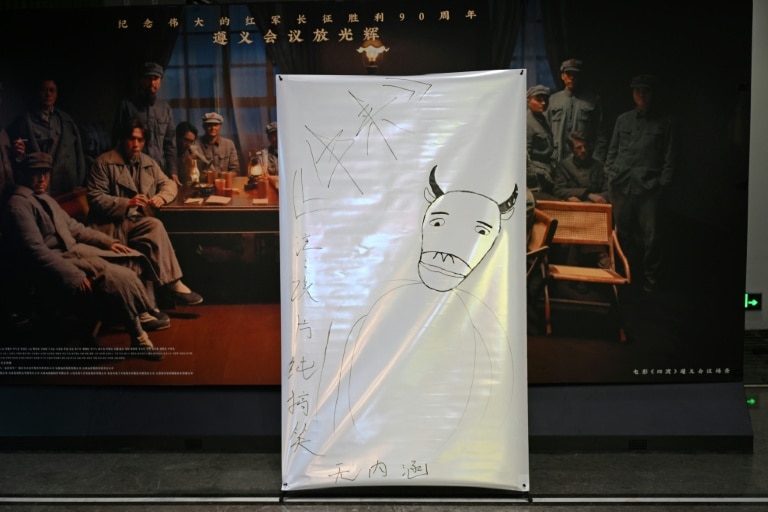
The contrast between *Here Comes the Cow* and big-studio productions is impossible to miss at Beijing cinemas: hand-drawn promotional banners featuring the yellow, human-like cow protagonist with exaggerated eyebrows stand directly beside the sleek, glossy marketing materials for major blockbusters such as Christopher Nolan’s latest release *The Odyssey*. Notably, the independent film received almost no traditional marketing or promotional support before its release, with its entire viral growth driven entirely by organic social media conversation.
As *Niu Lai* took over Chinese social media and climbed the box office charts, online vendors on major Chinese e-commerce platforms such as Taobao quickly moved to cash in on the trend, rushing out a wide range of unofficial merchandise featuring the iconic yellow calf, from graphic T-shirts and resin figurines all the way to casual apparel. One online seller told AFP he jumped into the market just days after the film went viral, adding *Niu Lai* keychains to his shop’s inventory to meet unexpected consumer demand.
Pan Wang, an associate professor of media studies at the University of New South Wales in Australia, explained that the film’s unexpected success comes from its radical departure from the polished, big-budget content that dominates mainstream cinema today. “It is a bit like eating refined grains every day and then suddenly having some coarse grains for a change — the contrast itself feels refreshing,” Wang said. “Its roughness, absurdity and imperfection become part of its appeal.”
The breakout success of *Here Comes the Cow* also comes at a time when animated content is booming in China, the world’s second-largest film market. Just months ago, the big-budget polished Chinese animated blockbuster *Ne Zha 2* overtook Disney’s 2024 hit *Inside Out 2* to claim the title of the highest-grossing animated film of all time at the Chinese box office, proving the massive audience appetite for animated content of all stripes.