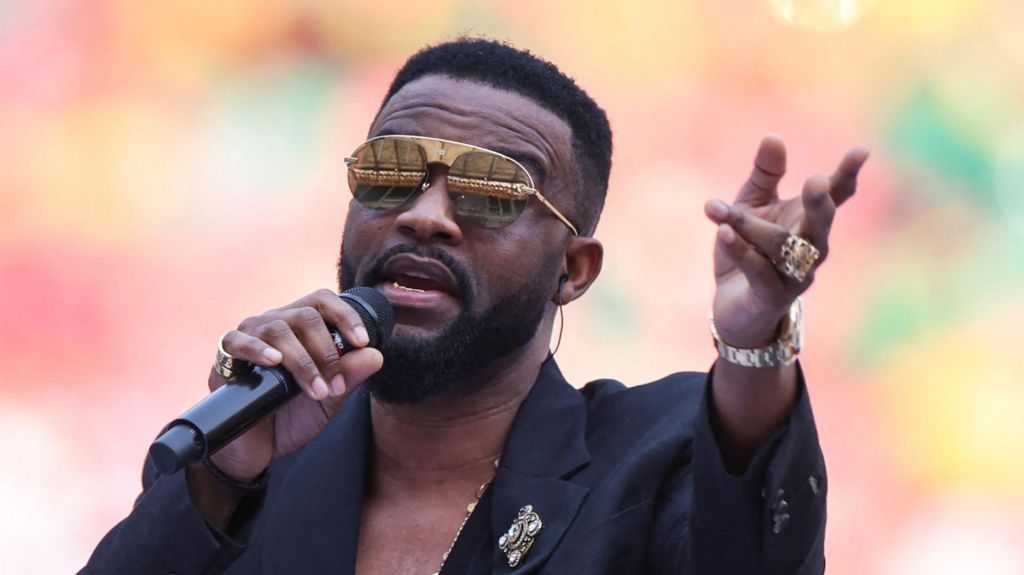
One of the most influential and successful African musical talents of his generation is celebrating one of the highest honors of his home country this week, after being formally inducted as a Knight of the Democratic Republic of Congo’s revered National Order of the Leopard. For 48-year-old Fally Ipupa, whose decades-long career has taken him from local collaborator to global icon with millions of loyal fans across every continent, the recognition carries far more meaning than a personal accolade.
Ipupa’s journey to international stardom began 30 years ago, when he launched his professional career performing alongside fellow Congolese music legend Koffi Olomidé. Over the course of his career, he has built an extensive and versatile discography: he contributed to chart-topping group tracks as a member of collectives Talent Latent and Quartier Latin International, before going on to release eight full-length solo albums that have cemented his status as a cross-regional hitmaker.
The knighthood, bestowed Tuesday, marks the highest honor Ipupa has received to date. The National Order of the Leopard is one of the DRC’s most prestigious state awards, granted exclusively by the country’s sitting president to public figures who have earned extraordinary distinction for their contributions to the nation. While the induction did not include a televised public ceremony, a government spokesperson confirmed Ipupa’s new title on state television the following day, praising the artist as a “worthy son of the nation.”
In her remarks, the spokesperson highlighted that Ipupa’s one-of-a-kind artistic style and creative vision have played a critical role in elevating Congolese rumba on the global stage and spreading Congolese culture to international audiences. He follows in the footsteps of the late iconic Congolese musician Papa Wemba, who also received the same knighthood honor.
Reacting to the news on social media, Ipupa shared his sense of “immense pride and deep emotion” with fans, emphasizing that his success has never been a solo achievement. “This path has never been mine alone. It belongs to an entire people,” he wrote, extending a message of encouragement to young Congolese creatives: “Your starting point does not define your destiny. Work, believe, persevere. The world is ready to hear your voice.”
The latest award caps off a landmark year for Ipupa’s global career, which has already seen a string of historic firsts. His most recent studio album, *XX*, made him the first African artist ever to debut directly at the top of the French official album charts. Just last month, he also made history as the first Francophone African artist to sell out two consecutive back-to-back shows at Paris’s 80,000-capacity Stade de France. Later this year, he is scheduled to perform one of the largest shows of his career in the United Kingdom at London’s iconic O2 Arena.
Ipupa’s grueling promotional schedule across Europe and the United States has come at a small cost, however: he recently told French outlet *Le Monde* that he lost his voice from repeated performances on television and radio programs, and his doctor ordered a full week of complete vocal rest to recover.
Beyond his string of professional highs, Ipupa’s career has also included moments of profound loss and public controversy. Four years ago, a fatal crowd crush at a sold-out Ipupa concert in Kinshasa, the DRC’s capital, left 11 people dead. The tragedy was linked to the venue being oversold by more than a third of its maximum capacity.
The artist has also faced criticism over the local Congolese music industry practice known as libanga, where musicians accept payment to shout out or praise politicians, corporations, and influential figures in their tracks. Ipupa has previously acknowledged the practice openly, telling Kenya’s Trace FM that he can earn roughly €10,000 per paid mention in a song. For years, Congolese diaspora fans angered by what they saw as overly close ties between Ipupa and the DRC’s widely criticized government organized boycotts that blocked his concerts abroad.
Beyond the controversy, Ipupa has also carved out a profile as a philanthropist and served as a UNICEF goodwill ambassador, and he has long maintained that his core mission as an artist is to unite rather than divide audiences. Accepting the knighthood, he reiterated that the award extends far beyond him as an individual: “This distinction is more than personal. Above all, it celebrates Congolese music, our culture, our identity, this force that unites us and elevates us beyond borders.”