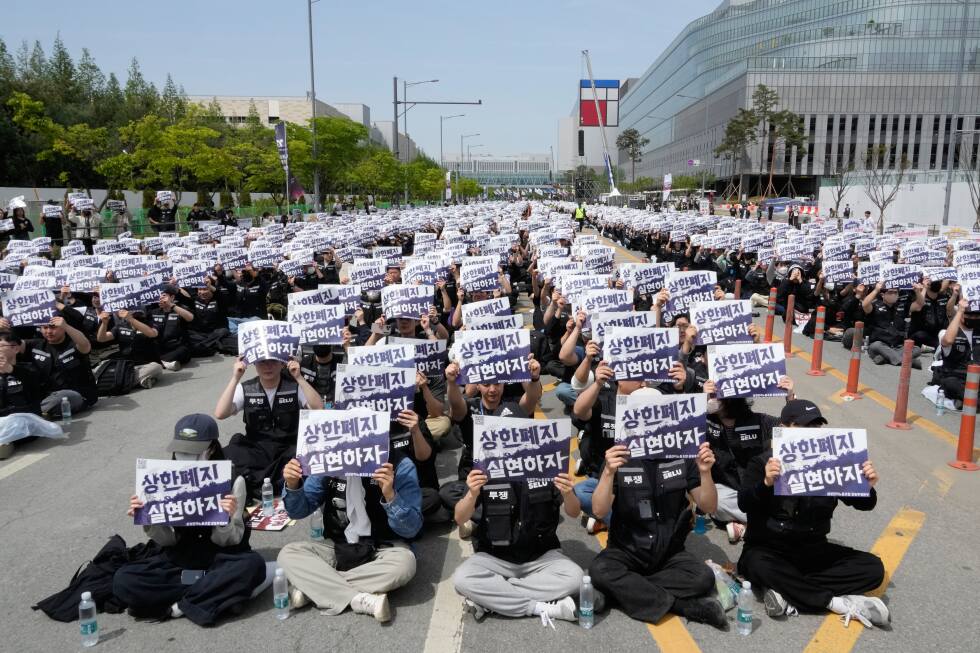
A high-stakes wage dispute at South Korea’s tech and manufacturing powerhouse Samsung Electronics has reached a breaking point, after last-ditch negotiations between company management and the worker’s union collapsed Wednesday, clearing the way for the first large-scale strike at the firm in decades that risks upending global semiconductor supply chains and rocking South Korea’s export-led economy.
The dispute comes at a moment of historic profitability for Samsung, which has ridden the global AI boom to staggering gains. The company’s 74,000-member union argues that frontline and manufacturing workers have not seen their compensation keep pace with the record-breaking profits the firm has posted amid skyrocketing demand for AI-grade memory chips. Samsung and cross-town rival SK Hynix collectively control roughly two-thirds of the global memory chip market, making any production disruption at the firm a major concern for tech manufacturers and supply chain managers worldwide.
Shortly after the final round of mediated talks ended without a breakthrough Wednesday, union leader Choi Seung-ho announced that unionized workers would launch an 18-day work stoppage starting Thursday. Both sides have traded blame for the collapsed negotiations: Choi said management rejected a compromise proposal brokered by South Korean government negotiators, declining to share specific details of the framework publicly. For its part, company management has pushed back against the union’s demands, arguing that the calls for sweeping changes to bonus structures are unreasonable, particularly for underperforming or loss-making business units outside Samsung’s core chip division.
The union’s core demands center on a restructuring of performance compensation: leaders are pushing for Samsung to commit to allocating 15% of annual operating profit to employee bonuses, while eliminating the current bonus cap that limits incentive pay to 50% of a worker’s annual base salary. Management has pushed back on these demands, noting that the semiconductor industry is notoriously cyclical, with periods of massive boom often followed by steep downturns that require the company to retain capital to weather market contractions.
South Korean government officials have already taken unprecedented steps to avert a widespread work stoppage that would cripple the national economy. Prime Minister Kim Min-seok, the country’s second-highest ranking official, warned in a recent televised address that a prolonged strike could disrupt Samsung’s precision semiconductor manufacturing processes, leading to as much as 100 trillion won ($66 billion) in total economic damage to South Korea’s trade-reliant economy. Officials have also threatened to invoke rarely used emergency mediation powers to force a binding resolution to the dispute if no voluntary deal is reached.
Last week, the Suwon District Court partially granted an injunction requested by Samsung, ruling that the union must maintain minimum staffing levels at critical manufacturing facilities to prevent damage to sensitive production equipment and in-progress materials, and to ensure ongoing safe operations. The court also barred union members from occupying key production sites and corporate offices during the strike.
Samsung reported last month that its operating profit for the first quarter of 2024 jumped eightfold year-over-year to a historic high of 57.2 trillion won ($38 billion), driven almost entirely by surging demand for advanced memory chips for AI data centers and new consumer electronics devices. While both sides have said they remain open to continuing negotiations to reach a last-minute settlement, it remains unclear when the two parties will return to the bargaining table to resume talks.