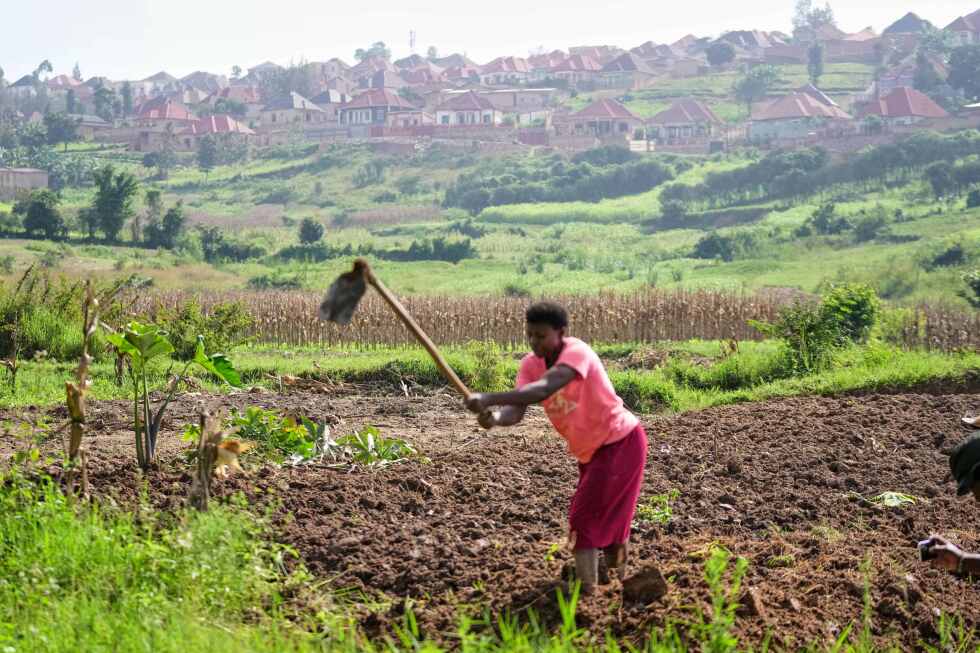
On a crisp chilly morning in Kigali, the hum of bulldozers and rhythmic clatter of construction work drown out the soft thud of farmers’ hoes against the soil. For Rwanda, a nation that holds the title of Africa’s most densely populated country, this sensory clash represents a growing crisis: how to balance booming urban expansion with the critical need to safeguard shrinking agricultural land and shore up long-term food security.
For 84-year-old Mukarusini Purisikira, the crisis is deeply personal. A lifelong farmer who fled to neighboring Congo to escape the 1994 Rwandan genocide, she returned home to find her family’s sprawling hillside farm seized for residential and commercial development. Today, she cultivates maize and sweet potatoes on a plot barely larger than a small cottage, a patch that barely produces enough to put food on her table. Standing near her crops, she glances nervously at construction idling on a nearby ridge: “It is all I have,” she says.
Now, Purisikira and other small-scale Rwandan farmers have a new layer of protection. Starting in September 2024, the Rwandan government launched an ambitious initiative to map all officially designated agricultural land across the country, leveraging satellite imagery to track unauthorized development that encroaches on protected farm and forest land. With Rwanda’s national population projected to hit 22 million within the next two years, and global fertilizer prices spiking sharply following the outbreak of the Iran war that has disrupted global supply chains, food security has become a top policy priority for the government.
In Kigali, the nation’s capital, city planners have already locked in 22% of the total land area specifically for agricultural use under the city’s updated master development plan. To enforce the new protections, authorities have imposed strict penalties for unauthorized encroachment: fines of up to $3,000 and prison sentences of as long as six months for violators. Multiple unapproved construction projects have already been demolished to enforce the rules, though stakeholders connected to the buildings declined to speak publicly over fears of government retaliation. Moving forward, the government plans to add drone surveillance to its monitoring toolkit, enabling real-time tracking of unauthorized land use across the country.
City officials acknowledge that unmet housing demand creates strong economic pressure to approve new construction projects, but they argue that prioritizing agriculture will deliver greater long-term value. “Farming will be even more productive” than unplanned urban expansion, city data projections show, especially as domestic food demand continues to climb alongside population growth. City leaders argue that with targeted innovation, productive farming can thrive on smaller, more efficiently managed plots of land.
Emma-Claudine Ntirenganya, a spokeswoman for the Kigali mayor’s office, explained that the pressure on farmland extends far beyond the capital. While most of Kigali’s current food supply is sourced from other districts across Rwanda, those rural agricultural areas are also losing land to development at a rapid pace. Over the past year, the national government has printed and publicly distributed detailed maps across all Rwandan districts, clearly marking land zoned for agriculture and land open for construction, to bring transparency to land use rules.
Ntirenganya says the initiative is rooted in a new vision of “urban agriculture” that redefines how Rwandans think about farming within city limits. “We will be able to show Kigalians that they can also do agriculture and be productive,” she explained. To model this approach, the city administration is already building a demonstration greenhouse on the roof of its headquarters, and now requires all developers applying for new building permits to integrate green spaces and community gardens into their project designs.
Beyond protecting existing open land, Kigali has become a testing ground for innovative, space-efficient urban farming techniques. Vertical farms, which grow leafy greens, strawberries and other produce in stackable modular plastic containers, have gained traction among local entrepreneurs. Christian Irakoze is the co-founder of Eza Neza, which translates to “grow well,” a local startup that installs small-scale vertical farms across Kigali. During a visit by the Associated Press, reporters saw one vertical farm growing 600 plants in vertical rows stretched along just 50 meters of perimeter wall, proving the model can produce significant amounts of food in minimal space.
Irakoze describes his work as a fundamental shift from traditional large-scale rural farming to a flexible, accessible system that fits urban contexts. “It is a different way of thinking about farming, from traditional large-scale upcountry farming to something smaller, modular, and that anyone can really do,” he said. To reduce reliance on volatile imported agricultural inputs, Irakoze’s company uses locally sourced manure and volcanic sediment in place of commercial potting soil, adapting farming practices to buffer against global market shocks. “We really have to find ways to find our own solutions, whether through inputs like fertilizers or seeds. Some of these global events are always a reminder that we should definitely have some alternatives,” he added.
A group of young Rwandan agronomists are also working to spread adoption of hydroponics, a soil-free farming technique that uses nutrient-infused water to grow crops, maximizing output per square meter of land. “The population is increasing, yet our land is not increasing. We make sure that we find solutions that can help farmers to overcome that, and then they produce more,” explained Richard Bucyana, one of the agronomists leading the training program. Bucyana echoed Irakoze’s view that local, homegrown solutions like those being rolled out in Rwanda help insulate the country from global supply chain disruptions, and called on other African governments to prioritize agricultural self-sufficiency. “African governments should start thinking how they can be self-sustainable,” he said.