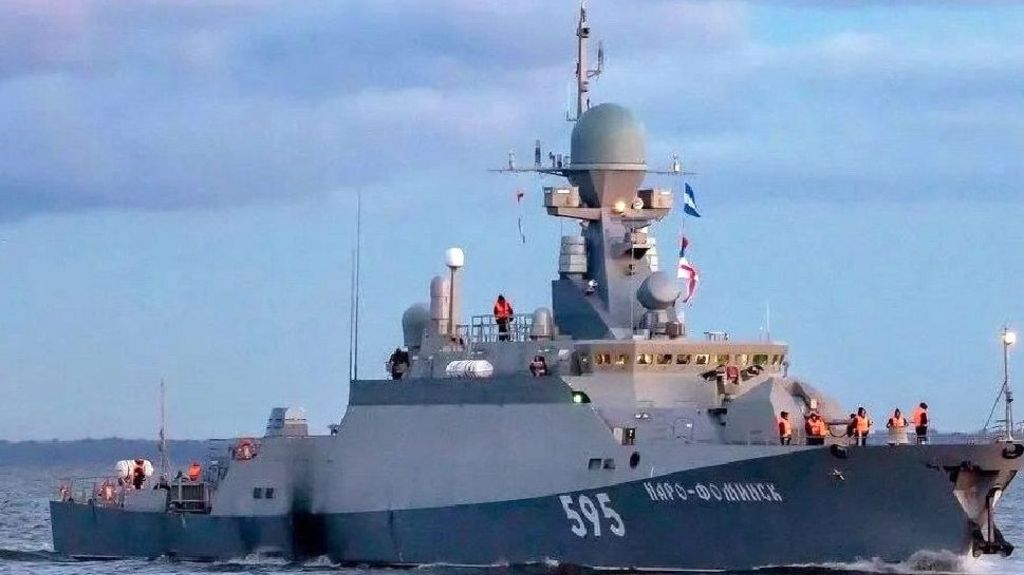
A landmark military incident unfolded in the Gulf of Finland on Wednesday, as Finnish authorities confirmed a Russian naval vessel came under direct attack, marking the first recorded instance of Ukrainian drones striking a Russian warship in a Baltic Sea stretch open to routine civilian maritime traffic. The targeted vessel, identified by Ukraine’s Security Service (SBU) as the Buyan-M class small corvette *Naro-Fominsk* – a craft equipped with Kalibr and Oniks cruise missiles – is believed to have sustained damage before setting course back to its home port in St. Petersburg following the strike.
The corvette assault formed part of a wider coordinated drone operation launched by the SBU against Russia’s strategically critical Ust-Luga oil export depot on the Baltic coast. Multiple unconfirmed reports have also surfaced alleging that several Russian combat helicopters were destroyed in the same wave of strikes, which spanned roughly from midnight to 06:00 local time on Wednesday. The attack wave also ignited fires at multiple storage tanks at the Ust-Luga terminal, with flames visible across the international border in Estonia, according to local officials.
Estonia’s Defence Minister Martin Herem, whose nation shares a border with the Gulf of Finland, confirmed to public broadcaster ERR that the *Naro-Fominsk* was struck at approximately 05:30 local time (03:30 GMT), with witnesses reporting thick smoke billowing from the warship immediately after the impact. Herem declined to specify the exact mechanism of the strike, and full details on the extent of damage to the corvette, as well as potential crew casualties, remain undisclosed: the Russian military rarely releases transparent updates on losses sustained in its ongoing full-scale invasion of Ukraine.
While Baltic Sea naval confrontations have been virtually non-existent since the 2022 launch of Russia’s full-scale incursion, the new strike breaks a long period of relative inactivity for Russia’s Baltic Fleet. Military analyst Emil Kastehelmi, co-founder of maritime monitoring group Black Bird, noted that until this week, the Russian Baltic Fleet had operated largely unimpeded, creating a window of operational opportunity that Ukrainian forces seized. Kastehelmi emphasized that despite the unprecedented nature of the attack, he does not classify the incident as a major military escalation, drawing a contrast with the regular reciprocal targeting of naval assets that has become routine in the Black Sea over the past two years of conflict.
Finnish officials, who are among Kyiv’s closest European allies, have framed the incident as a direct consequence of Russia’s unprovoked full-scale war against Ukraine. Helsinki’s Foreign Minister Elina Valtonen stressed publicly that the overall security situation in the Baltic Sea remains stable, and that no imminent threat to commercial maritime traffic has emerged. Finnish defence authorities have privately communicated to Kyiv that the narrow Gulf of Finland is a densely trafficked waterway hosting thousands of civilian oil tankers and commercial vessels, in addition to critical undersea data cables that underpin regional digital infrastructure.
Estonian officials also confirmed that during the six-hour drone operation, one Ukrainian drone briefly strayed into Estonian airspace after transiting from Latvian territory before reorienting back toward Russian airspace. Though NATO aircraft deployed across the Baltic states were on active patrol during the strike window, Herem noted that commanders judged it unsafe to attempt to intercept and destroy the errant drone. Ukraine’s Foreign Ministry spokesman Heorhiy Tykhyy later pushed back against Russian allegations that Kyiv had deliberately used Baltic state airspace to launch its assaults, dismissing Moscow’s claims as entirely baseless, while acknowledging that unintended border incursions can occur when Russian electronic warfare systems redirect drones off their intended flight paths.