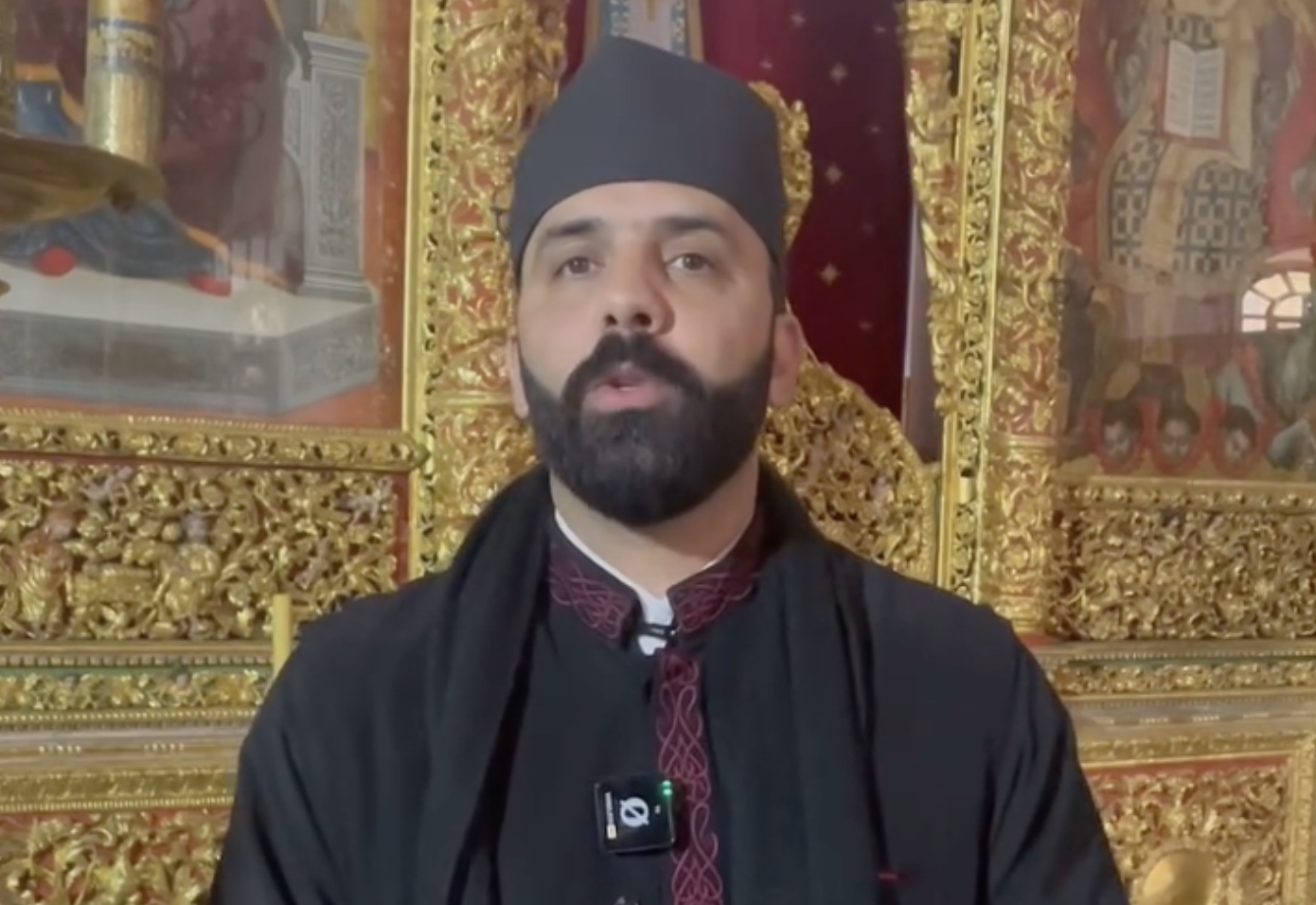
Two high-profile Palestinian Christian clergy figures from the occupied West Bank have been barred from entering the United States after their U.S. visa applications were rejected, disrupting planned speaking engagements aimed at educating American faith communities and policymakers about ongoing human rights abuses against Palestinian civilians. Father Issa Thaljieh, the parish priest at Bethlehem’s historic Church of the Nativity, was set to join a multi-faith gathering of Catholic, Orthodox, and Protestant leaders outside the U.S. Capitol next Monday to testify about the rising tide of violent Israeli settler attacks on rural Palestinian communities. Organized in part by the advocacy group Orthodox Christians for Palestine (OCP), the Washington D.C. event was designed to push U.S. congressional lawmakers to hold both extremist settler groups and the Israeli military accountable for documented abuses, while imposing new restrictions on U.S. military aid transfers to Israel. Organizers note that momentum for congressional oversight is already building: back in September, 46 Democratic senators and Republican Senator Rand Paul co-sponsored a measure introduced by Senator Chris Van Hollen that demanded the U.S. State Department publish a formal report cataloging Israeli human rights violations in the West Bank, including the killings of nine U.S. citizens in the territory since 2022. The event is scheduled just two weeks after Democratic candidates secured a landslide victory in the U.S. midterm elections, winning full control of both chambers of Congress and a majority of state legislative seats across the country, on a campaign platform that included pledges to condition U.S. military aid to Israel and reject campaign donations from the powerful pro-Israel lobbying group AIPAC. With Father Issa Thaljieh unable to travel to the U.S., his sister Honey Thaljieh will deliver his planned address on his behalf. “My brother could not enter America to tell you what is happening in Bethlehem. But you cannot deny a visa to a truth. You cannot silence a people by keeping one priest outside the room,” Honey Thaljieh stated in a public press release. “I will stand in Washington, DC, not only as his sister, but as a daughter of Bethlehem, carrying the voices of families determined to remain on the land where their roots run deeper than walls, checkpoints, and politics. We are not asking for pity. We are asking for justice, dignity, and the right to stay in our homes.” The Capitol-adjacent gathering will also feature appearances by other prominent Palestinian Christian voices, including Reverend Mitri Raheb, the founder of Dar al-Kalima University and a leading Palestinian Lutheran pastor, and Mother Agapia, a Greek Orthodox nun whose 2024 appearance on Tucker Carlson’s podcast marked a major turning point in how conservative American audiences engage with the realities of life for Palestinian Christians. A centerpiece of the event will be a public reading of the names inscribed on the Gaza Children’s Shroud, a 120-yard long textile that bears the handwritten names of more than 20,000 children killed during Israel’s ongoing military assault on the Gaza Strip, which has left a total death toll of over 74,500 people. The shroud will be displayed at multiple venues across the greater Washington D.C. region, including at the Islamic Center of Maryland on November 15, where congregants will hold Janazat-ul-Ghaib, the collective Islamic funeral prayer for those who have died and cannot be mourned in person, to honor the more than 22,000 children killed in Gaza during the campaign that the United Nations and leading Holocaust scholars have formally classified as a genocide. A second leading Palestinian Christian leader, Reverend Munther Isaac of Bethlehem’s Christmas Lutheran Church, was also denied a U.S. visa in recent weeks, preventing him from attending the Church at the Crossroads evangelical convention held in Atlanta, Georgia last week. The U.S. State Department is not required to publicly disclose reasoning for visa denials, and typically does not share details of such decisions, though public records show Isaac has visited the U.S. multiple times in the past, including a trip in September 2025, roughly eight months after the start of the Trump administration’s first term. Hosted by the Bethlehem Institute for Peace and Justice (BIPJ), a Palestinian Christian ministry affiliated with the Arab world’s leading evangelical seminary Bethlehem Bible College, the Church at the Crossroads conference was designed to invite American evangelical communities to engage directly with Palestinian Christian perspectives, and to confront how dominant strains of pro-Israel evangelical theology directly contribute to harm against Palestinian civilians on the ground. More than 500 attendees joined this year’s event, matching turnout for its successful inaugural iteration held in 2024. During his address to the Atlanta gathering, Isaac criticized the ideological framework of Christian Zionism, which frames modern Israeli state policy as the fulfillment of biblical prophecy. “The way of empire claims that God is on our side, as if [they] alone have exclusive access and rights to God,” Isaac told the crowd. “Do you know what the biggest problem with Christian Zionism is? You cannot find Jesus in it.” Current U.S. Ambassador to Israel under the Trump administration, Mike Huckabee, is an outspoken proponent of Christian Zionism, and many of the ideological backers of the influential conservative Heritage Foundation also identify with the movement. The Heritage Foundation’s widely circulated Project 2025 and Project Esther policy playbooks explicitly outline plans to crack down on public criticism of Israel as part of the administration’s domestic and foreign policy agenda. Despite this institutional alignment, shifting public sentiment among U.S. voters is creating new space for Palestinian advocacy, especially among younger American evangelicals. “Mirroring the discontent demonstrated in the midterm elections, many American evangelicals are no longer satisfied with the answers provided by faith leaders whose stances only take into account a prevailing one-sided narrative,” the BIPJ press release noted. “Instead, many are asking fraught questions about Israel, Palestine, and their relationship to these places as Christians, and shifting sentiment among younger believers continues to reshape the conversation.”