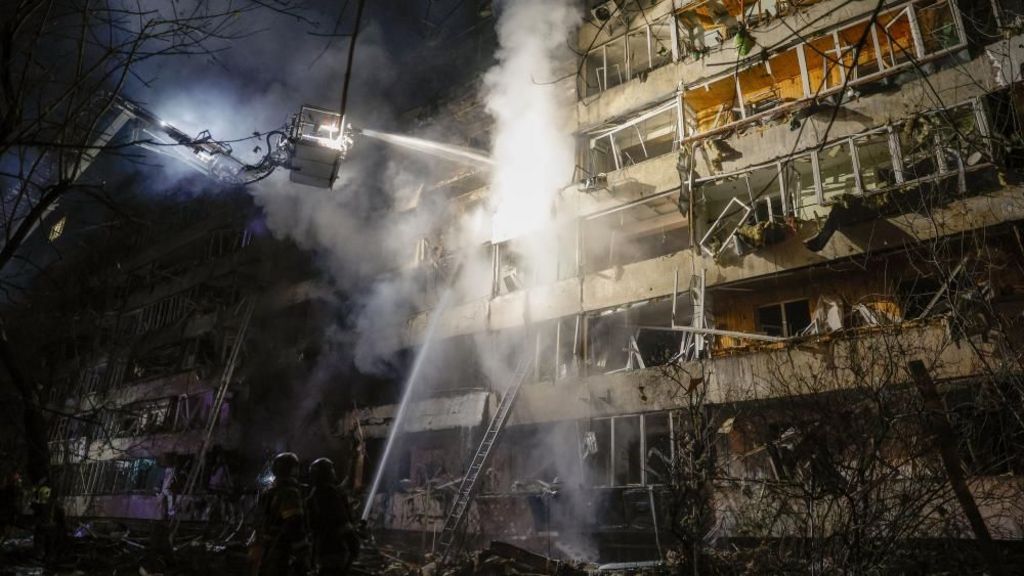
A wave of deadly overnight missile and drone attacks launched by Russia has left at least 600,000 Ukrainian citizens without access to electricity, Ukrainian President Volodymyr Zelensky has confirmed, directly contradicting a recent public claim by former U.S. President Donald Trump that a mutually agreed “energy ceasefire” had taken effect between the two warring nations.
Zelensky noted that critical energy infrastructure sites were damaged in the strikes, which hit Kyiv, the surrounding Kyiv region, and Kharkiv, Ukraine’s second-largest city located in the country’s northeast. In the capital city alone, Ukraine’s State Emergency Service (DSNS) confirmed that at least three civilians lost their lives and another 21 people sustained injuries in the assault on a residential building.
Russia’s defense ministry defended the operation, framing the massive overnight barrage as a targeted strike against communications and energy facilities that Ukraine’s military relies on to sustain its combat operations. The ministry also released its own battlefield update, claiming that Russian air defenses shot down 902 Ukrainian drones overnight across multiple Russian regions, including Moscow and the Crimean Peninsula – the southern Ukrainian territory that Russia illegally annexed in 2014, a move not recognized by most of the international community.
Ukraine’s air force offered a contrasting account of the overnight air assault, stating that Russia launched a total of 39 ballistic and cruise missiles alongside 128 attack drones. Of those incoming weapons, Ukrainian air defense crews successfully intercepted four missiles and 115 drones, according to the service.
The fresh strikes come just one day after Trump took to social media to announce that what he called an “energy ceasefire” had gone into effect immediately between Russia and Ukraine, claiming both sides had agreed to the deal. Since Trump’s announcement, Zelensky has repeatedly stated that Ukraine is willing to halt its strikes on Russian energy infrastructure including oil refineries, as long as Moscow agrees to reciprocate the ceasefire.
However, Russian Foreign Minister Sergey Lavrov has already rejected any such arrangement, arguing that Ukraine does not deserve the respite a ceasefire would provide. Lavrov claimed that under any temporary truce, European nations would rush to supply Ukraine with large volumes of new weapons to resume hostilities once the ceasefire expires.
The current escalation comes nearly three years after Russian President Vladimir Putin launched a full-scale invasion of Ukraine in 2022. As of today, Moscow retains control of roughly 20 percent of Ukraine’s internationally recognized territory, with fighting continuing across large swathes of eastern and southern Ukraine.