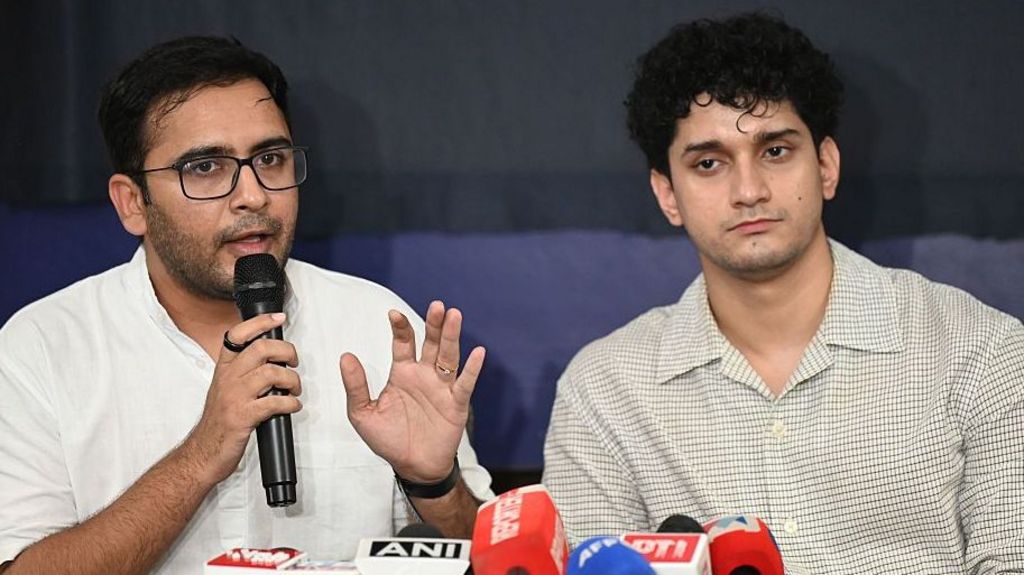
A fresh escalation of tensions over electoral reform protests in India’s capital has landed two senior leaders of the GenZ-driven Cockroach Janta Party (CJP) in five days of judicial custody, amplifying a growing clash between dissenting activists and the ruling government over democratic expression.
Saurav Das and Ashutosh Ranka were first detained early Tuesday at Jantar Mantar, the iconic central Delhi protest space that police had just weeks earlier stripped of its status as an authorized demonstration venue. The pair appeared before a Special Executive Magistrate Court on Wednesday, where judicial officials ordered their five-day remand. A third CJP activist, Ajinkya Shinde, who was also detained alongside the two leaders, was granted release on a personal bond. All three face multiple charges including trespassing, violating prohibitory public order laws, breaching existing peace bonds, and obstructing on-duty public officials — allegations all three have formally denied, and their legal team has pushed back against claims of inciting mass gathering.
The arrests mark the second round of detention for CJP leadership in less than a week. Over the weekend preceding this incident, Delhi police took Das, Ranka, Shinde, and CJP founder Abhijeet Dipke into preventive custody ahead of a planned protest at Jantar Mantar, before a magistrate ordered their release. In the aftermath of that weekend demonstration, police officially removed Jantar Mantar from its roster of approved protest sites, reallocating demonstration access to three alternate, less centrally located venues: Ramlila Maidan, Burari Ground, and CBD Ground. The CJP has decried this decision as a deliberate attempt to muzzle dissent, arguing that the new, out-of-the-way sites make it far harder for protesters to draw public and media attention to their demands.
Undeterred by the new restrictions, CJP activists returned to Jantar Mantar on Tuesday. Footage shared publicly by CJP leaders on social media shows Das and Ranka scaling locked gates and police barricades to enter the site, carrying Indian national flags and chanting demands for electoral reform. In a post on X following the demonstration, Dipke wrote, “You cannot denotify the resistance.”
Ratna Singh, head of the CJP’s legal team, has raised additional procedural concerns over the detentions. She alleged that Das and Ranka were denied access to legal counsel for multiple hours after their arrest, before being transported to Parliament Street Police Station in a private vehicle around 3 a.m. local time Tuesday. Singh also refuted police claims that CJP leaders had issued a public call for mass turnout at the Jantar Mantar protest, calling the allegation “absolutely false” in a public post on X.
The CJP is a relatively new grassroots pressure group, not registered as an official political party, that grew out of student-led unrest earlier this year. Its origins trace back to an offhand comment made in May by India’s Chief Justice Surya Kant, who compared unemployed young people to cockroaches during a court hearing. While the justice later claimed his remarks had been misinterpreted, the comment became a rallying cry that catalyzed young protesters frustrated by systemic issues including flawed exam processes, mass unemployment, and lack of government accountability. What began as a satirical online movement quickly evolved into street protests over education irregularities that ultimately forced the resignation of India’s federal Education Minister Dharmendra Pradhan, cementing the CJP’s status as a major voice for youth discontent.
The current wave of protests centers on new demands for the resignation of India’s Chief Election Commissioner Gyanesh Kumar, following an investigative report by *The Indian Express* that alleged Kumar ignored repeated objections from his two fellow Election Commission commissioners when making unilaterial changes to voter registration rolls. The newspaper reported that commissioners Sukhbir Singh Sandhu and Vivek Joshi raised concerns at least 14 times over 10 months over decisions made without their input, including changes to national voter databases and electoral rolls. Both Kumar and the full Election Commission have denied all wrongdoing, asserting that all institutional decisions have been unanimous. Opposition parties have also alleged that the ongoing Special Intensive Revision (SIR) of electoral rolls has been structured to benefit Prime Minister Narendra Modi’s ruling Bharatiya Janata Party (BJP), a claim the government and poll panel have also rejected.
The arrests have already drawn sharp condemnation from India’s main opposition bloc, with senior opposition leader Rahul Gandhi — who has led separate independent protests against the Election Commission — calling the detentions “an act of cowardice.” Gandhi reaffirmed his support for peaceful protest at Jantar Mantar, writing on X: “Students. Youth. Journalists. The [opposition’s] INDIA bloc. Different banners, one cause. All protests are one: citizens demanding their constitutional rights.”
Traveling to Delhi in the aftermath of the arrests, Dipke used strong language to criticize the ruling government’s crackdown, telling reporters from news agency PTI that the administration’s actions amounted to an undeclared attack on civil liberties, challenging Modi to “declare the Emergency officially.” His comments draw an explicit parallel to the 1975-1977 Emergency imposed by then Prime Minister Indira Gandhi, a dark period in Indian democracy when fundamental civil rights were suspended and thousands of political dissidents were jailed.
In the lead-up to the recent protests, Delhi police implemented sweeping security measures across the capital, closing multiple major metro stations and deploying thousands of regular police and paramilitary personnel to block protesters from reaching Jantar Mantar. In the weekend crackdown alone, thousands of people including working journalists were detained before being released, and viral footage on social media showed uniformed officers forcibly dragging protesters into police buses. While the CJP has not launched formal joint protests with the opposition INDIA bloc, their demonstrations have aligned in recent days, with Gandhi among the dozens of politicians, lawyers, and journalists detained during cross-country protests against the Election Commission. Das and Ranka remain eligible to file for bail in a higher Delhi court.