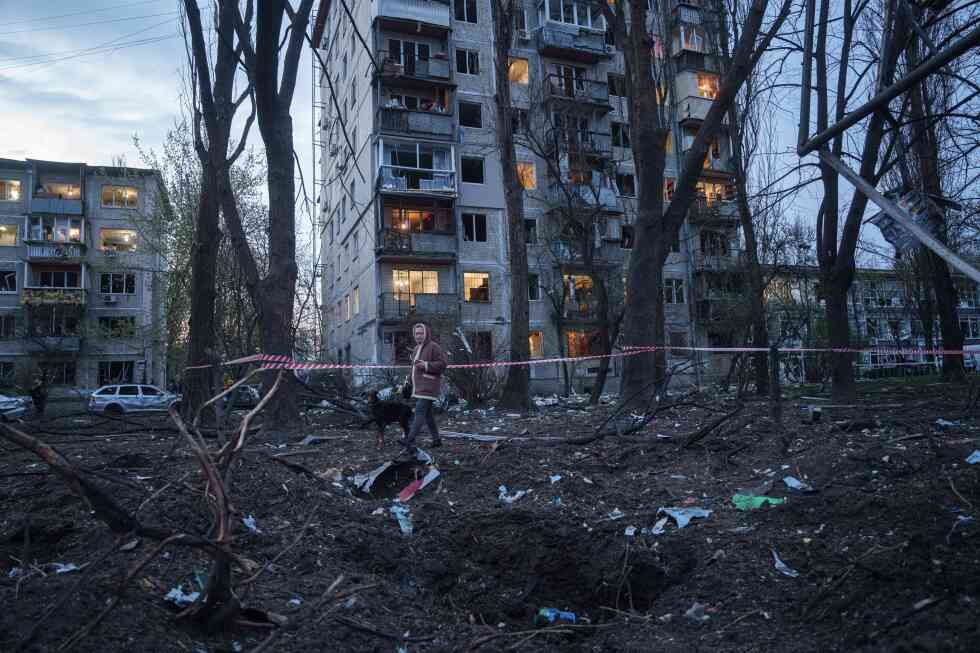
On Thursday, Ukrainian officials confirmed that Russian forces have carried out the largest multi-wave aerial assault on the country in nearly two weeks, a relentless hours-long attack that targeted civilian population centers across Ukraine from daylight through the overnight hours. The bombardment has left at least 16 civilians dead and more than 80 others wounded, according to official casualty updates.
Authorities reported that Russian forces deployed nearly 700 drones alongside dozens of ballistic and cruise missiles for the assault, with nearly all strikes focused on civilian infrastructure and residential areas. This large-scale attack fits a consistent pattern of Moscow’s military strategy since launching its full-scale invasion of Ukraine more than four years ago: daily small-scale strikes on civilian areas, punctuated periodically by massive, widespread barrages. To date, the United Nations has recorded more than 15,000 confirmed civilian fatalities from these ongoing Russian airstrikes and bombardments across Ukraine.
The latest attack comes just days after Ukrainian President Volodymyr Zelenskyy completed a urgent 48-hour diplomatic tour of Germany, Norway, and Italy, where his core mission was securing additional air defense systems to counter Russian aerial assaults. Ukraine has repeatedly raised alarms that existing stockpiles of critical American-made air defense interceptors are being depleted faster than new supplies can arrive, exacerbated by diversion of military resources to confront the ongoing conflict in Iran. Kyiv has also publicly opposed a recent temporary U.S. waiver on Russian oil sanctions, arguing the exemption generates critical revenue that the Kremlin uses to fund its invasion.
In a post on the social platform X following the attack, Zelenskyy emphasized, “Another night has proven that Russia does not deserve any easing of global policy or lifting of sanctions.” The Ukrainian president expressed gratitude to Germany, Norway, and Italy for the new air defense support agreements reached during his trip, adding that Ukrainian officials are currently negotiating additional air defense supplies with the Netherlands. At the same time, he acknowledged that some allied partner nations have failed to deliver on previously made military support pledges. “I have instructed the Commander of the Air Force to contact those partners who earlier committed to providing missiles for Patriot and other systems,” Zelenskyy stated.
Casualty reports from across the country reflect the broad impact of the barrage. Four civilians, including a 12-year-old child, were killed in Kyiv, with more than 50 others injured in the capital. Tetiana Sokol, a 54-year-old Kyiv resident, described the terror of the attack to the Associated Press: two missiles struck just blocks from her home, forcing her and her dog to take shelter in an interior hallway as blast waves shattered windows and lit up the night sky. “On the third attack everything broke, everything flew, we were shocked, we didn’t know where to run. I grabbed whatever came to hand and ran away with the dog,” she said. “I still can’t find the cats in the house, they climbed out somewhere, I don’t even know. No windows, nothing, the dog is still walking around in stress.”
Beyond Kyiv, nine civilians were killed and 23 wounded in the southern port city of Odesa, three killed and roughly 36 injured in the central Dnipro region, and one civilian killed in the southern Zaporizhzhia region. Ukrainian Foreign Minister Andrii Sybiha condemned the attack in a post on X, writing, “Such attacks cannot be normalized. These are war crimes that must be stopped and their perpetrators held to account.”
Ukraine’s Air Force reported that its air defense systems successfully intercepted or disabled 667 of the 703 incoming Russian targets, including 636 Iranian-made Shahed drones and other uncrewed aerial vehicles. Despite this high interception rate, 20 attack drones and 12 missiles still reached their targets, striking 26 populated and civilian locations across the country. The Associated Press continues to cover developments in the Russia-Ukraine war at its dedicated hub.