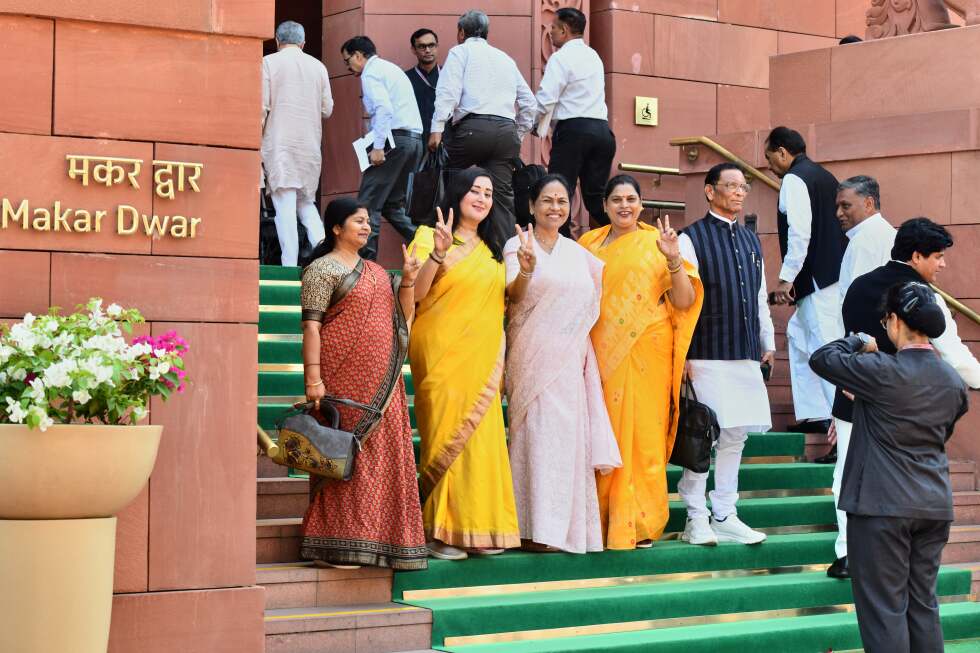
NEW DELHI – India’s Parliament kicked off a historic debate Thursday on a transformative bill that would reserve one-third of all national and state legislative seats for women, a proposal framed as a decades-overdue step to expand gender representation in Indian politics that is already sparking fierce political friction over its tie to a sweeping electoral boundary overhaul.
If enacted, the legislation would accelerate implementation of a 2023 law mandating 33% female reservation in legislative bodies, marking one of the most significant shifts to India’s political landscape since the country gained independence in 1947. For a national legislature where women currently hold just 14% of lower house seats, the reform could dramatically expand female participation in a system long dominated by male politicians.
The core point of controversy stems from the bill’s dependency on a separate, contentious delimitation proposal that would redraw India’s parliamentary voting boundaries based on 2011 census population data. If approved, the redraw could expand the total number of seats in the Lok Sabha, India’s lower house of Parliament, from the current 543 to roughly 850.
While broad cross-party support exists for the goal of increasing women’s representation in Parliament, opposition parties have raised urgent alarms over the linked boundary redraw, warning the process would be manipulated to shift political advantage toward Prime Minister Narendra Modi’s ruling Bharatiya Janata Party (BJP). The bills are being considered during a three-day special parliamentary session, and both require a two-thirds majority vote in both upper and lower houses to pass. Modi’s National Democratic Alliance coalition currently holds 293 seats, 67 short of the 360 votes needed for approval.
Proponents of the quota argue the reform will close India’s persistent gender gap in political leadership. Several of India’s regional neighbors, including Nepal and Bangladesh, already enforce similar female reservation policies for national legislatures, and India has long required 33% of seats in local governance bodies to be reserved for women. Supporters say adding hundreds of women to national and state legislatures will reframe policy priorities to address long-neglected issues such as women’s healthcare, access to education, and gender-based violence. The exact mechanism for allocating female seats in the expanded parliament has not yet been clarified.
Women’s rights advocate Ranjana Kumari emphasized that the reform would make India’s democracy truly reflective of its population, pushing political parties to field far more female candidates than they currently do. “The door is little open. Women will enter and fill the room slowly,” Kumari noted.
For young Indian women, the reform also carries profound symbolic meaning. Pranita Gupta, a 23-year-old law graduate, said the policy would instill “a sense of confidence that we can participate in politics and we can be part of Parliament not only as an exception but as well as a norm.”
Critics of the linked delimitation process warn that basing new constituency boundaries on population will reallocate parliamentary power toward India’s faster-growing northern states, where the BJP holds its strongest base of support, at the expense of southern states that have seen sharper declines in birth rates and built more robust regional economies. India’s Constitution requires parliamentary seat allocations to be revised after each national census to reflect population shifts, but boundary redraws have not been conducted since the 1971 census, as successive governments delayed the process over fears of political conflict driven by uneven population growth across regions.
Southern state leaders argue that a population-based delimitation would punish regions that successfully reduced population growth, cutting their seat share and national political influence while awarding additional seats to northern states. The BJP has dismissed these concerns as unfounded and misleading, according to Parliamentary Affairs Minister Kiren Rijiju, who pushed back against criticism earlier this week.
Political backlash has already spread rapidly. On Thursday, Tamil Nadu Chief Minister M.K. Stalin publicly burned a copy of the delimitation bill and raised a black flag in protest, urging residents across his southern state to join the demonstration. Several other southern state parliamentary representatives appeared in the legislature dressed in black to signal their opposition. India’s top opposition leader Rahul Gandhi has alleged the delimitation process is a deliberate attempt to gerrymander parliamentary constituencies to benefit the BJP ahead of the 2029 national elections. “Delimitation should be based on a transparent policy framework, developed after wide consultations with a consensus,” Gandhi wrote on the social platform X Wednesday.