In one of the deadliest large-scale Russian attacks on Ukraine in recent months, a massive overnight barrage of missiles and drones launched early Thursday has killed dozens of civilians, including 10 members of a single extended Ukrainian family whose home was completely obliterated in an eastern strike.
Ukrainian emergency service officials confirmed to Agence France-Presse that six deaths have been formally verified at the residential site outside Kryvyi Rih, Ukrainian President Volodymyr Zelenskyy’s hometown, with four additional people still missing and presumed dead amid extensive destruction. Forensic teams are still processing the blast site, where 17 body fragments have been recovered to date amid piles of splintered wood and crumbled concrete. Regional governor officials have released on-the-ground photos showing rescue workers sifting through the rubble of what was once the Voronov family home.
Zelenskyy identified the victims in a social media statement Thursday morning: mother Olena, father Artem, their seven children, and a grandchild, noting the youngest presumed victim was just 18 months old. “It was an ordinary home, blown into smithereens,” he wrote, condemning the deliberate targeting of civilian residential property.
Sergiy Kovtoniuk, press officer for the State Emergency Service in Dnipropetrovsk region, told AFP that the scale of devastation leaves little hope of survival for the 10 people present in the home at the time of the strike: “It can be preliminarily stated that all 10 people who were in the house have died.”
The strike on the Voronov family home was part of a far larger coordinated assault that saw Russia launch 74 missiles and 284 drones across Ukraine overnight, the latest escalation in a four-and-a-half-year war that has seen civilian casualties spike sharply in recent weeks. Zelenskyy had issued a public warning of an impending attack late Wednesday, prompting tens of thousands of Kyiv residents to seek shelter ahead of the first blasts, which rang out shortly after midnight across the capital.
For the first months of the full-scale invasion, Kyiv’s subway system served as a primary bomb shelter for residents, and that long-held routine reactivated quickly Thursday night. More than 56,000 people packed into station platforms, setting up tents, rolling out yoga mats and unfolding sleeping bags in a now well-rehearsed process. Galyna Doschuk, a 27-year-old photojournalist who has taken shelter in the subway repeatedly during the war, summed up the mindset of many Ukrainians amid the ongoing attacks: “I want to live… sometimes our neighbour gets in the way. But we’re fighting on.”
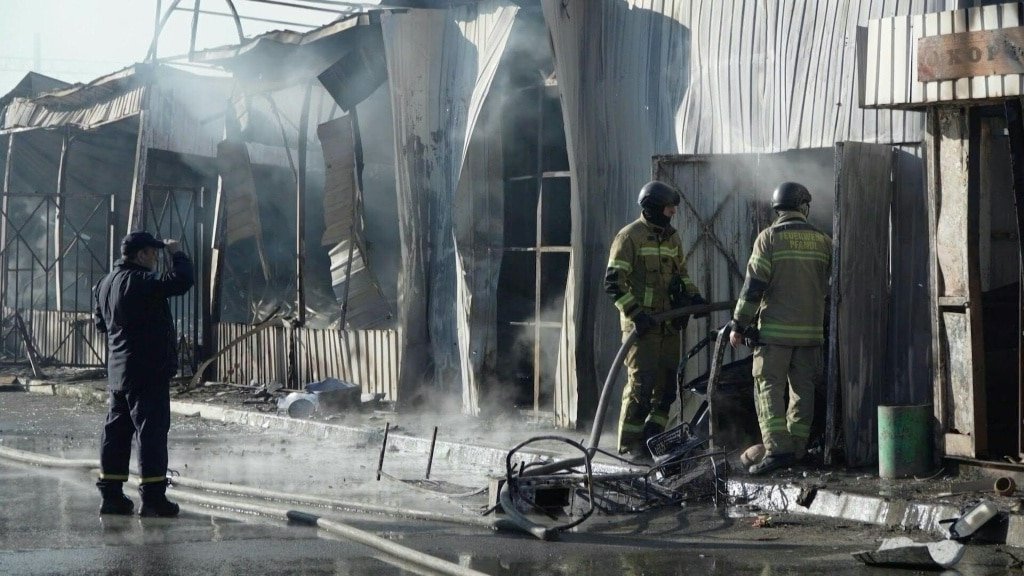
By dawn Thursday, three additional civilian deaths were confirmed across Kyiv, Poltava and Lviv. A popular Kyiv flea market was destroyed in the strike, with its charred, twisted metal framework still smoldering as vendors arrived to salvage whatever belongings they could. In the western city of Lviv, which suffered extensive damage across multiple residential blocks, rescue teams pulled a 93-year-old woman alive from the rubble of a collapsed five-story apartment building, where she had been trapped alone on the top floor. AFP reporters on the ground saw stunned local residents gathering around destroyed apartment blocks, many crying and covering their faces as they surveyed the damage.
The assault also spilled over into NATO territory, triggering new diplomatic tensions after a 10-meter-wide crater was discovered in an agricultural field in eastern Poland, roughly 80 kilometers from the Ukrainian border. Polish Prime Minister Donald Tusk confirmed Thursday that debris recovered from the site matches a Russian Kh-101 cruise missile, confirming the projectile originated from the overnight Russian barrage.
Ukrainian air force officials reported that defense systems successfully intercepted 55 of the 74 Russian missiles and 265 of the 284 drones launched in the attack. However, Ukrainian forces continue to face critical gaps in defense against advanced Russian ballistic missiles, which Moscow has increasingly deployed in recent strikes and are far harder to intercept. Zelenskyy renewed his urgent appeal to Western allies Thursday for additional air defense systems and interceptor missiles to shield civilian population centers.
The appeal comes just two days after Zelenskyy met with U.S. President Donald Trump at the White House to discuss anti-ballistic defense cooperation. Trump previously announced plans to grant Ukraine a license to domestically produce Patriot anti-ballistic interceptors, but neither government has released further details of the agreement to date.
April 2025 has already become the deadliest month for Ukrainian civilians since April 2022, according to casualty tallies, as Russia has dramatically scaled up the frequency and size of its missile and drone strikes across the country. Russia’s defense ministry claimed in a statement Thursday that the overnight barrage exclusively targeted Ukrainian military-industrial sites, military communications hubs and logistics centers, a claim that contradicts extensive on-the-ground reporting of civilian damage and casualties.