Four years into Sudan’s brutal civil conflict between the national army and the Rapid Support Forces (RSF), gripping firsthand testimonies from former child soldiers have pulled back the curtain on systematic abuse, forced conscription, and the hidden role of foreign mercenaries in the capital region of Khartoum. Six former child conscripts held by the RSF spoke anonymously to The Associated Press, sharing harrowing details of their exploitation that align with broader investigations into foreign fighter involvement in the war.
One 17-year-old survivor, who was abducted at 15 while selling cigarettes in Omdurman – Khartoum’s twin city – described being mistakenly seized by RSF fighters searching for deserters, then thrown directly into frontline combat with no prior weapons training. Chained by his hands and feet to an anti-aircraft weapon mounted on a pickup truck, he recalled being left exposed as Sudanese warplanes launched airstrikes. When enemy jets approached, Colombian mercenaries who commanded the post retreated to fortified bunkers, ordering the chained children to open fire on the aircraft. Anyone who tried to run, the teens were told, would be killed by their captors before the bombs could hit them.
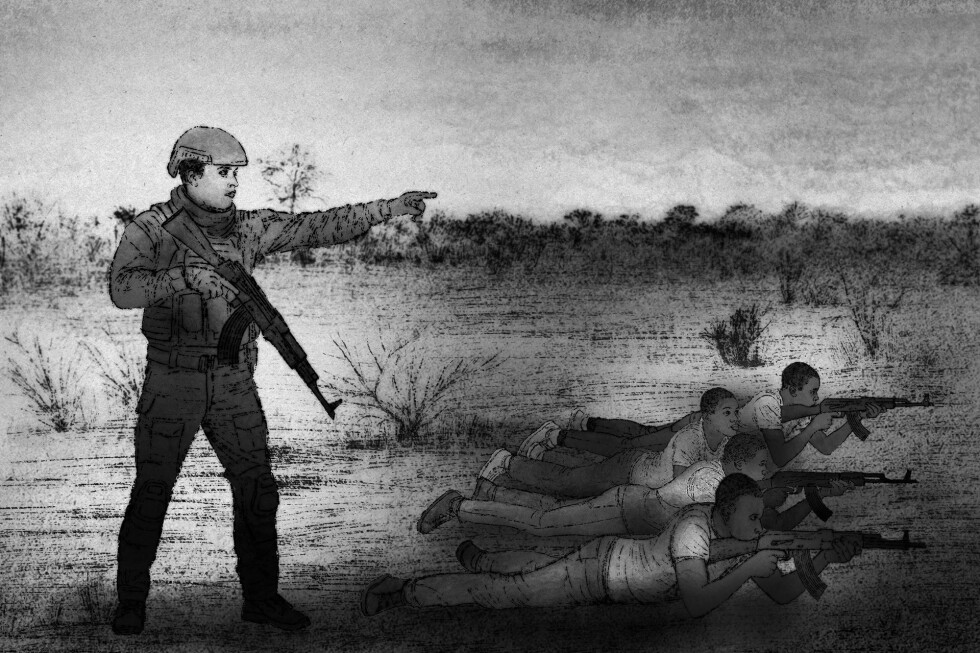
The teenager, who still bears shrapnel scars on his head and face, spent 18 months in captivity at the RSF’s Central Reserve Camp in Omdurman, where dozens of child recruits were held. He described being kept bound around the clock – even during meals, when guards poured water over the shackled boys instead of allowing them to bathe. Colombian mercenaries stationed at the base trained the children to operate heavy anti-aircraft systems and explicitly ordered that the teens be chained to the weapons to prevent escape, he said. Too terrified to aim accurately, he never hit a target, he added.
A second 17-year-old survivor, abducted at 15, shared equally devastating accounts from his detention at the RSF’s al-Konan camp, where he said Colombian mercenaries trained him and other underage recruits to handle heavy artillery and operate drones. Locked in a cell unless he was ordered to carry out strikes, he described seeing civilian targets through drone cameras, and being beaten – sometimes unconscious with electric batons – when he refused to fire. He watched an 18-year-old friend who attempted to escape shot dead by RSF fighters, and he still suffers nightly nightmares from the trauma.
These testimonies confirm long-suspected reports of widespread Colombian mercenary deployment alongside the RSF. Rights researchers say the foreign fighters are recruited by a United Arab Emirates (UAE) state-linked contractor and trained in Emirati military bases, supporting the RSF in its fight against the Sudanese army. A UN panel has previously tracked weapons shipments from the UAE to the RSF, though the UAE has repeatedly denied arming the paramilitary group, claiming all shipments were humanitarian aid for refugees. It did not respond to multiple AP requests for comment on the mercenary allegations.
Colombia’s long history of internal armed conflict has created a large pool of combat veterans with specialized U.S.-backed training, many of whom turn to mercenary work abroad due to low domestic pensions and limited civilian job opportunities. While Colombia has passed legislation banning its citizens from fighting in foreign wars, recruitment networks continue to operate, veteran groups report. Human Rights Watch and the private research firm Conflict Insights Group have already documented Colombian mercenary presence in Sudan’s Darfur region, including during the RSF’s 2024 capture of El Fasher, where the paramilitary has been accused of mass civilian killings. A Colombian mercenary who fought in Darfur for six months in 2025 told the AP that hundreds of Colombian fighters were deployed on RSF front lines, and he personally encountered child recruits as young as 13.
The accounts from Khartoum mark the first concrete on-the-ground confirmation of Colombian mercenary activity training child soldiers in the capital region. Multiple independent sources, including a defected former RSF fighter and a senior Sudanese military officer, confirmed to the AP that Colombian fighters were actively training underage recruits in Khartoum while the RSF controlled the city. The Colombian government said it has no official information confirming the child soldier training allegations, but condemned any such abuses.
Across Sudan, an estimated tens of thousands of children as young as 8 have been forcibly conscripted by all parties to the conflict, according to Sudan’s National Council for Child Welfare. The United Nations confirms both the RSF and government-allied militias have deployed child soldiers on front lines, with thousands still held in combat roles. The RSF, which grew out of the Janjaweed militias that carried out a genocidal campaign in Darfur in the 2000s, has a well-documented pattern of repeating these abusive tactics today. International law explicitly classifies forced child recruitment as a war crime, and rights experts say the UAE’s documented support for the RSF could leave the Gulf nation complicit in widespread crimes against humanity.
Both of the surviving teens interviewed by AP spoke from a government-run rehabilitation facility on the outskirts of Khartoum, which housed more than 200 former child soldiers recaptured when the army retook the capital over the past year. Facility staff told AP that multiple child recruits have confirmed Colombian mercenary involvement in their training across Khartoum’s camps. Many of the released children face a difficult path forward: some carry permanent disabilities from combat and torture, while others have been rejected by their families traumatized by the war. Psychologists at the facility work to reconcile families with the boys, who are struggling to process severe trauma and guilt over acts they were forced to commit.
Since the AP’s visit to the facility in April 2025, all children held there have been released through a joint process between the Sudanese government and UNICEF. The UN children’s agency is working to expand efforts to release and reintegrate remaining child soldiers across the country, pushing for all parties to recognize conscripted children as victims rather than combatants. For the teens who survived their ordeals, the desire to rebuild is mixed with lingering trauma. “We have made mistakes,” one boy said. “We want to get out of here to rebuild Sudan.”