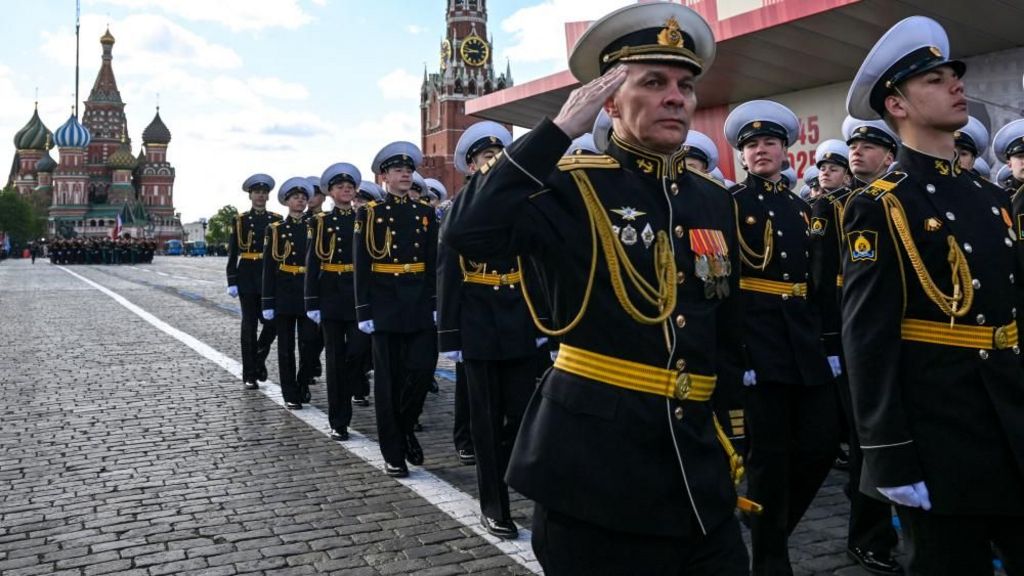
For decades, Russia’s May 9 Victory Day parade on Red Square has stood as one of the most prominent showcases of national pride and military power, marking the Soviet Union’s 1945 defeat of Nazi Germany in World War II. This year, however, the iconic event will look drastically different, after the Kremlin formally confirmed it will pare back major elements of the celebration in response to what it calls a rising terrorist threat from Ukraine.
Dmitry Peskov, spokesperson for Russian President Vladimir Putin, told reporters on Wednesday that security officials have enacted sweeping precautionary measures to reduce potential risks amid what the Kremlin frames as expanded hostile activity from the Kyiv government. “The Kyiv regime, which is ceding ground daily on the frontlines, has now shifted to full-scale terrorist operations,” Peskov said. He emphasized that despite the cuts, the parade will proceed as scheduled on Red Square, with all steps taken to keep attendees and participants safe.
The Russian Ministry of Defense clarified the scope of changes in an official statement released Tuesday evening. While representatives from all branches of the Russian armed forces will still take part, and a ceremonial aerial flyover will be held, traditional elements that have been staples of the parade for years will be absent this year. Notably, cadets from the country’s elite Suvorov military schools, Nakhimov naval schools and other military cadet corps will not march, and no heavy military vehicles or armor will roll across Red Square’s cobblestones. National television will instead broadcast footage of Russian service members carrying out their duties in what Moscow officially calls the “special military operation zone” — its formal term for the full-scale invasion of Ukraine launched in early 2022.
This is not the first time Russia has adjusted its traditional Victory Day format in recent years, but it marks the first time since the 2022 invasion that no armored column will be featured in the central Moscow parade. Putin, who revived the Soviet-era tradition of marching heavy military hardware through Red Square in 2008, has used the annual event to demonstrate Russia’s growing military strength to both domestic audiences and the international community. In 2024, which marked the 80th anniversary of the 1945 victory, Moscow hosted more than 20 global leaders for an elaborate, high-profile celebration that featured a full procession of modern military equipment, including frontline tanks and combat drones.
Rumors of a scaled-back 2025 parade first circulated on Russian social media earlier this month, when pro-Kremlin military bloggers publicly raised concerns about the risk of long-range Ukrainian air attacks on the large public gathering. “If you have a parade in full swing and then a missile threat is announced, that would be a massive public relations blow even if no strike actually lands,” prominent pro-war blogger Ilya Tumanov told Russian media outlets. Other pro-Kremlin commentators also noted that none of the usual large-scale parade rehearsals, which require widespread road closures across central Moscow, had taken place in the lead-up to the event, matching the formal announcement of cuts.
In line with stepped-up security measures, a telecommunications source told BBC Russian that enhanced restrictions on mobile connectivity will be enforced across Moscow on May 5, 7 and 9. This follows widespread mobile internet outages in central Moscow back in March, which Russian authorities tied to unspecified security priorities.
The decision to scale back the parade comes against a backdrop of a clear increase in Ukrainian strikes targeting Russian territory deep behind the front lines, more than three years into Moscow’s full-scale invasion. In recent weeks, Moscow — widely considered Russia’s most heavily defended city — has already faced multiple Ukrainian drone incursions, with Russian military officials consistently stating that most of the drones are intercepted and shot down before they can hit targets.
Ukraine has significantly ramped up attacks on critical energy infrastructure across Russia in recent weeks, stretching thousands of kilometers from the border. On Wednesday, plumes of smoke were reported near Perm, a major Ural Mountains city roughly 1,500 kilometers from Ukrainian territory. Ukrainian officials confirmed the site was an oil pumping station hit by a drone, while local Russian authorities only described it as an industrial facility incident. That strike came just one day after Russia’s major oil refinery in the Black Sea port of Tuapse was hit for the third time in April. Earlier strikes on the Tuapse refinery triggered a large oil spill into the Black Sea, with local residents reporting “black rain” laced with oily residue that coated residential areas across the city.
Kyiv has repeatedly stated that all of its strikes deep inside Russia target legitimate military or war-related infrastructure, arguing that these facilities directly enable Moscow to sustain its invasion. Ukraine has not yet issued an official public response to the Kremlin’s latest terrorism accusations, but a senior Ukrainian official last week explicitly ruled out any attack on the Moscow Victory Day parade. Mykhailo Podoliak, an advisor to Ukrainian President Volodymyr Zelenskyy’s office, noted that the event would draw large crowds of ordinary civilian onlookers, and stressed that “nobody is attacking civilians and civilian infrastructure.”
For most Russians, the victory over Nazi Germany — referred to domestically as the Great Patriotic War — remains one of the most unifying historical events in the country’s modern history. Many international and domestic analysts broadly agree that Putin has centered this victory as a core national narrative to bind Russian society together, particularly amid the ongoing conflict in Ukraine and heightened tensions with the West.